
About Vikings
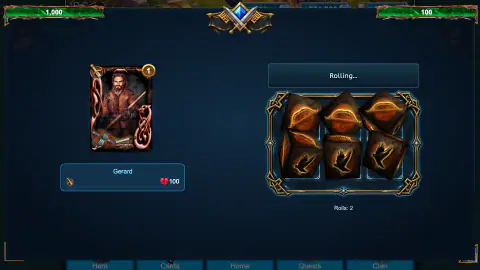
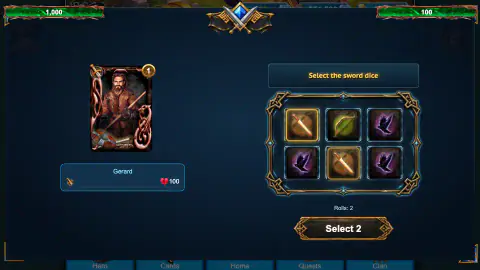
Six dice sit in a gilt frame on the right of the battle screen, and the first thing to understand about Vikings is that they do not decide how hard you hit. They decide what you are allowed to do at all. Each face carries a weapon on its own colour — a sword on amber, an axe on red, a bow on green, a raven on purple — and a banner above the grid names the one that counts this turn. Ours read Select the sword dice. The bow and the three ravens on the table might as well have been blank.
On the left stands the card doing the fighting. Gerard: a bearded man with a long haft across his shoulder and a broad axe at his feet, a gold 1 in the corner for his level, a red heart reading 100. Two green health bars run across the top above him, ours showing 1,000 and the opponent's 100. The opening raid is less a fight than a demonstration.
TopsWap made it, and Vikings, and it was published in April 2025. Our session ran about four minutes, and all of it was the tutorial: we won the opening raid — it is called Road at the house — and from there the game queued up one reward window after another. We never reached the second raid, and everything below says which part is which.
The dice hand out verbs, not damage
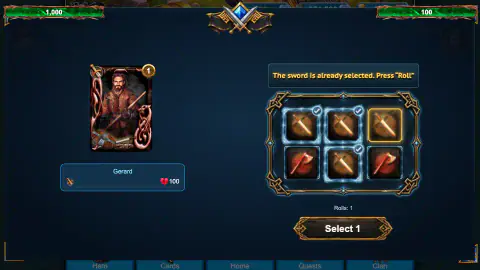
Watch the grid across two throws and the system shows itself. On the first, the six faces were two swords, one bow and three ravens. We ticked the two swords and pressed Roll. On the second, the table was four swords and two red axes — the ticked dice had stayed exactly where they were, and everything else had been thrown again.
That is a keep-and-reroll, and it makes the Rolls counter the only thing in the frame worth real thought. A table that already carries what the banner asked for is a table you take; one that does not is worth a throw and rarely two.
Now the honest limit. We used swords and nothing else, because the tutorial never asked for anything else. What an axe does differently, what a bow reaches that a sword cannot, what a raven is for at all — four faces, and we can account for one. Nor did we ever see Rolls reach zero, so what an empty counter costs is a guess, and we would rather label it as one.
Winning the first raid is where this game starts
The trophy window is called Road at the house: a gold cup with raven heads for handles, an empty box beside it where a reward would go, a Continue button. Press it and Astrid, the woman who narrates the whole tutorial, appears with a card reading "Your first victory — a great start!"
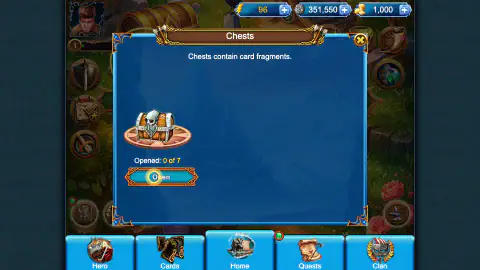
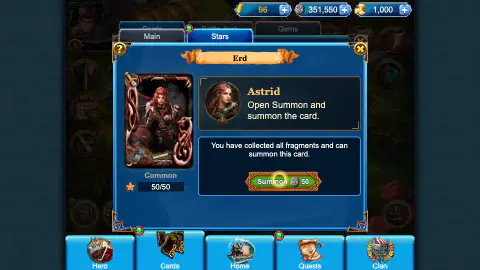
Then the chain. A chest, with a horned skull on the lid and a line that tells you the size of what you have started: Opened: 0 of 7. Inside, fragments. The fragments fill a card to 50 of 50, which unlocks a Summon button priced at 50 of the game's silver, which becomes a card named Erd, rarity Common. An item from the raid goes on the hero, whose profile shows six equipment slots around him — one filled, the other five reading only Find — above an Upgrade button costing 1,500.
A daily quest, Open 1 chest, is already at 1 of 1, so you claim it. A wheel of eight multiplier segments, the biggest x25, gives you a free spin. Then a window headed Pathway points at the next raid with an axe in the reward box and one line from Astrid: "Win this raid to get your axe!"
Three minutes to be walked through all of that, and it is worth being blunt about what it means. This is a phone game's economy running in a browser tab. The chest counter, the five empty slots, the quest that resets daily — none of it is built to be finished in a sitting; it is built to be come back to. The battles are good. The game around them is a collection, and collections take weeks.
Two kings once cast dice for a district, and one die split in half
The kings of Norway and Sweden met at Konungahella to settle a peace, and one thing was left over: an inhabited district on Hising, an island at the mouth of the Göta river, which had belonged sometimes to one crown and sometimes to the other. Rather than argue it, says Snorri Sturluson in the Heimskringla, the two agreed to throw dice for the land, highest score taking it.
The Swedish king threw two sixes and told Olaf of Norway he need hardly bother. Olaf, shaking the dice in his hand, answered that two sixes would be no great obstacle to God Almighty — then threw two sixes himself. The Swede threw two sixes again. Then Olaf threw: a six on one die, and the other split in two, so that it showed seven eyes in all. Thirteen. The district went to Norway, and the kings parted the dearest of friends.
Take it for what it is: Snorri wrote some two centuries after the fact and credits the tale to an earlier writer, so it is a saga, not a record. What it reliably tells you is something about the culture this game is dressing itself in — a world where two kings settling a province on a throw was a story worth repeating, and where the winning throw was the one that broke the equipment.
The raven on the purple dice has a pedigree too. The oldest written mention of a Viking raven banner is in the Anglo-Saxon Chronicle for 878, when the men of Devon beat a Danish force and took its standard, a banner the chronicle simply calls Raven. The game repeats the bird without comment: on a die face, and again as the handles of the cup you win.
More cards, and more dice
Card Quest is the closest neighbour without dice in it: campaign battles on a map, the rules changing from enemy to enemy. Card Quest: 10 Minute Adventure is the honest opposite of Vikings, over when it says so. Mini Dice Chess runs the same idea as the dice here: the roll decides which pieces you may move, not how hard they land. TCG Shop: Dino Adventure is the packs-and-pulls half of this game, pulled out and made into its own. Vikings: An Archer's Journey shares the theme and nothing else: it is a runner. The rest are in strategy games.
Screenshots
How to play Vikings
- Tap the middle of the opening screen to get in. It took us several taps and a key press or two before the battle screen appeared.
- Read the banner above the dice. It names what the turn wants in plain words: Select the sword dice, then Tap the sword dice.
- Tap the dice that match. Each takes a blue tick, and the long button underneath counts down — Select 2 becomes Select 1.
- Press that button to confirm, then Roll. The Rolls counter drops by one, and the faces you did not keep come back different.
- Win, and the game drives for a while: a trophy window with a green Continue, then a run of pop-ups you clear with Go, Claim and Open chest.
Things we only found out by being there:
- The banner is the rule, not a hint. Ours cycled through three phrasings on one turn — Select the sword dice, then Tap the sword dice, then The sword is already selected. Press "Roll" — which reads a lot like a game noticing you have stopped reading it.
- Watch the number on the button, not the dice. It tells you how many picks the turn still wants, and the rest of the frame is noise until it reaches zero.
- Rolls only ever goes down. It is the one thing on the battle screen you spend, and nothing there is on a clock. Throw again to fix a bad table, knowing you will not get the throw back.
- Escape closes the pop-ups. There are a lot of pop-ups, and the close cross is small.
- The five tabs along the bottom are the actual game. Raids launch from Home; every other tab is somewhere to spend what the raid gave you.
Controls
| Tap or click a die | Picks that face for the turn. A blue tick appears in its corner, and the long button under the grid counts down from Select 2 to Select 1 |
|---|---|
| Select 2 / Select 1 | Confirms the dice you have picked. The number on it is how many the turn still wants from you |
| Roll | Rolls again. The Rolls counter under the grid drops by one, and the faces you did not keep come back different |
| Continue, Go, Claim, Open chest | The green buttons that walk you through everything after a win. Each one opens the next window |
| The cross in the corner of a pop-up, or Escape | Closes it. Escape worked on every window we tried it on and is quicker than aiming for the cross |
| Hero, Cards, Home, Quests, Clan | The five tabs along the bottom. Raids start from Home; everything you win is spent in the other four |
Features
- Combat runs on six dice with four faces — sword, axe, bow and raven — and a banner that names the one the turn wants
- The dice you keep are ticked and held; the rest are thrown again, so the mix on the table changes between rolls
- Rolls is the real budget: it counts down, not up, and it is the only number on the battle screen that you spend
- The opening raid is weighted heavily your way — the two health bars read 1,000 against 100 — and the game talks you through every tap of it
- Everything after the win is a collection loop: a chest, fragments, a card summoned at 50 of 50, an item equipped, a daily quest, a prize wheel
- Your hero has six equipment slots. One was filled when we looked; the other five simply read Find
- A wheel of eight multiplier segments, the largest x25, with the first spin free
- Five tabs along the bottom — Hero, Cards, Home, Quests, Clan — which is a phone game's shape, running in a browser tab
Game details
- Developer
- TopsWap
- Release date
- April 2025
- Last updated
- October 23, 2026
- Added here
- May 2025
- Technology
- HTML5
- Platforms
- Browser (desktop), Browser (mobile & tablet, touch)
- Classification
- Adventure , Cards & Board , Strategy
- Saved progress
- Saving, when available, is managed by this game. Mava cannot confirm your level.
FAQ
What kind of game is Vikings?
It is a card game with dice combat and a long collection loop behind it, closer to a phone RPG than to a browser game you finish in one sitting. Battles are turn-based and short, but what they feed is a cycle of chests, card fragments, summons, equipment and daily quests. If you are after something you can start and finish in ten minutes, this is not it.
How do the dice work in Vikings?
Six dice are thrown at once, each showing one of four weapon faces: a sword on amber, an axe on red, a bow on green or a raven on purple. A banner above the grid names the face the turn is asking for. You tap the matching dice, each gets a tick, and the button underneath counts down until you have picked enough.
What does the Rolls counter mean?
It is how many times you may throw again. Ours started the turn at 2 and dropped to 1 the moment we pressed Roll, and the dice we had already ticked stayed put while the others came up different. We never saw it reach zero, so what happens when it empties is something we cannot tell you.
What are chests and card fragments for in Vikings?
Chests hold fragments, fragments summon cards, and cards are what fight for you. The window that explains it is blunt about the scale: ours read Opened: 0 of 7. Our first chest filled a card to 50 of 50 fragments, which let us summon it — a common card named Erd — for a further 50 of the game's silver.
Who made Vikings and when did it come out?
A developer listed as TopsWap. It was published in April 2025 and was last updated in August 2026. There is no studio website we could find, so the developer page is the only thing to point at.
Is Vikings free, and does it work on a phone?
It is free and it runs in a browser on this page with nothing to install. The layout is built for a phone — a tall screen with five tabs across the bottom — and it is listed for desktop, mobile and tablet alike. We played it with a mouse, so how the dice feel under a thumb is still its claim rather than ours.
Does Vikings have a clan or play against other people?
There is a Clan tab in the bar along the bottom, and the opponent in our first raid had a name rather than a label. We never opened the tab and nothing on the battle screen settled whether we were fighting a person, so we will not pretend to know. What we can say is that the opening raid needs no one else.
How long does a game of Vikings take?
A single raid is a couple of minutes. The game around it is not: the chest counter, the six equipment slots and the daily quests are all built to be returned to over days rather than cleared in an evening. Treat the first raid as a four-minute sample of a much longer thing.