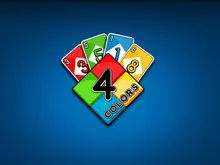



About 4 Colors Game
Most card games that run in a browser keep one thing from you: whose turn it is. You click, nothing happens, and you guess. The 4 Colors game puts the answer in the names. The name of the player whose turn it is lights up and blinks. Once you notice it, you stop clicking at the wrong moment.
That is typical of this table. 4 Colors is the family game of getting rid of your cards by matching the pile, by colour or by number. Most of what you need is drawn on the table. Three things are not, and they decide hands. When do you press the 1? When is the black +3 card allowed? And why does a table of two play so fast?
The game is by Code This Lab. It was published in January 2025. We played it in October and again in November, on a computer with a mouse. We finished two hands: we lost one and won the other.
What is on the table
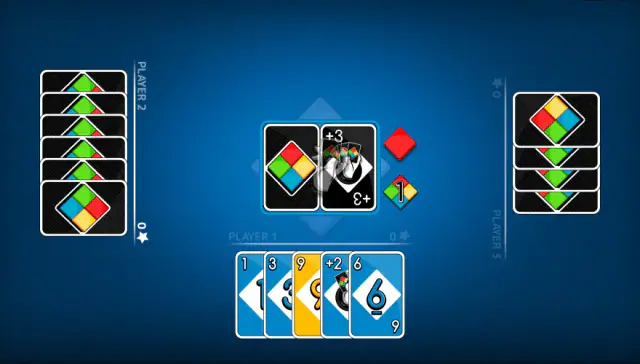
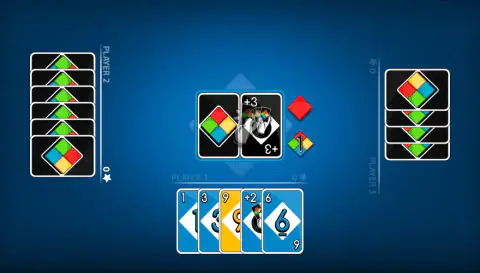
Your hand runs along the bottom, face up. At a table of two your rival sits at the top. At a table of three the others sit left and right. At four they sit left, top and right. Their cards are face down, but each one is a separate back, so you can count them.
In the middle are the deck and the pile. Next to the pile are two diamonds. The top one shows the colour you must play. The bottom one has all four colours and a 1. That is the button for your last card.
Each card type has its own big sign. A skip throws a giant no-entry sign over the table. A reverse sends two big arrows round the pile. A +2 brings a white hand holding two cards, and a +3 a hand holding three. The sixes have a small bar under the digit, so you can tell them from nines.
The black +3, and choosing the colour
We saw no +4 card in this edition. The black card with +3 on it does a similar job. The next player takes three cards, and you pick the colour. The tutorial adds one rule: you may only use it when you have no other card to play.
We saw that rule work. With a blue reverse in our hand, the +3 would not move. We played the reverse first, which gave us the turn again at a table of two. Now the +3 was our only play. A panel with four diamonds asked us to choose a colour. We picked green, because we held a green 7 and a green +2. The diamond by the pile turned green, our rival went from four cards to seven, and it was our turn again.
So pick the colour you hold most of. The plain black wild works the same way, but it can go down at any time.
What each card costs you at the end of a hand
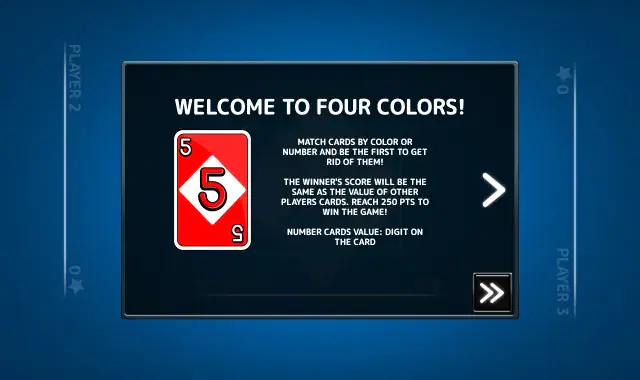
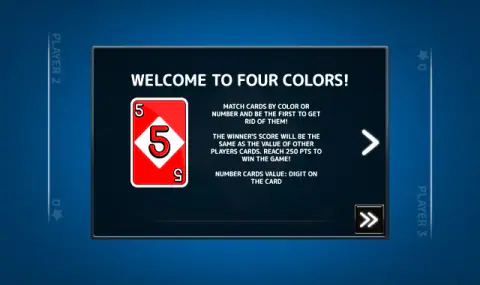
The welcome panel sets the goal. The winner of a hand scores the cards left in the other hands, and the panel says the first to 250 points wins. The tutorial gives the prices:
- a number card is worth its digit;
- a +2, a skip or a reverse is worth 20;
- a wild or a +3 wild is worth 50.
Our two hands show how much that matters. We lost the first one holding a 4 and a 7. Our rival scored 11. We won the second while our rival held a green reverse and three small cards. We scored 24, and the reverse alone was 20 of it.
So when a rival gets low, play your action cards and wilds first. Keeping them is the most expensive way to lose a hand. After each hand, a summary shows the points out of 250 in green. The double arrow starts the next hand.
The 1 button, and the old habit of calling your last card
Around a real table, a player who is down to one card has to say so out loud. The others get one last chance to stop you. If you keep quiet, you pay.
The rule was not invented for the screen. Mau-Mau is the version played with an ordinary pack in Germany and Austria. Its rules were first published in 1958. Players must say "Mau" when they hold their final card, and forgetting costs penalty cards. In the Netherlands the game is called Pesten, and you say "laatste kaart" or knock on the table.
A screen cannot hear you, so 4 Colors turns the call into a button. As in Mau-Mau, you say it when one card is left, not before. The computer players never forgot it when we watched.
Languages, and the globe button
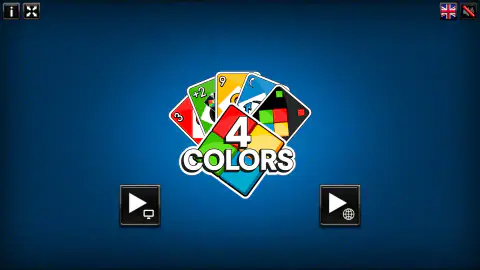
The flag on the title screen opens 13 languages. The title changes with them: 4 COLORES, 4 COULEURS, 4 CORES, 4 COLORI. The tutorial and the summary change too.
The right play button, with a globe, opens a box that asks you to choose a nickname. We closed it without typing one. So we cannot tell you how online play works. Everything on this page comes from tables against the computer.
Who it suits
Anyone who knows this kind of card game from the kitchen table can sit down at once. A new player learns most of it in one hand from the blinking name, the colour diamond and the big signs. The two rules to learn on purpose are the 1 and the +3.
A hand is short. The 250-point goal is far off, though: our two hands paid 11 and 24 points. We have not played that far.
More card and board games on Mava Games
The same studio's Four Colors is another edition, with a +4 card. ZAP is another card game of matching by colour or number, with the same 250-point goal on its welcome panel. If you like matching what is on the table, Domino Legend does it with tiles. More are in card games and games for three and four players.
Screenshots
How to play 4 Colors Game
- Press the left play button. It has a small monitor on it. It seats you with computer players.
- Choose the table. A green diamond is for two players, yellow for three, red for four.
- Read the tutorial or skip it. The single arrow turns the page. The double arrow takes you to the cards.
- Match the pile. You get seven cards. When your name blinks, click a card with the same colour, number or symbol as the top card.
- Draw when nothing fits. The card comes from the face-down deck. Several times the game dealt it to us without a click, and the turn moved on.
- Press the 1 at the right moment. Play your second-last card first. Then press the 1 at once.
Tips from our table:
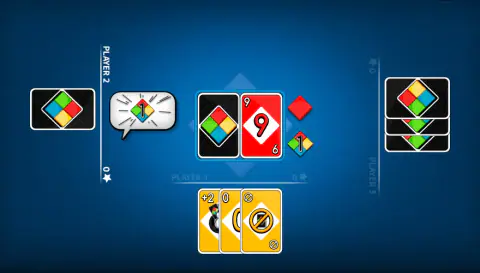
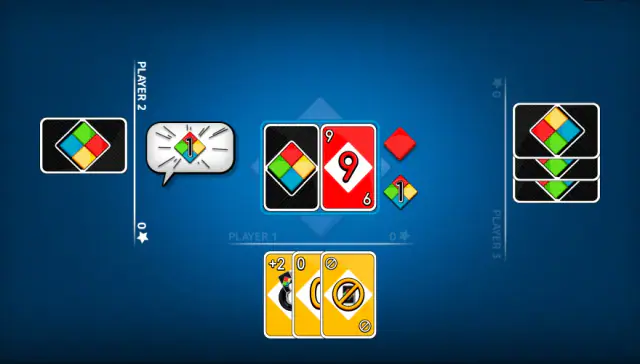
- Press the 1 after the card, not before. We pressed it with two cards in hand, then played one. Less than a second later, two penalty cards arrived with a message: you must press 1 when you have just one card left. In the next hand we played first and pressed the 1 straight after. A bubble with the 1 popped up next to our name. No penalty, and we went out on our next turn.
- Keep the +3 for when you are stuck. We held a +3 and a blue reverse, with blue on the pile. We clicked the +3 and nothing happened. The game only lets it out when no other card fits.
- At a table of two, action cards play twice. A reverse, a skip, a +2 or a +3 gave us the turn straight back. The computer did it to us too: two +2 cards in a row, four new cards for us.
- Watch for the rival's bubble. When a rival is down to one card, a bubble with the 1 pops up next to them. That is the moment to hit them with a +2.
Controls
| Click a card in your hand | Play it, if it matches the top of the pile by colour, by number or by symbol |
|---|---|
| Click the 1 diamond | Call your last card, right after you play your second-last one |
| Click a coloured diamond | Choose the new colour after a wild or a +3 card |
| When no card fits | You draw from the face-down deck. Several times the game dealt us the card without a click |
| Click the double arrow | Skip the tutorial, or start the next hand from the summary |
| Click the flag | Change the language; there are 13 flags |
Features
- Tables of two, three or four, all against the computer when you use the monitor button
- Number cards, skip, reverse, +2, wild and a black +3 wild that only goes down when nothing else fits
- A 1 button you press after playing your second-last card, or you take two penalty cards
- Skip and reverse cards are worth 20 points, wild cards 50, number cards their digit
- At a table of two, a reverse, a skip, a +2 or a +3 gives you another turn
- A summary after each hand, with points out of 250 and the cards that paid the winner
- 13 languages behind the flag on the title screen
Game details
- Developer
- Code This Lab
- Release date
- January 2025
- Last updated
- August 10, 2026
- Added here
- April 2025
- Technology
- HTML5 (2D)
- Platforms
- Browser (desktop, mouse)
- Classification
- Cards & Board , Multiplayer
- Saved progress
- Saving, when available, is managed by this game. Mava cannot confirm your level.
FAQ
What is the 4 Colors game?
4 Colors is a free browser card game by Code This Lab. You and one to three computer players take turns matching the top card of the pile by colour or by number. The first player to empty their hand wins the hand and scores the cards the others still hold. The welcome panel sets 250 points as the goal; we have not played that far.
When do you press the 1 button in 4 Colors?
Right after you play your second-last card, when one card is left in your hand. We pressed it with two cards in hand, before playing, and it did not count: two penalty cards came straight away. When we pressed it just after playing, a bubble with the 1 popped up and there was no penalty.
What does the +3 card do in 4 Colors?
It is a black wild card. The next player takes three cards, and you choose the new colour on a panel with four diamonds. The game only lets you play it when no other card in your hand fits. We tried it while holding a card that fitted, and nothing happened.
How many points is each card worth in 4 Colors?
The tutorial gives the values. Number cards are worth their digit. The +2, skip and reverse cards are worth 20. The wild card and the +3 wild are worth 50. The winner of a hand scores all the cards left in the other hands.
Can you play 4 Colors online with other people?
The title screen has two play buttons. The left one, with a monitor, seats you with computer players, and that is the one we played. The right one, with a globe, asks you to choose a nickname. We closed that box without typing, so we have not tested online play.
How many players can play 4 Colors?
Two, three or four. A green diamond seats two, a yellow one three and a red one four. You always sit at the bottom. At a table of two your rival sits at the top. At a table of four the others sit left, top and right.
Can you play 4 Colors in other languages?
Yes. The flag on the title screen opens 13 languages, among them English, Spanish, French, German, Portuguese and Italian. The title changes too, for example to 4 COLORES in Spanish. We played in English and Spanish, and opened French, Portuguese and Italian.
Who made 4 Colors?
The game is by Code This Lab, whose name is on the panel behind the i button. It was published in January 2025.