










About Domino Legend
Most dominoes games on the web look the same: a green baize, two rows of tiles, a line that snakes across the screen. The difference is in the rules they follow, and most never tell you which ones. Domino Legend puts its rule on the table after every round, and it is one that punishes a heavy hand harder than the textbook version does.
You play one against one with the computer on a red table. Each of you gets seven tiles from a standard double-six set, and you take turns laying a tile whose number matches one of the two open ends of the line. Your hand sits at the bottom, face up. The computer's sits at the top, face down, so the only thing you ever know about it is how many tiles are left.
The game is by Inlogic Software, a studio from Slovakia that makes browser versions of classic card and board games. It offers the two rule sets most people grew up with, Block and Draw. We played a round and a half of Block against the computer and lost the first round by a single pip.
We lost our first round by one pip
The clearest thing Domino Legend taught us came from losing. The first round ended with tiles still in both hands, after the computer had already been forced to pass once. In Block, that means the line is blocked: nobody can play, and the round is decided by counting the dots, or pips, left in each hand.
The computer was holding two tiles, the double five and the double four, for 18 pips. We were holding four small tiles worth 19. Four tiles against two sounds like a clear loss, but only the pip count mattered, and the gap was one dot.
Then came the score. The summary gave the computer 19 points, the whole of our hand. The traditional Block rules published on Pagat, the long-running card and tile game reference, credit the winner with the loser's pips minus their own, which would have been a single point. Domino Legend does not subtract. So a blocked round you lose by one pip can cost as much as a round your rival wins outright, and a heavy hand is always a liability.
Who goes first is not what the instructions say
The instructions the listing gives say the player holding the highest double starts, and if nobody has a double, the highest tile starts. That is not what we saw.
In our first round the computer opened with the blank-one, a tile worth a single pip. Our own hand held the double blank and the double two, and the computer was holding the double five and the double four the whole time, since both were still in its hand at the end. Under a highest-double rule, the double five would have opened. So at least in the round we played, you cannot plan around getting the first move just because your hand is full of doubles.
Why you can never count every tile in Block
A double-six set has 28 tiles: every pairing of the numbers blank to six, each exactly once. In a two-player game of Block, each player is dealt seven, and the other 14 stay face down out of play for the whole round. Half the set never reaches the table.
That changes how you read the game. Each number appears on seven tiles. If you can see most of the fives, on the table and in your own hand, you know the computer cannot hold many more. But some of the missing ones are sitting in the unused pile, and you have no way of telling which. Counting gives you odds, not certainty.
It also explains why blocked rounds happen so often. With only 14 of 28 tiles in play, it is easy for both ends of the line to show a number that nobody holds, and the round stops dead. That is exactly how our first round ended.
Draw is the other answer to the same problem. When you cannot move, you take tiles from the spare pile, called the boneyard, until one fits. Rounds last longer and blocks are rarer, but you can end up with a bigger hand to be caught holding. We did not play Draw; the rules here are the standard ones the listing and the portals describe.
What the table shows you
The layout is simple. The computer's name and score sit in a bar at the top, yours in a bar at the bottom. When the line reaches the edge of the table, it turns the corner and carries on down the side, so it never runs off the screen.
The white and grey highlighting is the most useful thing on the table. On our first turn we held seven tiles, and exactly four of them were white: the four that carried a blank or a one, the two numbers showing on the tile in the middle. You never have to check a tile against the ends yourself.
Between rounds a summary panel shows each player's total with a progress bar towards 100. Our first round took well under a minute of play, and at 19 points a round, a full match is a handful of rounds, not an evening.
Who it is for
Domino Legend suits anyone who already knows dominoes and wants a quick game against the computer with no account and nothing to set up. It is also a gentle way to learn: the highlighting stops you from making illegal moves, so a beginner can focus on which tile to play, not on which tiles are allowed. What it does not have, in what we played, is a human opponent. If you want to play dominoes against real people, look elsewhere.
What we saw, and what we did not
We played about four minutes of Block in a desktop browser, in a copy that showed its menus in Spanish. We finished one round and played part of the second. We did not play Draw, did not reach the end of a match, and did not find out what the counter with the yellow cards in the top left corner is for; it read zero the whole time.
More dominoes and board games
Inlogic's other dominoes game in our catalogue is Domino Battle, with the same choice of Draw or Block. For dominoes against real people, Domino Online Multiplayer has online duels. Dominoes Classic Duel is another take on the two-player game, and Checkers Legend moves the same quiet, turn-by-turn thinking to another classic board. More games that reward planning are in our strategy category.
Screenshots
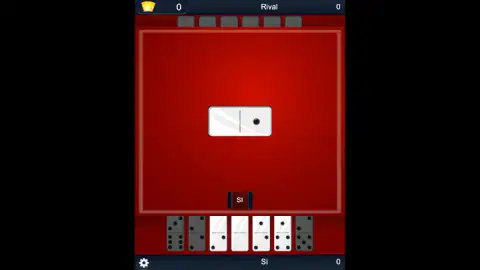
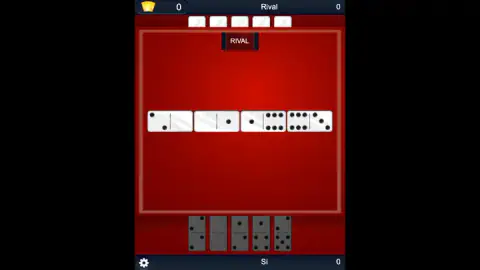

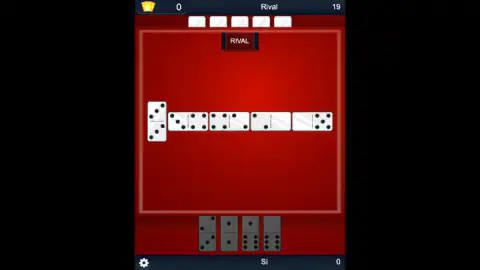
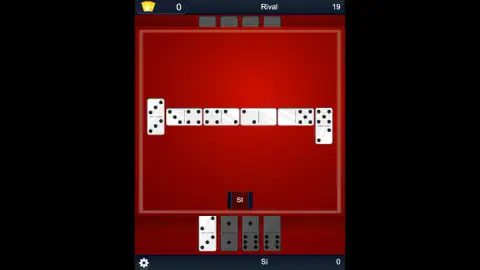
Taken by opening the game ourselves and letting it run — not supplied by the publisher, and not the same picture every other site shows.
How to play Domino Legend
- Choose Block or Draw from the title screen. The copy we played showed its menus in Spanish, and the Block button read BLOQUERO.
- Look at your hand. The tiles that fit one of the open ends are white; the ones that cannot be played right now are grey.
- Play a white tile on your turn. A small tag on the table shows whose turn it is: one near your hand for you, one reading RIVAL near the top for the computer.
- When nobody can move, or someone plays their last tile, a summary shows both scores and a button to start the next round. The first player to 100 points wins.
Tips from our session:
- The turn tag is not a button. We lost the second half of our session clicking it. The game waits for you to play a tile, not to confirm anything.
- Get rid of heavy tiles early. A round can end with tiles still in your hand, and every pip on them goes to your opponent.
- Watch the ends, not your hand. When one number is showing at both ends, only tiles with that number can be played. If you hold several, you control the round.
- Doubles are dangerous to keep. They fit fewer places than any other tile, so they are the ones most likely to be stuck in your hand at the end.
Controls
| Mouse or touch | Pick a white tile from your hand to play it on an open end of the line |
|---|---|
| Siguiente ronda / next round button | Starts the next round after the score summary |
| Gear (bottom left) | Settings |
Features
- Two classic rule sets, Block and Draw, played one against one with the computer
- Tiles that fit an open end turn white in your hand; the rest stay grey
- A turn tag on the table shows whose move it is, yours or the rival's
- Pip scoring - the winner of a round takes the points left in the loser's hand
- Matches run to 100 points, with a progress bar for each player between rounds
- A double-six set of 28 tiles, seven dealt to each player
Game details
- Developer
- Inlogic Software
- Release date
- June 2022
- Added here
- April 2025
- Technology
- HTML5 (2D)
- Platforms
- Browser (desktop, mouse), Browser (mobile & tablet, touch)
- Classification
- Cards & Board
- Download size
- 4.5 MB
- Ad requests
- 3 (few)
- Has a save
- Yes
- Saved progress
- Saving, when available, is managed by this game. Mava cannot confirm your level.
Measured by opening the game ourselves on 2026-09-10, not taken from the feed. Twelve seconds on a phone-sized screen, with ad requests counted and blocked rather than loaded.
FAQ
What is Domino Legend?
Domino Legend is a free dominoes game for the browser made by the Slovak studio Inlogic Software. You play one against one with the computer on a red table, in either Block or Draw rules, and the first player to reach 100 points wins the match.
How do you play Domino Legend?
Each player gets seven tiles. On your turn, play a tile whose number matches one of the two open ends of the line. The tiles you can play turn white in your hand and the others stay grey. In Block you pass when nothing fits; in Draw you take tiles from the spare pile until one does.
How do you win a round of Domino Legend?
Play all your tiles first, or, if the line is blocked and nobody can move, hold fewer pips than your rival. The winner scores the pips left in the loser's hand. In our first round the computer won a blocked round by one pip and scored all 19 of ours.
Who goes first in Domino Legend?
The game's instructions say the player with the highest double starts. In the round we played, the computer opened with the blank-one while it was holding the double five, so do not count on getting the first move just because you hold a big double.
What is the difference between Block and Draw in Domino Legend?
In Block, the tiles nobody was dealt stay out of play and a player who cannot move simply passes. In Draw, a player who cannot move takes tiles from that spare pile, called the boneyard, until one fits. We played Block.
What does SI mean in Domino Legend?
In the Spanish-language version we played, the small tag reading SI on the table marks your turn, and a tag reading RIVAL marks the computer's. It is not a button. To move, pick one of the white tiles in your hand.
Who made Domino Legend?
Inlogic Software, a Slovak studio that makes classic card and board games for the browser. The game's listing, WildTangent and classicgame.com all credit Inlogic, and the game appears in Inlogic's own HTML5 catalogue alongside its other dominoes game, Domino Battle.