


About Emoji Memory: Find a Pair
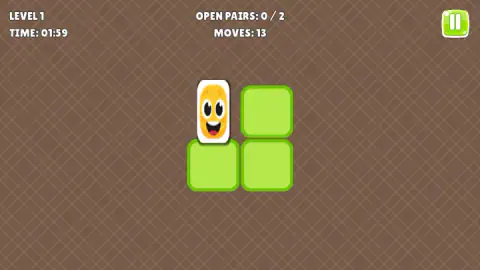
Two numbers run down the top of the screen in Emoji Memory: Find a Pair, and they do not want the same thing from you. TIME is a clock counting backwards from two minutes. MOVES is a ration: it starts somewhere in the teens, and it drops by one every single time you turn a card over. Most memory games count your moves upwards, as a tally to feel vaguely bad about once you have finished. This one hands you a fixed number of looks and lets you spend them.
That one choice is what makes the game worth a few minutes. In the version everybody knows, the opening flips are free reconnaissance: you turn cards over almost at random, learn the board, then cash in. Here reconnaissance costs exactly what a confident guess costs. Sitting still and memorising is the only free thing you can do, and it burns the clock instead.
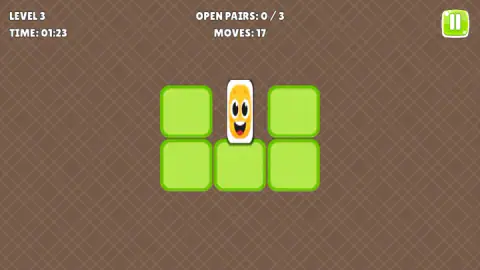
The boards themselves are tiny and they grow one card at a time. Level 1 is four cards in a square, two pairs. Level 3 is six cards in two rows of three, three pairs. And the clock, counterintuitively, gets shorter as the boards get bigger: two minutes on the first level, a minute and a half on the two after it.
Kirill Vetrinskiy made it, one of three of his games, and it was published in April 2025. We played it on a desktop and got as far as level 3 — far enough to see the pattern, not far enough to see the end.
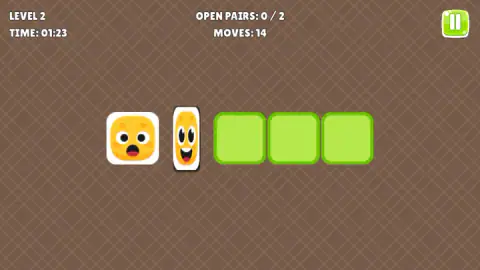
Level 2 deals five cards and asks for two pairs
Count them on the second board. Five cards in a single horizontal row, and the header reads OPEN PAIRS 0 / 2.
Two pairs is four cards. Five are on the table. And because matched pairs here stay face up for the rest of the level rather than disappearing, five really is the whole board — nothing has been taken away and nothing is hiding. One of those five has no partner anywhere.
We never got all five face up at once, so we cannot say which one it is. What it does to the level is clear enough: somewhere in your run sits a card that cannot possibly help you, and the only way to identify it is to spend a move finding out. On a board that hands you sixteen turns that is no crisis, just a strange little piece of design.
Levels 1 and 3 are honest about their arithmetic: four cards, two pairs; six cards, three pairs. Level 2 is the one with a passenger.
Two counters, and why they pull against each other
TIME counts down. It starts at 02:00 on level 1, at 01:30 on the two after it, and you lose it by existing, whether or not you touch anything.
MOVES counts down too, but you only lose it by acting. We watched it fall from 11 to 7 across four clicks on level 1 — one per card, no exceptions, including cards we had turned over a minute earlier and forgotten. The fresh-board rations we caught were sixteen turns on level 2 and twenty on level 3.
So the two meters punish opposite sins. The clock punishes dithering, the move counter punishes fishing. A player who sits and thinks loses time; a player who clicks around hoping loses turns. The sweet spot is the thing memory games are actually about — look once, hard, and do not look again.
One honest gap. On level 1 our move counter reached zero with a pair still missing and thirty seconds on the clock, and nothing happened: no message, no sound, no reset. We finished the level a few seconds later anyway. Whether the counter is meant to end the level when it empties, or simply floors at zero, we do not know.
Matching pairs is 700 years older than the screen you are reading this on
Turning over hidden objects to find two that match is not a card-game idea, and it is not a modern one.
In Japan it is kai-awase, shell-matching, played with the two halves of a hamaguri clam. The insides were painted — scenes from the Tale of Genji were the favourite — so that only the correct two halves completed a picture. It began in the Heian period as an aristocrats' competition in composing poems about shells, and by the late thirteenth century it had hardened into the matching game the name now means. A full set ran to 360 shells. The right-hand halves were laid face down in a circle; the left-hand halves were drawn one at a time from the centre, and whoever found the most partners won. Swap the shells for green rectangles and that is the board in front of you, minus about 354 pieces.
The maths of it is more recent and more useful. In 2013 Daniel Velleman and Gregory Warrington worked out what a player with a perfect memory should expect from a game of Memory, and the headline result is that clearing n pairs takes roughly 1.61 × n turns. A turn there means a pair of flips, so flawless memory gets you through a board in a little over one and a half tries per pair — not far off the theoretical floor of one.
That is why the rations here feel so forgiving once you understand them. Level 3 is three pairs: turning over six cards and being right every time is the absolute minimum, and the game gives you twenty. The caveat is real, though — 1.61 is a result for large boards, and three pairs is not a large board. On something this small, luck swamps technique.
The same paper has a detail that will feel familiar if you have ever played badly. A perfect player still turns over two matching cards without noticing about 0.69 times per game on average, and that figure barely moves however big the board gets. Even flawless memory does not save you from the one mistake everybody makes: seeing the pair and not registering it.
What the game says about itself
Its own description promises two extra modes beyond the level run — one against the clock, one for the fewest moves — with records set against other players. We never saw either. Everything we played was the straight sequence: a board, a NEXT button, a bigger board. If those modes exist, they live behind the menu we never opened.
Where the description is exactly right is the small print: two mismatched cards turn themselves back over and give you a moment to memorise them first. The window is short, and nothing marks it. The game is quiet in a way that suits it — after the sound that played when we got in, we did not hear another thing, not when a pair landed and not when the move counter emptied.
It is listed for desktop, mobile and tablet, and a tap is the control its instructions name. We played with a mouse, so how the cards feel under a finger is still its word rather than ours.
More games to match things in
2048 3D: Merge Cubes is the other Vetrinskiy game in our catalogue: the same instinct pointed at numbers. Tile Match and Onet Puzzle - Tile Match Game show you every tile from the start, which turns a memory test into a search problem. Find Match 3D keeps the pairs but hides them in a heap of objects instead of behind card backs. Zen Garden Match drops the timer altogether, if counting down is the part you would rather do without. The rest are in kids games.
Screenshots
How to play Emoji Memory: Find a Pair
- Click the middle of the opening screen to get to the board. One or two clicks did it for us.
- Click a green card to turn it over. A yellow face appears, and the MOVES counter drops by one.
- Click a second card. If the faces match, both stay face up and the OPEN PAIRS counter climbs. If they do not, they flip back down — and the second before they do is the only look you get.
- Keep going until OPEN PAIRS reaches the number after the slash: two on levels 1 and 2, three on level 3.
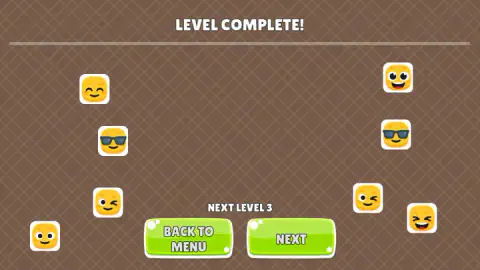
- The LEVEL COMPLETE screen offers you NEXT. Take it, and the next board is one card bigger.
What we worked out the slow way:
- Pause before you click, not after. Thinking only costs you clock; clicking is the opposite. If you are unsure which card to turn, sit and recall rather than poke.
- Turn the unknown card second. With one face already showing, your second click should land on a card you have never seen. Re-opening something you know buys nothing and still costs a move.
- Matched pairs stay up, so use them as landmarks. Nothing is ever removed from the board, and the faces already solved sit there as fixed reference points for the ones that are not.
- The faces are more alike than you expect. Same yellow, same size, and several differ only in the mouth or in whether the eyes are open. Remember the detail that differs, not "a smiling one".
- Nothing is counting you. No score, no stars, no coins. The only pressure is the two headers, and one of them stops mattering the moment you stop clicking.
Controls
| Click a face-down card, or tap it | Turns it over. The MOVES counter in the header drops by one every time you do it |
|---|---|
| Click the middle of the opening screen | Gets you to the board. One or two clicks did it for us, and a sound played as the first level appeared |
| NEXT | On the LEVEL COMPLETE screen, carries you to the next level. The other button there, BACK TO MENU, goes somewhere we never went |
| The green button in the top-right corner | The only control on the playing screen besides the cards. It carries a pause symbol. We left it alone |
| The keyboard | Nothing we pressed moved anything. Every card we turned over, we turned over with a click |
Features
- Two counters run down at the same time: a clock that starts at 02:00 on level 1 and 01:30 after it, and a ration of card turns
- The move counter is a budget, not a score — it drops by one for every single card you turn over, including the ones you have already seen
- Boards grow one card at a time: four cards and two pairs on level 1, five cards and two pairs on level 2, six cards and three pairs on level 3
- Level 2 is the odd one: five cards for two pairs means one card on that board has no twin at all
- Matched pairs stay face up for the rest of the level, so the board never shrinks and you can always see what you have already solved
- A header, a pause button and the cards: there is no score, no stars, no combo meter and no coins anywhere on screen
- Listed for desktop, mobile and tablet, with a tap as the control the game's own instructions name
Game details
- Developer
- Kirill Vetrinskiy
- Release date
- April 2025
- Last updated
- October 23, 2026
- Added here
- May 2025
- Technology
- HTML5 (Godot)
- Platforms
- Browser (desktop), Browser (mobile & tablet, touch)
- Saved progress
- Saving, when available, is managed by this game. Mava cannot confirm your level.
FAQ
How do you play Emoji Memory: Find a Pair?
You turn cards over two at a time looking for two that carry the same face. A matched pair stays face up; two that do not match flip back down after a moment, and the moment is your chance to memorise where they were. The level ends when the OPEN PAIRS counter in the header reaches the total it is counting towards.
What does the MOVES counter mean in Emoji Memory?
It is a ration, not a tally. It starts at a number the level gives you and drops by one every time you turn a card over, so it counts down instead of up. Level 2 handed us 16 turns and level 3 handed us 20, which is generous — a flawless run on a three-pair board needs six.
What happens if you run out of moves?
We cannot tell you, honestly. Our counter reached zero on level 1 with one pair still unfound, nothing announced itself, and we finished the level a few seconds later anyway. Either the counter floors at zero without a penalty or the penalty is something we did not trigger.
How many levels does Emoji Memory have?
We do not know. We played three and the game kept offering a NEXT button after each one. The boards grew by one card each time — four, then five, then six — and the clock got shorter rather than longer, dropping from two minutes on level 1 to a minute and a half afterwards.
Why does level 2 have five cards?
That is the strangest thing on the board, and it is real: five cards sitting in one row with the header asking for two pairs. Two pairs account for four cards, and matched pairs stay face up rather than vanishing, so the fifth card has no twin. Whichever one it is, turning it over is a wasted move you cannot avoid making.
Who made Emoji Memory: Find a Pair?
It was published on 2048. This one was published in April 2025 and was last updated in August 2026.
Is Emoji Memory: Find a Pair free?
Yes. It runs in a browser on this page with nothing to install and nothing to buy, and it is listed for desktop, mobile and tablet alike. We played it with a mouse on a desktop; its own instructions describe the control as a tap, which suggests a phone is what it was designed around.
Does Emoji Memory have a time attack or a high score mode?
The game says it does — two extra modes, one for time and one for the fewest moves, with records set against other players. We never reached them. Everything we played was the straight level-by-level run, so those modes are the game's claim about itself rather than something we can describe.