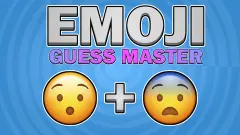

About Emoji Guess
Lion King was printed across the top of the screen in dark blue. Two empty squares sat under the words. Under those lay five loose emojis — a child in a red helmet, a panda, a wrapped gift, a pink flower, an umbrella in the rain — and among them, a lion and a crown.
Lion into the first square, crown into the second, and a band of pink swept across the screen with "VICTORY!" written on it.
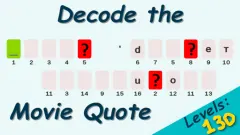
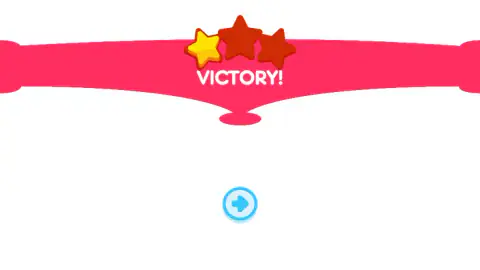
That is the whole game, and the opening level hands it over with nothing in the way. What the opening level does not tell you is how it goes wrong. Look at the top of that same screen and three cross marks sit side by side, two of them already red. We had not walked that level; we had stumbled through it. The victory banner that followed carries three stars, and ours lit exactly one.
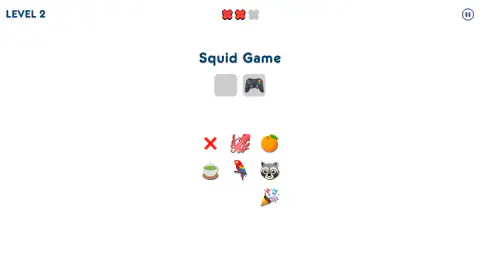
The second level made the shape of the thing plain. The prompt read Squid Game, the second slot already held a games controller, and sitting in the pile below — in the place where an emoji used to be — was a large red ✗. That was a tile we had picked and got wrong, crossed out and left standing where it stood. The right answer was a squid and that controller, in that order, with an orange, a bowl of matcha, a parrot, a raccoon and a party popper around them as decoys.
The game is credited to Drivix Games and has been available since September 2025. Our session ran about four minutes: we solved those two levels, reached a third, and stopped there without ever seeing how the game ends.
The third level stopped using words
On levels one and two the prompt is a line of text and the job is translation: you know the phrase, you go looking for pictures that carry it.
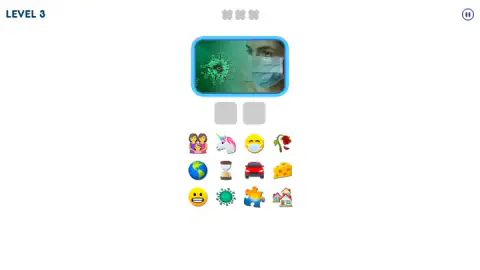
The third level took the words away. In their place sat a photograph inside a rounded blue frame — a green model of a virus on the left, and on the right a face wearing a surgical mask. Under it, the same two empty squares as always. Under those, twelve tiles: a family, a unicorn, a face in a mask, a wilted rose, the globe, an hourglass, a red car, a wedge of cheese, a grinning face, a green microbe, a puzzle piece and a row of houses.
Those are not the same puzzle wearing different clothes. With a written prompt the words are given to you and only the pictures are missing. With a photograph, nothing is given: before you can pick a tile you have to decide what the image is called, and then your name for it has to be the one the game had in mind. A picture of a masked face next to a virus has several honest captions, and only one of them is being scored.
It is also the level where the pile is at its widest, which is probably not a coincidence. Twelve tiles for a two-tile answer, two of which — the mask and the microbe — sit in plain view, so the puzzle is not really which pictures but which order, and that is a question the photograph refuses to answer for you.
Pictures have been standing in for words for longer than there has been a word for it
The name for this kind of puzzle is a rebus, and it arrived in English around 1600 from the Latin ablative plural rebus — "by means of things". A seventeenth-century French scholar, Gilles Ménage, traced it instead to satirical carnival sheets from Picardy headed de rebus quae geruntur, "concerning the things going on". That story is doubted, mostly on dates: the Picardy phrase shows up later than the word it is supposed to explain.
The puzzle itself is far older than either account, and for a while it was not a puzzle at all. The move that turned pictures into writing was the decision to use a picture for its sound rather than its meaning: in Egyptian, the sign for a duck also wrote the word for "son", because both were pronounced sa. Once a drawing can stand for a noise, you can spell anything.
Emoji Guess never takes that step, and the game is the better for it. Its tiles always mean what they show. The lion is a lion; the crown is not a king but the thing a king wears, which is the only sleight of hand in the whole level. A squid is a squid and a controller is a game. The puzzle is association, not pronunciation — which is why the answers survive translation, and why nearly all the difficulty has been pushed into the ordering. Two tiles, two slots, one correct sequence, and the pile below keeping a straight face.
What the crosses and the stars are counting
Three ✗ marks sit at the top centre of every level. On the third level, which we had only just started, all three were grey. On both the levels we solved, two were red and one was grey by the end.
The simplest reading is that they are your three goes, and that each wrong pick turns one of them red. It fits what else was on screen: two mistakes on the first level, and a victory banner with one gold star and two left dark. It also fits the red ✗ sitting in the pile, which marks the tile that burned one of them.
What we cannot tell you is what happens when the third one goes, because we never spent it. We also do not know whether a tile can be pulled back out of a slot once you have put it there, or what the hints are that the game's listing mentions — we never saw one offered. Those are open questions, and we would rather leave them open than guess at them.
More puzzles by Drivix Games
The studio keeps a quiet shelf here. Stack Swipe is the loudest of them, a colour board where one drag moves every tile at once, and Word Search Hidden Words is the opposite: a grid, a list, and all the time you want. If it is the picture-to-word trick you came for, Pics 2 Word runs it the other way round — four photographs, one word to name them all — and Guess Drawing swaps the photographs for sketches. Emoji Sort uses the same little pictures as tokens instead of as language. The rest is in puzzle games.
Screenshots
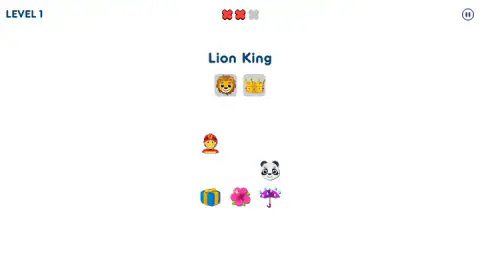
Taken by opening the game ourselves and letting it run — not supplied by the publisher, and not the same picture every other site shows.
How to play Emoji Guess
- Read the prompt first, then decide how many pictures you need. Every level we played wanted exactly two, which is why the squares under the prompt are worth a glance before the pile is.
- Say the phrase out loud and split it in half. "Lion" and "King" are two words and they want two tiles. The pile is arranged to make that split harder than it sounds.
- Click the tile rather than dragging it. Both levels we cleared went in by clicking an emoji, which sent it up into the next empty slot. Dragging tiles towards the squares got us nowhere.
- Fill the slots left to right. The two squares read as a sentence. Crown-then-lion is not a film title, and the game will not reorder your picks for you.
- Take the blue arrow on the victory banner to move on, and check the crosses at the top of the next level before you start guessing.
What the session taught us:
- A wrong pick narrows the pile instead of ending the level. It gets crossed out in red and stays put, so the board turns into a shortlist. Being wrong once is cheap; being wrong three times costs stars.
- Most of the pile is noise, and the noise gets louder. The first level offered five loose emojis, the third offered twelve. The answer stayed two tiles long the whole time, so what grows is not the puzzle but the haystack.
- The decoys do not belong to your riddle. On the third level we were looking at an hourglass, a red car and a wedge of cheese, none of which had anything to do with the prompt in front of us. They are there to make the two right tiles cost a search.
- Second-guess the picture, not the word. When the prompt is a photograph you have to name what you are looking at before you can pick anything, and your name for it has to match the game's.
- The pause control is in the top-right corner, close to the edge of the play area and easy to catch with a stray click.
Controls
| Click or tap a loose emoji | Sends it up into the next empty answer slot. Both of the levels we solved went in this way |
|---|---|
| Answer slots, under the prompt | Two of them on every level we played, filled left to right. Order is part of the answer |
| Blue arrow button on the victory banner | Moves you on to the next level |
| Circle with two bars, top right | The pause sign, sitting close to the edge of the play area |
Features
- A prompt that is sometimes a written phrase and sometimes a photograph, which are two different puzzles
- Two answer slots on every level we reached, filled in order, so the sequence matters as much as the pictures
- A pile of loose emojis that is mostly decoys, and that grows: five tiles on the first level, twelve on the third
- Three cross marks at the top of each level that go red as you get picks wrong
- A wrong pick crossed out in red and left standing in the pile, so you can see what you have already ruled out
- A victory banner with three stars, of which a level solved on the third go lights one
- Available since September 2025
Game details
- Developer
- Drivix Games
- Release date
- September 2025
- Last updated
- August 10, 2026
- Added here
- July 2025
- Technology
- HTML5 (2D)
- Platforms
- Browser (desktop), Browser (mobile & tablet, touch)
- Classification
- Puzzle
- Saved progress
- Saving, when available, is managed by this game. Mava cannot confirm your level.
FAQ
How do you play Emoji Guess?
A phrase or a picture appears at the top of the screen, two empty squares sit under it, and a pile of loose emojis sits under those. You pick the emojis that stand for the prompt and put them into the squares in the right order. On every level we played the answer was exactly two emojis, and most of the pile was there to be ignored.
Does the order of the emojis matter in Emoji Guess?
Yes, and it is most of the difficulty. The answer slots fill left to right and they read as a phrase, so a lion followed by a crown gives you a film title while a crown followed by a lion gives you nothing. Knowing which two pictures are right is only half the level.
What do the three crosses at the top of the screen mean?
They look like your allowance of wrong picks. On a level we had only just started all three were grey, and on both levels we solved two of the three had turned red by the time we finished. The victory banner then lit one star out of three, which fits two mistakes having been spent.
What happens when you pick the wrong emoji?
The tile you chose is crossed out with a large red mark and left exactly where it was in the pile. That is useful rather than punishing, because the pile stops being a wall of equal choices and starts being a shortlist. You do not lose the level for one wrong pick.
Are all the puzzles in Emoji Guess written out in words?
No. The first two we played were written phrases, but the third replaced the words with a photograph in a blue frame, and two slots to describe it with. The game's listing claims hundreds of levels, which we cannot confirm, but both kinds of prompt turn up inside the first three.
How many levels does Emoji Guess have?
We cannot tell you. Our session ran about four minutes, we cleared the first two levels and we were still working on the third when it ended, so we never saw an ending. The game is described as having hundreds of short levels, and that figure is theirs rather than something we counted.
Who made Emoji Guess?
The game is credited to a studio called Drivix Games, which also made Stack Swipe, Word Search Hidden Words and Jigsaw Puzzles. No studio name appears on screen while you play. The game has been available since September 2025.
Is Emoji Guess a game for children?
It is handed to us filed under kids, and nothing in it is violent or frightening. The riddles themselves are pop-culture general knowledge, though, and that is the limiting factor: the two we were dealt were a film title and a television series rated for adults, so a young player will solve the ones they happen to recognise and stall on the rest.