



About Unravel Eggs Puzzle
Nothing in Unravel Eggs Puzzle keeps score. There is no clock in the corner, no move counter, no row of stars waiting to be earned and no tally of how many times you got it wrong. The only number anywhere on the screen is the one at the top that says which level you are on. Everything else the game has to tell you, it tells you in colour.
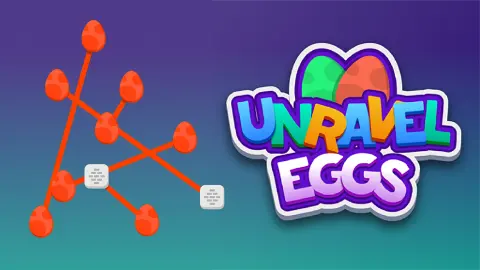
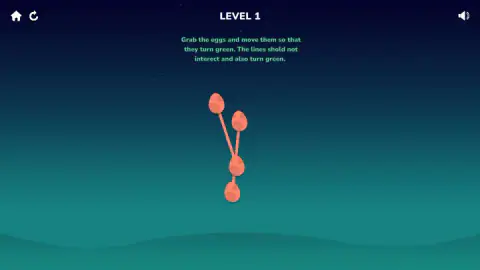
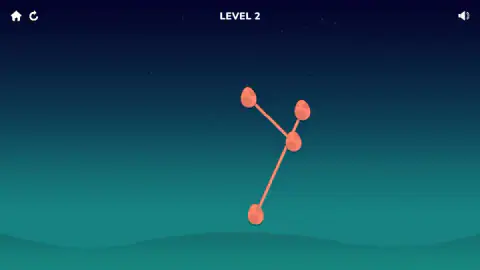
The board is a night sky fading into a dark teal sea, with a few pale specks drifting across it. Sitting in the middle of it are the eggs, coral-coloured, joined to one another by thick coral lines. Coral means wrong. Somewhere in that arrangement, two of the lines are crossing. Grab an egg and drag it, and every line attached to it stretches and follows; let go somewhere better and you have changed the shape of the problem. Get the whole board to a position where no line crosses any other and the eggs and the lines turn green at once. That is the win condition, and it is also the entire interface.
Drivix Games made it, a studio making mostly small logic, sorting and block puzzles rather than anything with a health bar. This one went up in September 2025, was last touched in August 2026. It is filed under Easter, which the eggs earn and nothing else does: there is no basket, no bunny and no spring palette in sight.
We played it on a desktop for four minutes. Level 1 fell on the sixth drag. Level 2 did not fall at all, and the honest part of this page is the bit further down where we explain why that is stranger than it sounds.
The one shape this game could never ask you to untangle
What you are doing here has a name and a date. A set of points joined by lines is a graph, and a graph that can be drawn flat with no line crossing another is called planar. In 1930 the Polish mathematician Kazimierz Kuratowski proved exactly which graphs are not: a drawing is impossible to untangle if and only if it hides one of two particular shapes inside it. One is five points each joined to all four of the others. The other is two groups of three points, with every point in one group joined to every point in the other — the old puzzle about three houses each connected to gas, water and electricity, which has no solution for the same reason.
So the game has a hard ceiling it can never cross. Five eggs, each joined to every other egg, would be an unsolvable level no matter how long you dragged them around, and no amount of clever positioning would save it. Every board you are given has to avoid that shape, which is a real design constraint on whoever built the levels and not a stylistic one.
There is a second theorem underneath the first, and it is the one that makes this game possible at all. If a tangle can be untangled, it can always be untangled using straight lines only — no curves, no detours, no lines bending around an obstacle. That was proved independently three times over, by Klaus Wagner in 1936, István Fáry in 1948 and Sherman Stein in 1951, and it is why Unravel Eggs Puzzle can draw every connection as a rigid coral rod and still promise that a solution exists. Take that guarantee away and a game like this would need rubber bands.
The puzzle reached browsers in its modern form in 2005, when John Tantalo wrote Planarity from an idea by Mary Radcliffe. It opened with the points arranged in a circle, maximally tangled, and asked you to pull them apart; it spread fast enough that the whole genre is now usually described as untangle games. Twenty years on, this one has swapped the circle for a handful of eggs over a dark sea, and the rules have not changed by a single line.
Why level 2 beat us, and why that is odd
Here is the part we cannot explain. Level 1 is a chain of four eggs in a bunch, two of its lines running nearly on top of each other, and it took six drags. Level 2 also has four eggs, and the arrangement we ended up with is a fork: one egg a little right of centre, with three lines running out of it to the other three. Three lines meeting at a single point cannot cross each other anywhere else — and yet, in that arrangement, the eggs were still coral.
So something about that board was still unsatisfied, and across roughly three minutes and nineteen drags we never worked out what. It might be a connection we could not see because two lines were overlapping. It might be that lines lying exactly along one another count as crossing. We do not know, and we would rather say so than invent a rule. What we can report is the shape of the difficulty: on a four-egg board, understanding the tangle is harder than fixing it, and once two eggs end up close together you are reading a picture that no longer tells you the truth.
That is the real skill the game trains, and it is a strange one. Not planning, not reflexes, not arithmetic — just the ability to look at a knot of overlapping lines and work out which end goes where.
What the game promises and what it actually puts on screen
The description that travels with the game is written for Easter weekend, and talks about warming up on light puzzles and working your way up to something much bigger. We cannot confirm any of that. Two levels in, both boards had four eggs, and there is no level map, no progress bar and no total count anywhere to tell you how far the thing goes. If the tangles grow, we did not get to see it.
What we can confirm is the restraint. In four minutes nothing interrupted us, nothing asked us to watch anything, and the only decoration between levels was the word VICTORY in coloured letters. A game that gives you no score cannot nag you about it, and the result is a puzzle that behaves more like a pencil-and-paper diversion than a browser game with a monetisation loop bolted on. Whether that holds at level 40 is not something two levels can tell you.
More games by Drivix Games
Push The Box is the studio's take on the oldest warehouse puzzle there is, where the hard part is also spatial and also one wrong move from a dead end. Hexa Block Puzzle and Connect Puzzle Image are the fitting-things-together half of their catalogue, and Find Out Hidden Object is the one that asks you to look rather than to think. The rest of our shelf is in puzzle games.
Screenshots

How to play Unravel Eggs Puzzle
- Look at the tangle before you touch it and find the crossing. On a bunched-up board the lines sit almost on top of each other, so it is worth pulling the eggs apart first just to see what is joined to what.
- Click an egg and drag it. The lines attached to it stretch; nothing snaps and nothing is fixed in place, so you can move the same egg as many times as you like.
- Work outwards rather than sideways. Dragging an egg away from the middle of the cluster almost always reveals more than nudging it a few pixels across.
- Keep going until the board turns green. The colour change is instant and total — every egg and every line at once — and a VICTORY card drops over the board with NEXT written underneath it.
Things we only found out by doing them:
- The instruction card shows up once. Level 1 carries three lines of green text across the top, typo and all: "The lines shold not interect and also turn green." From level 2 on, the board is bare.
- The arrow keys do nothing. We pressed all four and the board did not react. This is a game for one pointer, whether that is a mouse or a finger.
- A bad drag costs nothing. With no timer and no move limit, flailing is a legitimate tactic. The cheapest way to understand a board is to yank one egg right out to the edge of the screen and look at what follows it.
- The VICTORY card has one button. NEXT, and nothing else — no video offer, no triple-your-reward panel, no star rating being filled in. We clicked NEXT and pressed Enter in quick succession and level 2 appeared, so we cannot swear which of the two it was listening to.
- Eggs can be parked on top of each other. Nothing stops you dropping one egg over another, and when you do, the board becomes much harder to read than it is to solve.
Controls
| Click and drag an egg | Move it anywhere on the board. The lines joining it to the other eggs stretch and follow it as you go |
|---|---|
| Touch and drag | What the game's own instructions give for phones and tablets. We played with a mouse, so this is its word and not ours |
| Click NEXT on the VICTORY card | Go on to the next level. We clicked it and also pressed Enter, and level 2 came up; we cannot say which of the two did it |
| The circular arrow, top left | Read as restart the current board. We never pressed it |
| The house icon, beside it | Read as the way out of the level. We never pressed it |
| The speaker, top right | Read as sound on and off. We left it alone |
| The arrow keys | Nothing we could detect. We pressed all four and the board did not move |
Features
- Four eggs on the board in both of the levels we played, joined by straight lines that stretch as you drag
- Coral while the arrangement is still wrong, green when it is right — the colour of the board is the whole scoreboard
- No timer, no move counter and no star rating; the level number at the top is the only number on screen
- Nothing to lose — we found no fail state, no penalty for a bad drag and no sound for getting it wrong
- One card of instructions on level 1, typo included, and then no written guidance again
- A VICTORY card with a single NEXT under it, and no video offer or reward attached
- A night sky over a dark sea, with drifting specks, and no Easter dressing beyond the eggs themselves
Game details
- Developer
- Drivix Games
- Release date
- September 2025
- Last updated
- October 23, 2026
- Added here
- July 2025
- Technology
- HTML5 (2D)
- Platforms
- Browser (desktop), Browser (mobile & tablet, touch)
- Classification
- Puzzle
- Saved progress
- Saving, when available, is managed by this game. Mava cannot confirm your level.
FAQ
How do you play Unravel Eggs Puzzle?
Each board holds a handful of eggs joined to one another by straight lines. You drag an egg with the mouse, or your finger on a touchscreen, and the lines attached to it stretch and follow. The job is to find an arrangement in which no line crosses any other line. When you manage it, the eggs and the lines turn green and a VICTORY card appears.
How do you know when you have solved a level in Unravel Eggs Puzzle?
By colour, not by numbers. While lines are still crossing, every egg and every line on the board is coral; the moment the arrangement is untangled, the whole thing turns green. The game has no score, no timer and no star rating, so that colour change is the only feedback there is.
Can you lose or run out of time in Unravel Eggs Puzzle?
Not in anything we played. There is no clock, no move limit and no life counter, and a drag that makes the tangle worse costs you nothing but the time it took. In four minutes on the first two levels nothing ever told us we had failed, which makes it a puzzle you can leave half-solved and come back to.
Who made Unravel Eggs Puzzle?
This one was published in September 2025 and was last updated in August 2026. The studio's shelf is mostly small logic and sorting puzzles rather than action games.
Is Unravel Eggs Puzzle an Easter game?
It is filed under Easter alongside Puzzle, Logic and Brain, and eggs are of course the Easter object. The game itself is not dressed for the holiday: the board we played is a dark blue sky fading into a teal sea, with no baskets, bunnies or spring colours anywhere. The eggs are plain coral ovals that turn green when you solve the board.
How many levels does Unravel Eggs Puzzle have?
We cannot tell you. We finished level 1 and got stuck on level 2, and the game shows no level map, no progress bar and no total anywhere on screen. Both boards we saw had four eggs each, so we also cannot say how much bigger the tangles become later on.
Can you play Unravel Eggs Puzzle on a phone?
It is listed for desktop, mobile and tablet, in both landscape and portrait, and the game's own instructions are written for touch: grab an egg and drag it. We played it on a desktop with a mouse and did not test a touchscreen ourselves, so we cannot say how well four eggs and their lines read on a small screen.
Is Unravel Eggs Puzzle based on a real maths problem?
Yes. Untangling a drawing so that no two lines cross is the question of whether a graph is planar, settled by Kazimierz Kuratowski in 1930, and the fact that a solvable tangle can always be solved with straight lines was proved independently by Klaus Wagner, István Fáry and Sherman Stein between 1936 and 1951. The browser game that made the puzzle popular was Planarity, written by John Tantalo in 2005 from an idea by Mary Radcliffe.