
Quiz Games
Multiple choice measures recognition. Recall is a different and much harder thing, and almost nothing here asks for it.
42 games · hand-picked, then filled from the catalogue
Italiano ›Français ›Português ›Español ›
A quiz asks what you know. A good quiz asks how fast you know it, and those are not the same question.








How this list is put together
Without a clock, almost everybody eventually retrieves the capital of Bolivia. The countdown turns general knowledge into reflex: either the fact is already loaded or it arrives too late. It is the only dial that really matters in this genre, and it is the one bad quizzes leave alone.
The reason these feel easier than they are
Here is the thing that explains the pleasant, slightly suspicious feeling of doing well at a quiz you would have failed as an exam.
Multiple choice tests recognition. Recall is a different operation. Picking the right answer out of four is a matching job — you compare what is on screen against something already in your head, and a partial memory is enough to do it. Producing the same answer from an empty box is retrieval, which needs the whole thing, correctly, unprompted. Memory research has treated these as distinct processes for decades, and the gap between them is large.
Practically all the quizzes on this page are multiple choice, which is why they flatter you. It is also why the rare one with a typed answer field feels punishing out of all proportion: it has quietly switched to the hard mode of the same subject.
Subtract the quarter
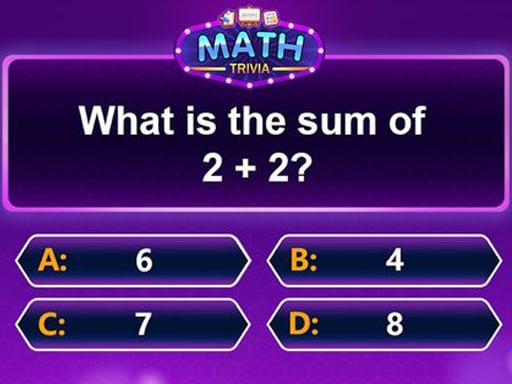
Four options means a one-in-four chance of being right while knowing nothing.
Over twenty questions, pure guessing scores five. So eight out of twenty is not "forty per cent" of anything — it is three questions above a cat walking on the keyboard. A six is indistinguishable from chance. You need somewhere around eleven or twelve before the number is evidence.
No game will tell you this, because a raw percentage looks better on the results screen. But if you want to know where you actually stand, subtract the quarter first, then decide whether to be pleased.
What the tag holds
Eighty-four games carry the quiz tag in this catalogue. Thirty-six have quiz, trivia or guess in the title.
The others arrived through a side door: a paper-folding puzzle, a reaction game, a bird-flinging game. They pose the player a question in the loosest sense and somebody decided that was enough. The grid below drops the worst of it, but the shelf stays mixed.
What is genuinely here falls into three families. Multiple-choice general knowledge, which is the default. Recognition quizzes — a flag, a logo, a song clip, a game cover — which are the purest form of the recognition point above, since the answer is literally shown to you. And competitive quizzes, where other people are answering at the same time, which is the most interesting of the three because it makes the clock visible: it stops being you against the timer and becomes you against somebody who already knew.
Questions people ask
What counts as a good score?
It depends on how many options there are, and almost nobody adjusts for it. With four choices you get one in four right knowing nothing at all, so twenty questions gives pure chance an expected score of five. Eight out of twenty is therefore not forty per cent of the knowledge — it is three questions above guessing. You need roughly eleven or twelve before the score means anything.
Why do I recognise answers I could never have produced?
Because recognition and recall are genuinely different jobs for the brain, and recognition is far easier. Seeing the right answer among four is a matching task; producing it from nothing is a retrieval task. Almost every quiz here is multiple choice, which is why they feel flattering — and why a quiz with a typed answer box feels brutally hard by comparison.
The questions start repeating.
Yes, and that is the ceiling of the genre in a browser. A question bank is expensive to write; most of these have a few hundred, not tens of thousands. After an hour you will start recognising questions rather than answering them.
Do they work on a phone?
Often, and we mark which. Quizzes lose less than almost any genre in the move to touch — you read, you tap. What breaks is a tight timer over long text, because reading is slower on a narrow screen.