About Correct Math
Every question in Correct Math offers you three numbers. One is right. The other two are the right answer minus two and the right answer plus two — always, in every phase, for every operation. Put the three in order and the correct one sits in the middle every time. We generated 200 questions straight out of the running game to check, and the pattern held for all 200. A child can top the score table here without adding anything.
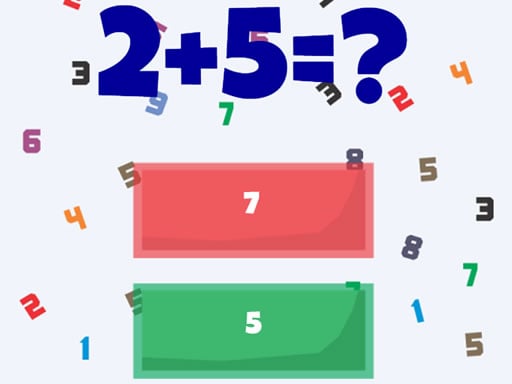
That is worth knowing before anything else, because Correct Math is sold as an educational game and the rest of it is built with more care than the answer generator. A sum appears in 110-point type across a tall portrait screen. Three fat buttons — red, green, orange — sit underneath. A red counter at the top starts at 3 and ticks down. Tap the right button and you score a point and the next sum appears with no pause at all. Tap a wrong one, or let the counter reach zero, and the run is over. There are no lives.
The clock is the whole design. Three seconds is not long enough to count on your fingers past the easy sums, and because the countdown runs on its own one-second cadence rather than restarting with each question, the window you actually get is somewhere between two and three seconds. The sums are small: both numbers are always whole numbers from 1 to 8, so the hardest thing the game will ever ask you is 8 × 8.
Correct Math is a Construct 2 build carrying G8 Games branding — the splash screen shows a "G8 GAMES" logo and the menu's More button opens g8-games.com with a campaign tag naming this game. Its distributor, GameMonetize, credits a different account (newgamess), so the authorship is not settled; we go with what is inside the file. It went up on GameMonetize on 26 March 2021, and the build served today was uploaded on 12 November 2021 according to its own HTTP headers. Nobody publishes a rating for it, so we will not invent one.
The difficulty curve changes the operator, never the numbers
Correct Math has four phases, keyed to your score rather than to a timer or a level select. The whole progression, read out of the game's own event sheet:
| Score | Operation | Operands | Hardest possible question |
|---|---|---|---|
| 0–9 | Addition | 1–8 | 8 + 8 = 16 |
| 10–19 | Subtraction | 1–8 | 1 − 8 = −7 |
| 20–29 | Multiplication | 1–8 | 8 × 8 = 64 |
| 30+ | Random mix of all three | 1–8 | 8 × 8 = 64 |
The numbers never grow. A player 100 points into a run is answering the same 1-to-8 sums as a player on their second question, so once you know your eight-times table the game can only test tapping speed. The second consequence matters more if a young child is playing: subtraction is not bounded to positive results. From the tenth correct answer onwards you start seeing 5 − 6, 2 − 4 and 1 − 6, with answer sets like −7, −5, −3. In the US Common Core, negative numbers are not introduced until grade 6 (standard 6.NS.C.5) — a seven-year-old drilling addition facts meets them here around their tenth right answer.
Three seconds is the line researchers draw between remembering and working it out
Research on arithmetic fact fluency distinguishes two ways a child can produce "56" when shown 7 × 8. They can retrieve it — the answer arrives as a single remembered fact — or they can compute it, by counting, doubling, or working from a fact they already own. Mark Ashcraft's chronometric studies of mental arithmetic found the difference is visible in the clock: children who are still counting take longer, and take longer in proportion to the size of the numbers, while children who have moved to direct retrieval drop from over three seconds to under one second on average. Laboratory measurements of true retrieval put it at roughly 400 to 900 milliseconds.
Three seconds is therefore a generous line, not a strict one. Isaacs and Carroll noted in Teaching Children Mathematics that a two-or-three-second criterion deliberately "allows enough time for students to use efficient strategies or rules for some facts". Correct Math sits on that boundary: you can survive 2 + 3 by counting, and you cannot survive 7 × 8 that way. The clock quietly sorts the facts a player owns from the ones they are still assembling.
What the game does with that information is where it parts company with the research. Hasselbring, Goin and Bransford's 1988 study of computerised drill used the same idea, calling it a controlled response time: start at three seconds, work down to about 1.25. But their procedure had a second half — when the time ran out, the student was given the answer and the same fact was presented again until they produced it inside the window. Correct Math inverts that. Miss on time and it flashes the right answer for three seconds, then ends your run; tap the wrong button and it never shows you the right one at all. The same authors were blunt about what happens without the loop: typical computer drill rarely produces the shift to memory retrieval, and the speed gains are often just children becoming faster counters.
Two smaller mismatches are worth naming. Choosing between three printed numbers is a recognition task, and the testing-effect literature (Kang, McDermott and Roediger, 2007) finds recall formats generally produce larger retention gains than multiple choice. And the phases are blocked — ten additions, then ten subtractions, then ten multiplications — where Rohrer, Dedrick and Stershic's classroom experiment with 126 seventh-graders found interleaved practice beat blocked practice 74% to 42% on a test thirty days later. Correct Math does have an interleaved phase; it starts at 30 points, which means thirty correct answers in a row without a miss.
None of that makes the game harmful, and the popular claim that timed drills cause maths anxiety is contested rather than settled — Jo Boaler argues it in Teaching Children Mathematics, while the underlying evidence (Ramirez, Gunderson, Levine and Beilock, 2013) found the anxiety-achievement link in early primary held only for children with higher working memory. The honest summary is narrower: this is a stopwatch, not a teacher. It can show you which facts a child already half-knows. It will not put new ones in.
Playing Correct Math unblocked at school
The reason a game like this ends up in American classroom-portal search results is mechanical. It is one HTML page, a jQuery file and a 680 KB Construct 2 runtime — no plugin, no installer, no login — so it loads on a school Chromebook the way a news article does, which is what "unblocked" usually means in practice. The 480×800 portrait build helps too: it fills a phone screen edge to edge and letterboxes politely on a laptop instead of cropping the counter off the top, a failure we have seen in plenty of games laid out for landscape.
The catch is the advertising. The build calls the sponsor's ad function when you press Play and again on every Try Again?. On the day we tested, that produced a full-screen playable advert for another game with a Google Play link attached. Because a beginner's run genuinely can last three seconds, a child who keeps hitting retry will spend more time in adverts than in arithmetic. If you are handing this to a class, check that first.
More number games on Mavagames
If the three-second guillotine is too much, Math Kids covers the same ground without a countdown. Easiest Maths is the closest relative — a multiple-choice quiz aimed at under-tens that adds number patterns — and Find the Missing Number uses the same portrait 480×800 frame and the same beat-the-clock format, but asks you to complete a sequence rather than a sum, which is a different kind of thinking. For pure pace, try Math Speedrunner.
The rest of the shelf is in Kids games.
How to play Correct Math
- Press Play. A sponsor advert fires first, and the same call runs again on every "Try Again?".
- Read the sum. It sits in dark blue across the middle of the screen, over an animated background of floating digits that does the reading no favours.
- Tap one of the three buttons before the red counter reaches zero. Correct scores a point and the next question replaces it instantly.
- Keep going until you miss. One wrong tap or one expired counter ends the run and shows your score, plus "New Highscore!" in amber if you beat your best.
Things worth knowing before your first run:
- The colours mean nothing. Green is not "correct" and red is not "wrong". The right answer lands on each button about equally often — in our 200 samples, 67 times on top, 78 in the middle, 55 at the bottom.
- The counter starts the instant the question appears. No ready screen, no first-question grace. Look away while the layout loads and you get a game over with a score of zero, which is exactly what happened to us.
- A wrong tap tells you nothing. The button you hit flashes for three seconds and the run ends. The right answer is only ever shown when you run out of time, never when you guess wrong.
Controls
| Click / tap an answer button | Lock in that number. Correct scores a point and the next question appears instantly; wrong ends the run |
|---|---|
| Play (menu) · Try Again? (game over) | Start a run. Both buttons also fire the sponsor's ad call, so expect an advert before the first question |
| Home (game over) | Return to the menu, where your best score is stored in the browser |
Features
- Two operands drawn from 1 to 8 every time — 1+8, 5-4, 8x7 — with no larger numbers at any stage
- A 3-second countdown per question that never pauses; letting it reach zero ends the run outright
- Three answer buttons holding the correct result, that result minus 2 and that result plus 2
- [object Object]
- Subtraction is unbounded, so negative answers such as 2-7 = -5 appear from the tenth correct answer onwards
- [object Object]
- Best score saved in the browser under localStorage key "highscore", so it survives a page reload but not a cleared cache
Game details
- Developer
- G8 Games
- Release date
- March 2021
- Last updated
- November 12, 2021
- Added here
- March 2023
- Technology
- HTML5 (Construct 2, 480×800 portrait)
- Platforms
- Browser (desktop), Browser (mobile & tablet, touch), Chromebook
FAQ
What is Correct Math?
It is a free browser arithmetic drill built in Construct 2. A sum appears at the top of a 480x800 portrait screen, three numbered buttons sit below it, and you have three seconds to tap the right one. Every correct answer is worth one point and the first mistake ends the run.
Is there a trick to Correct Math?
Yes, and it is built into the code. The three buttons always hold the correct answer, the correct answer minus two, and the correct answer plus two. Sorted by value the right answer is therefore always the middle number, which we confirmed across 200 generated questions. Tapping the middle number wins every time without doing any arithmetic.
How much time do you get per question in Correct Math?
Three seconds. The countdown is a global variable called MAX_SECONDS set to 3, and it is decremented by a timer that runs on its own one-second cadence rather than restarting with each question, so in practice the window is between two and three seconds.
What kind of maths does Correct Math cover?
Addition, subtraction and multiplication, in that order. The feed description mentions only addition and subtraction, and the title screen art shows a division sign, but division is never generated. Both operands are always whole numbers from 1 to 8, so the hardest question in the game is 8x8.
Does Correct Math get harder as you play?
Only in one way. The numbers never grow. What changes is the operator - addition until 10 points, subtraction from 10 to 19, multiplication from 20 to 29, and a random mix of all three from 30 onwards. Reaching that mixed phase means 30 correct answers in a row without a single mistake.
Is Correct Math good for learning times tables?
It is practice, not teaching. It gives no worked answer when you tap the wrong button, it only ever asks you to recognise a number rather than produce one, and the middle-answer pattern lets a child score without calculating. Research on computer drill (Hasselbring, Goin and Bransford, 1988) found that practice of this kind rarely produces automatic recall on its own, so treat it as a stopwatch for facts a child already half-knows.
Who made Correct Math?
The build itself is branded G8 Games - the splash screen carries a G8 GAMES logo and the More button opens g8-games.com with a campaign tag naming this game. GameMonetize, which distributes it, credits an account called newgamess instead. We name G8 Games because the branding is inside the file, but the two sources do not agree.
Can you play Correct Math unblocked at school?
It is a plain HTML5 page with no plugin, no download and no account, so it runs on Chromebooks and locked-down school browsers wherever the host is reachable. It is a portrait 480x800 build, so it fills a phone screen and sits in a tall column on a laptop.