





About Find the Rule
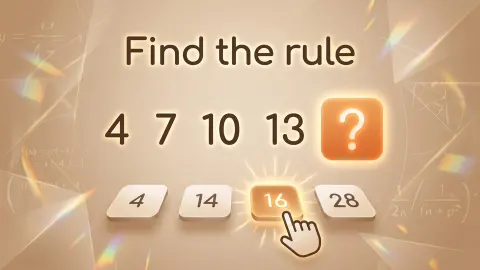
Most number puzzles ask whether you can do the sum. Find the Rule asks whether you can see it. A row of numbers, a question mark at the end, four answers underneath, and the whole job is to say what turns each number into the next. The arithmetic is easy. Noticing what to add is the game.
It opens gently. The first row climbs by two and the right answer is the one anybody would guess. A few minutes later the drops are getting bigger as the row falls, one puzzle hands you 100, 81, 64, 49 and waits for you to recognise what those numbers are, and the four buttons underneath have stopped being generous.
Find the Rule is made by 27Studio and was listed at the end of last August. We played it for ten minutes without stopping, long enough to finish three chapters and carry on past them, and everything below comes out of that run.
The wrong answers are answers to a rule that is nearly right
This is the thing nobody tells you about Find the Rule, and it changes how you play. The three wrong buttons are almost never random. Each one is what you get by following a rule that is close to the real one.
Two rows from our run, side by side:
| The row | The answer | The three decoys, and the rule behind each |
|---|---|---|
| 6, 10, 14, 18 | 22 | 21, the gap made one too small · 23, one too big · 26, the number after the answer |
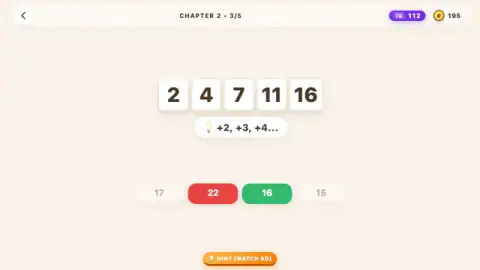
| 2, 4, 7, 11 | 16 | 15, the last gap repeated · 17, the gap grown too fast · 22, the number after the answer |
We pressed a red button on both. The first row climbs by a fixed step and the second grows by one more each time, and yet the traps underneath them are built the same way: one option repeats the last gap, one pushes it too far, and one belongs to the step after the one you were asked for.
So when two buttons both look possible, name the rule behind each. Those three questions sort nearly every case, and whatever survives them is the answer that fits every gap in the row, including the first.
Five steps a chapter, and what gets harder
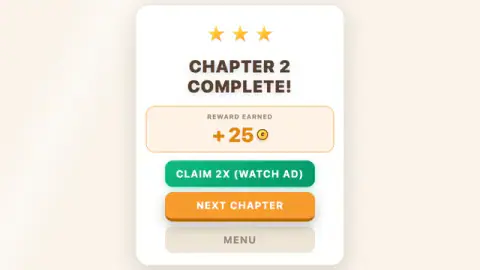
The header tells you where you are at all times, in the form CHAPTER 2 · 3/5. Five steps closes a chapter; a card appears with three stars, a coin reward and a button to move straight on. The rules themselves climb in layers:
| Chapter | What the rules did | A row we met |
|---|---|---|
| 1 | One fixed step, the same every time, up or down | 7, 9, 11, 13 → 15 |
| 2 | Gaps that grow, and rows that double | 2, 4, 8, 16 → 32 |
| 3 | Drops that grow as the row falls, and square numbers | 100, 81, 64, 49 → 36 |
The first chapter is warm-up arithmetic, and we cleared it with one miss. The second is where rows start doubling and the gaps stop being constant, and we got stuck on the same step four sequences in a row. The third asks you to track two things at once, the size of the drop and how fast that drop is growing.
And it keeps going: the chapters did not run out in ten minutes of play, and the five-step shape never changed.
The IQ badge, the coins and the price of a third hint
Two counters sit in the top right corner and never leave. The purple one says IQ and starts at 97, just under the average of a real intelligence scale; the yellow one counts coins from a round hundred. They climb together, which is the tell: both are a record of how far you have come, not of how well.
A solved row pays ten coins and about two points of IQ. Finishing a chapter pays twenty-five coins on top, with a green button offering to double that in exchange for an ad. Over three chapters ours went from 97 to 121 on the badge and from 100 to 260 in coins. Neither one ever went down when we answered wrong.
The hint button is the one thing you can run out of. It starts as HINT (2), drops to HINT (1) when you spend one, and then becomes HINT (WATCH AD) for good. What you buy with it is the rule, written plainly in a little lightbulb tag under the row before you choose: "+4", "× 2", "+2, +3, +4…". The useful part is that a wrong answer shows you exactly the same tag for nothing, which makes a miss almost as instructive as a hint.
That is also where the ads live. There is the one that doubles a chapter reward, the one that buys a hint after the free two, and a card that slid up after we missed a step, headed "SAVE YOUR STREAK!", offering an ad to rescue the attempt. Each was attached to something extra rather than to the game itself, and each came with a way to say no.
"Find the rule" in maths class
If you arrived here from homework, you are in the right place. "Find the rule" is a standard instruction in primary school maths, and it means exactly what this game asks: look at a pattern and say what turns one number into the next. In the US Common Core it sits in grade 4, where pupils make number patterns that follow a given rule and then notice features of the pattern the rule never mentioned.
Teachers show one method for it, and it is the method that works here too. Write the differences, the gaps between neighbouring numbers, underneath the row. If every gap is the same, the rule is add or subtract that gap, which mathematicians call an arithmetic sequence. If the gaps themselves grow by a fixed amount, there is a second layer under the first, which is chapter two. If each number is the one before it multiplied by the same thing, it is a geometric sequence, which is what the doubling rows are.
The falling row of 100, 81, 64, 49 rewards a different habit. Its gaps shrink steadily, so the differences method does reach the answer in the end, but it is quicker to recognise the square numbers running backwards from ten squared and take the next one down. Knowing your squares by sight is worth as much here as your times tables.
What the game never does is the other kind of find-the-rule exercise, the input and output table, where one column of numbers becomes another through a machine. Every puzzle here is a single row read from left to right.
Who it is for
Find the Rule suits children who already add, subtract and know their times tables and want practice that does not feel like a worksheet, and adults who want a quiet puzzle with nothing ticking. The first chapter is comfortable for a confident eight-year-old. The third made us write the gaps out on paper.
It is not a broad brain-training app: every puzzle we met was a row of whole numbers, with no shapes and no reading beyond one line. The game's page also describes a daily challenge timed against other players, which we did not open, and we never found anywhere to spend the coins.
More number puzzles
Correct Math is the opposite temperament: one sum, three answers and a few seconds to decide. Math Squares drills the square numbers that chapter three quietly expects you to know, and Slide and Divide turns division into a sliding tile puzzle. Block Blast 2048 is the calm option for merging numbers rather than predicting them. Every other sequence, sorting and logic game we carry sits in the puzzle category.
Screenshots
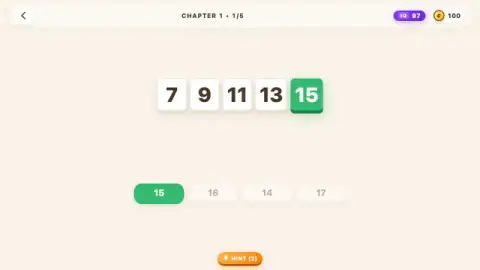
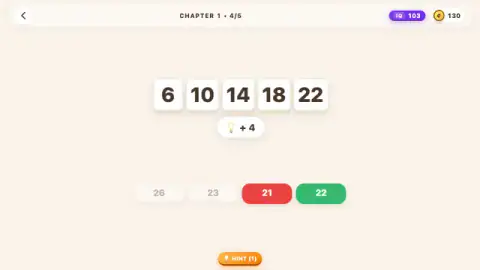
Taken by opening the game ourselves and letting it run — not supplied by the publisher, and not the same picture every other site shows.
How to play Find the Rule
- Read the row from left to right and look at the gaps between the numbers, not the numbers themselves.
- Say the rule to yourself in words: "add two", "the jump grows by one each time", "double it".
- Apply it to the last number in the row and find that result among the four answers.
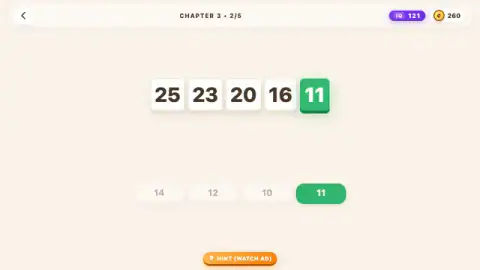
- Click or tap it. The button turns green, and the number drops into the row in green.
- Clear all five steps to finish the chapter, collect the reward and open the next one.
Tips from our run:
- Nothing is counting down. There is no clock on the chapter screen, so there is no reason to guess. The ten seconds it takes to check the rule against every gap are free.
- Check the first gap, not just the last. Most of our misses came from reading the end of the row and assuming the start matched.
- Save your two free hints. The button literally counts them down, and once they are gone it wants an ad. The first chapter does not need them.
- A miss is a free lesson. Answer wrong and the game writes the rule you missed under the row, then puts you back on the same step with a fresh sequence of the same kind. Read that tag before you carry on, because the replacement will test the same idea.
Controls
| Click or tap an answer | Picks one of the four numbers under the row; the game checks it at once |
|---|---|
| HINT button | Writes the rule under the row before you answer; two are free, after that the button asks you to watch an ad |
| Keys 1, 2, 3, 4 | According to the game's instructions, pick the first to fourth answer from the keyboard |
| Esc | According to the game's instructions, closes menus |
| Back arrow (top left) | Leaves the current chapter |
Features
- A row of numbers ending in a question mark, and four possible answers underneath
- Chapters of exactly five steps, counted in the header as "CHAPTER 2 · 3/5"
- Wrong options built from believable wrong rules, so picking the nearest number rarely works
- Two free hints that spell the rule out in a lightbulb tag before you commit
- A miss costs you the step and nothing else, and the game tells you the rule you missed
- An IQ badge and a coin counter that climb together, ten coins a step and twenty-five a chapter
- No clock anywhere in chapter mode, so a hard row can take as long as you need
Game details
- Developer
- 27Studio
- Release date
- August 2026
- Last updated
- September 1, 2026
- Added here
- August 2026
- Technology
- HTML5 (2D)
- Platforms
- Browser (desktop), Browser (mobile & tablet, touch)
- Classification
- Educational , Puzzle
- Saved progress
- Saving, when available, is managed by this game. Mava cannot confirm your level.
FAQ
How do you play Find the Rule?
Each step shows a row of numbers ending in a question mark and four answers below it. Work out what happens from one number to the next, then click or tap the number that continues the row. Five correct answers finish a chapter and open the next one.
How many puzzles are in a chapter of Find the Rule?
Five. The header counts them as "CHAPTER 2 · 3/5", so you always know how far you are from the end of the chapter. Finishing all five brings up a card with three stars and a coin reward, and the next chapter starts straight after it.
How many free hints do you get in Find the Rule?
Two per run. The button at the bottom starts as HINT (2) and counts down to HINT (1) as you spend them; once both are gone it changes to HINT (WATCH AD). A hint writes the rule in a small lightbulb tag under the row, such as "+4" or "+2, +3, +4...", before you answer.
Is the IQ score in Find the Rule a real IQ test?
No. It is a game score. It starts at 97 and goes up by about two points for every row you solve, and in our run it never went down after a wrong answer. It measures how far you have played rather than how clever you are.
What are the coins for in Find the Rule?
Each solved row pays ten coins and finishing a chapter pays twenty-five more, with an offer to double the chapter reward by watching an ad. We played for ten minutes and never found a shop or anything to spend the coins on, so for now they work as a second progress counter.
What happens if you get an answer wrong in Find the Rule?
Your pick turns red, the right answer turns green, and a tag under the row states the rule, for example "× 2" or "+1, +2, +3...". You stay on the same step and get a new sequence of the same kind. A miss can also bring up a card offering an ad to save your streak, which you can decline.
What does "find the rule" mean in math?
In school maths it means looking at a pattern of numbers and saying in words what turns each number into the next one, such as "add 4" or "double it". It is part of the US Common Core for grade 4, which asks pupils to make and explain number patterns that follow a given rule. Writing the gaps between the numbers under the row is the usual way to find it.
Who made Find the Rule?
Find the Rule is made by 27Studio. It was published in August 2026, updated in September 2026.