




About Love Story: Find the Piece
Hidden-object games usually hand you a list. Twelve things to find, a scene stuffed with four hundred objects, and a magnifying glass. Love Story: Find the Piece gives you neither the list nor the clutter. A level here is two cartoon figures standing on a blank white page, drawn in plain lines, with a thin floor line behind their knees and nothing else in the room. Above them, in black type, sits a single question. That is the whole brief.
The questions are short and they are about people, not objects. "What did she steal?" is one. "What does he want to give?" is another. A blond man in a green T-shirt stands opposite a woman with pink hair who is holding something with colour in it; the question asks what she took, and the colour in her hands is the only thing on the page that is not a plain outline. You answer by pressing on the picture. When you press the right thing, the scene is redrawn and a NEXT button appears underneath it, and the next couple walks on.
The game is credited to Ahs S, who also made Draw or Delete LoveStory. It was published in February 2026.
Now the part most pages leave out. We played for ten minutes with a mouse, solved a scene, pressed NEXT and then failed completely on the one that followed. Roughly half of what crossed the screen in that sitting was not the game at all: it was an advert break. Both of those things shape what playing this actually feels like, so both are on this page.
Five words instead of a tutorial
Most free puzzle games open with a hand icon, an arrow and a pulsing circle showing you exactly where to press. The scenes we played opened with a sentence of four or five words and nothing else, and that sentence has to carry everything: what kind of answer counts, where to look, and what the joke is going to be.
It works because of the kind of question it asks. "What did she steal?" is not a search instruction, it is an accusation. It makes you read two faces and build a small story — he is offering her something, she is holding something back — and the thing you press is whatever completes that story. The puzzle is in the sentence; the drawing only confirms whether you understood it.
The cost of that elegance is that a level can lock you out entirely. If you read the question one way and the artist drew it another, there is no partial progress, no warmer-or-colder feedback and no second clue. You press, nothing happens, and you press somewhere else. That is exactly how our sitting ended.
What the screen actually shows
There is less on screen than in almost any puzzle game of this kind, and knowing what the few marks mean saves you from hunting for tools that do not exist.
The scene fills the middle of the page: two figures, the question above them, and a thin horizontal line crossing at waist height that reads as a floor. A small green counter sits in the top-left corner and a round, sand-coloured icon in the top-right. Under the scene is one round button carrying a cluster of small coloured shapes.
We left the two corner marks alone, we never saw the counter reach anything, and the round button under the picture did nothing for us. So here is the honest boundary of this page: the scene and the question are the game as we played it, and if any of those three controls hides a hint system, we have not seen it work.
A hidden-object game with the list taken away
Wikipedia defines a hidden object game as a puzzle in which the player must find items from a list that are hidden within a scene. The idea is older than computers, and it comes from print — the I Spy picture books, and the hidden-picture pages of the magazine Highlights for Children, where readers hunted for objects tucked into crowded drawings.
Screens took it up early. Mother Goose: Hidden Pictures appeared for the CD-i in 1991, and Scholastic published video game versions of I Spy from 1997. The template for the whole modern genre was set by Mystery Case Files: Huntsville, published by Big Fish Games in 2005, which paired cluttered scenes with a list and a story.
Set against that history, this game throws away both halves of the definition. There is no list, only a question. There is no crowded scene, only two people on an empty page. What remains is the part of the genre that was always the good bit: working out what you are supposed to be looking for. The clutter was never the puzzle, it was the padding — and a game with four hundred objects removed turns out to still have a puzzle in it.
The advert breaks, and when they come
This is the single thing you should know before you start. Over our sitting, the breaks came about as often as playable screens did. They take two forms. One is a placard reading "the ad" that covers the middle of the picture while an advert plays. The other is a notice that says "Oops! No ads available right now", with a "Continue playing" button that puts you back in the scene — an interruption that delivers no advert at all.
The good news is that the puzzle is patient. Nothing on screen is timed, so a break never costs you a level, only your train of thought. The bad news is that a riddle made of one sentence and two drawings is exactly the kind of puzzle you solve by staring, and staring is what gets interrupted. If you can, give it a run of a few minutes rather than one level at a time.
Who it is for
It suits anyone who likes a joke built into a puzzle and does not want a clock. The reading is one short English sentence per level, which makes it usable by younger players and by people reading English as a second language. The humour is about couples: flirting, suspicion, small betrayals. If what you want is a big scene to comb through or a score to beat, this is not that game.
More picture riddles to try next
The same developer made Draw or Delete LoveStory, where a scene is solved by rubbing something out or drawing something in. Delete it: Erase One Part is another one-line riddle answered with an eraser. For the classic sort of search, Find The Dog hides dogs in a black-and-white street, and Find Out Hidden Object gives you both the list and the clutter this game does without. The rest are under puzzle games.
Screenshots
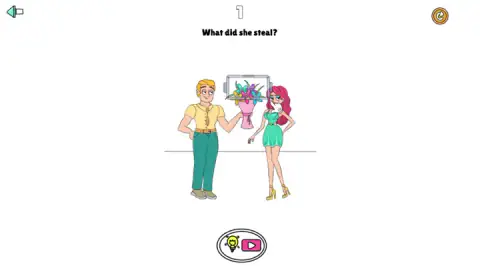
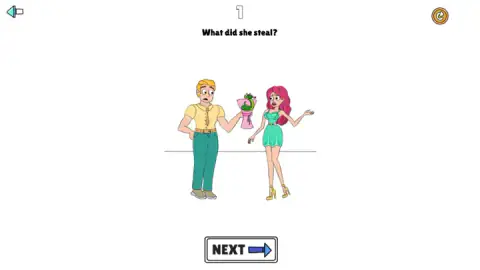
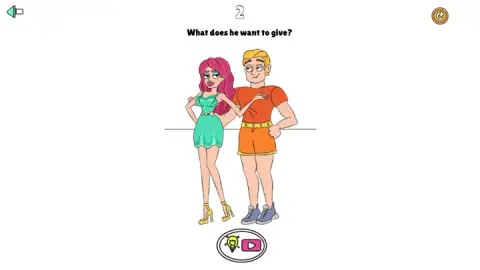
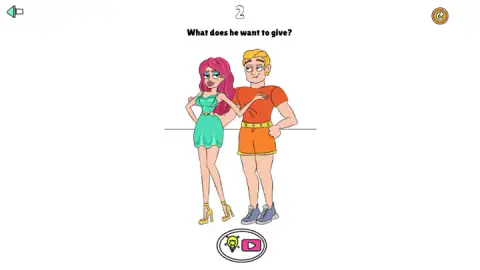
Taken by opening the game ourselves and letting it run — not supplied by the publisher, and not the same picture every other site shows.
How to play Love Story: Find the Piece
- Read the question at the top. It names one of the two characters — "she" or "he" — and that is the only instruction the game will ever give you.
- Look at the pair. Who is holding something, who is hiding a hand, who is looking away. The drawing is a tiny scene from a relationship, and the answer is part of that scene.
- Press the thing that answers the question. Not the person: the thing. A wrong press does nothing at all, so you can try as many as you like.
- Press NEXT. When you are right, the picture is redrawn and the button appears under the scene. That is the only confirmation you get.
What our sitting taught us:
- Follow the colour. In line art this plain, a patch of colour is a decision somebody made. The object in the pink-haired woman's hands was the loudest thing on the page in the scene that asked what she stole.
- The question is a filter, not a hint. "What does he want to give?" rules out her half of the drawing before you press anything. Reading it twice is faster than pressing twenty times, which is the mistake we made.
- Nothing is counting. No clock, no lives, no score. We pressed dozens of wrong spots and the scene waited.
- The round button under the picture did not rescue us. We pressed it again and again on the scene that beat us, and the level did not move.
- Expect to be interrupted. Plan on stopping about as often as you play, because that is the rhythm the adverts set.
Controls
| Click or tap on the picture | How you answer. Press the part of the drawing that answers the question at the top |
|---|---|
| NEXT button | Appears under the scene once a level is solved, and brings on the next couple |
| Round button under the scene | Holds a cluster of small coloured shapes. We pressed it many times and the level never moved |
| Green counter (top left) | A small number in the corner. We did not press it and cannot say what it counts |
| Round sand-coloured icon (top right) | Not pressed in our session |
Features
- One drawing and one written question per level, with no list of objects to tick off
- Flat line-art scenes on a plain white page: two people, a floor line, nothing else to comb through
- Questions written as plain English sentences, such as "What did she steal?" and "What does he want to give?"
- A solved scene is redrawn and hands you a NEXT button
- No timer, no lives and no score on the scenes we played
- Advert breaks about as often as playable screens, some of them with nothing to show
- Credited to Ahs S
Game details
- Developer
- Ahs S
- Release date
- February 2026
- Last updated
- August 10, 2026
- Added here
- December 2025
- Technology
- HTML5 (2D)
- Platforms
- Browser (desktop, mouse), Browser (mobile & tablet)
- Saved progress
- Saving, when available, is managed by this game. Mava cannot confirm your level.
FAQ
How do you play Love Story: Find the Piece?
Each level draws a couple on a white page with a question written above them, such as "What did she steal?". You answer by pressing the part of the picture that answers that question. Get it right and the scene is redrawn with a NEXT button under it, which brings on the next couple.
What are the instructions in Love Story: Find the Piece?
The question at the top of the scene is the whole instruction. There is no list of objects, and in the scenes we played nothing marked the spot for you, so reading the sentence carefully is the game rather than a preamble to it.
What questions does Love Story: Find the Piece ask?
They are short English sentences about what one of the two characters is up to. The two we met were "What did she steal?" and "What does he want to give?". Each one points at one person in the drawing, which is the clue to where you should be looking.
How many levels does Love Story: Find the Piece have?
We cannot say. We solved a level, pressed NEXT and got stuck on the next one inside a ten-minute sitting, and nothing on screen showed a total. A small counter sits in the top-left corner, but we never saw it reach an end.
Is there a penalty for a wrong guess in Love Story: Find the Piece?
We saw none. Dozens of wrong presses went by on the scene asking "What does he want to give?" and nothing happened: no timer started, no lives disappeared and no score moved. A wrong press simply does not register.
Does Love Story: Find the Piece have adverts?
Yes, and often. Across our sitting, roughly half of what we saw was an advert break rather than the game: a "the ad" placard over the scene, or a notice reading "Oops! No ads available right now" with a "Continue playing" button to get back in. The puzzle itself is never on a clock, so a break costs you nothing but patience.
What is the button under the picture in Love Story: Find the Piece?
A round button sits under the scene with a cluster of small coloured shapes on it, which looks like a picker of some kind. We pressed it repeatedly and the level stayed exactly where it was, so we will not tell you what it does until we have seen it work.
Who made Love Story: Find the Piece?
It is credited to Ahs S. It was published on 15 February 2026. It is listed for PC, Android and iOS; we played it on a desktop computer with a mouse.