




About Mystery of the Old House: Hidden Objects
Most hidden object games show you what you are looking for. A silhouette, a little picture, a shape to match against the clutter. Mystery of the Old House gives you a word and nothing else. Three names sit at the bottom of the screen, and turning each word into a shape is your job.
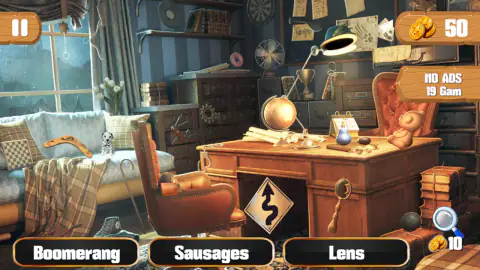
That sounds like a small difference. It is the whole game. "Lens" could be spectacles, a camera, a telescope. In the study we played, it was none of those: the lens hangs on the front of the desk like a drawer pull, a wooden-handled magnifier that reads as furniture.
We know where it is. We have clicked it before. And on our long visit we still did not clear it: ten minutes in that room, the magnifier in plain view at the edge of the desk, and the word was still sitting on its plate when we stopped. That is the honest measure of this game. Knowing the answer and seeing the answer are two different things when the picture is this busy.
The game is by CarrotHood and has been available since August 2025. Everything below comes from two visits to the same room.
A queue of three names, and the one that never moves
The list is a queue. It holds three names, and every time you clear one another takes its place. Both of our visits opened on the same three plates: Boomerang, Sausages and Lens. On the long one the queue then ran Penknife, Ball and Machete through the left-hand slot while we worked.
Look at the middle plate through all of that. Sausages never moved. It was there at the first click and still there ten minutes later, with other names coming and going around it. We never found them, in either visit.
That is the quiet trick of the queue. A name you cannot find does not block the others, so you keep making progress around it, and it also never leaves. Sooner or later you have to deal with it, either by searching harder or by paying.
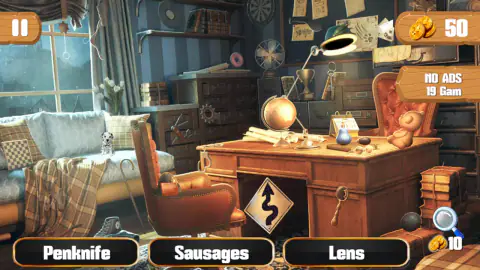
The room is worth describing, because it is the whole board. It is an old study with rain on the window, a striped blue wall, a sofa with a tartan blanket and a toy Dalmatian, a leather armchair with a teddy bear in it, and a big wooden desk under a lamp. There is a globe, a dartboard, an old fan, a trophy, a wall of little drawers, a stack of books tied with string and a road sign leaning under the desk. Any of them could be the next name. Most are there to make the real ones harder to see.
What a hint costs, and what the game does when you run out
The hint button is a blue magnifying glass at the bottom right with a coin badge marked 10. Press it and a white burst of light appears over one of the items on your list. The first time we used it, the light landed on the penknife behind the armchair and the counter in the corner dropped by ten.
Here is what surprised us. The penknife did not go anywhere. It was still on the list and still in the drawers a minute later. The hint is a pointer, not a solve: you have to find the spot again and click it yourself.
So the counter is a budget, and a short one. Fifty coins, ten a hint: five hints in the whole sitting. Finding things did not pay us back, and the number stayed where it was each time a name left the list.
Spend it all and the button stops helping. The game raises a wooden card saying there are not enough coins for hints, and offers packs of 20, 200 and 1000 instead. Close that card with the red X in its corner and you can keep searching by eye for as long as you like, for nothing.
Two small things about the trimmings. The coins are gold pieces stamped with a lightning bolt, which is a nice touch in a room full of Victorian clutter. And the wooden sign on the right offers NO ADS at a price the sign itself cuts off mid-word. It is an offer, not a promise: in ten minutes one ad break reached us, announced by a short countdown reading "Ad in 1" and followed by a card asking us to click to keep playing. Our search was exactly where we had left it.
Level 1 is called The Master's Office
The plaque that opens the room gives it a number and a name, and that number is the most interesting thing the game told us. Level 1 implies a Level 2. The title promises an old house, and a house has more rooms than a study.
We never saw one. Two visits, one room, the same desk and sofa every time. Names kept clearing and the plates kept refilling. If there is a door out of The Master's Office, it is further in than our searching took us, and the names standing between us and it were Sausages, Lens and Machete.
So treat the beginning as the whole of what we can vouch for. What the room holds, how the hints work and what happens when the coins run out are all settled. How many rooms the old house has is not.
Words instead of pictures, and why that is harder
The modern hidden object game began with a list of words. Mystery Case Files: Huntsville, released by Big Fish Games in November 2005, is widely credited with starting the genre on home computers, and it asked you to find named items in crowded scenes much like this one.
Words are harder than pictures for a simple reason. A picture tells you the shape, the colour and often the angle. A word tells you only the idea, and the artist chooses which version of the idea to paint. A lens can be a magnifier. Sausages might be a string of them, or one on a plate, or a painted packet on a shelf.
That is why the game's own instructions ask you to play slowly. Rushing gets you nowhere when the problem is not finding a shape but deciding what shape you are looking for. The best habit we found was to say each word aloud and picture three versions of it before scanning the room.
Who it is for
It suits anyone who likes slow, quiet puzzles. There is no clock in what we played, nothing chases you, and a wrong click costs nothing we could see. Younger players can join in, but they need to read: every target is a word, and some of them, like penknife and machete, are not everyday ones.
It is not a spot-the-difference game, and it is not an escape room. You do not combine items or open locks. You read, you look, you click.
More rooms to search
If you want more of the same kind of search, Blackriver Mystery. Hidden Objects and Hidden Object: Clues and Mysteries both send you through scenes full of clutter, and Hidden Objects: Home Sweet Home keeps the house setting. From CarrotHood itself there is HexaSort, a very different puzzle about stacking and sorting coloured tiles. The rest are in our puzzle games.
Screenshots
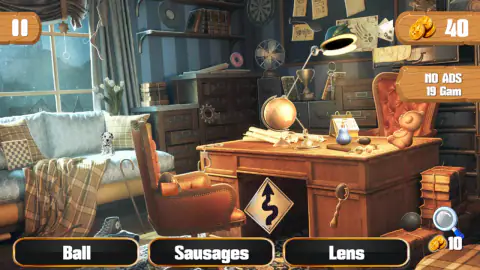
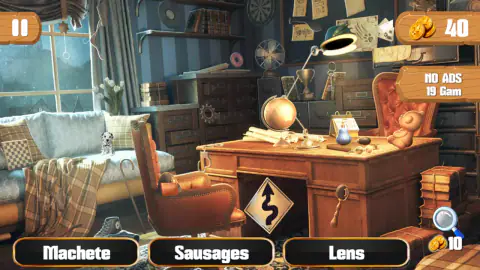
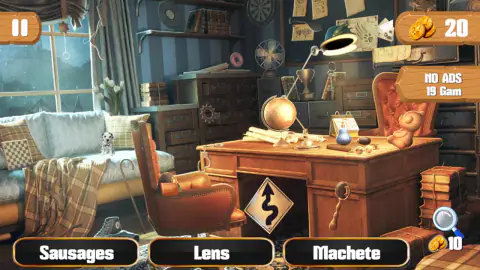
Taken by opening the game ourselves and letting it run — not supplied by the publisher, and not the same picture every other site shows.
How to play Mystery of the Old House: Hidden Objects
- Press the start button on the title card. A wooden plaque names the room, Level 1, The Master's Office, and a prompt asks you to tap once more before the search begins.
- Read the three names on the plates at the bottom. Those are the only items that count.
- Search the painting of the room and click or tap an item when you find it. Its name leaves the list and another slides in.
- If you are stuck, press the blue magnifying glass at the bottom right. It costs 10 coins and flashes a burst of light over one of the items.
Tips from our run
- Things are lying about, not hidden behind anything. The boomerang was flat on the sofa blanket beside the toy dog; the ball was on the floor by the stack of books. Both were in the open, both looked like decoration.
- Think about scale. The penknife was the size of a thumbnail, tucked against a chest of drawers. Small things are drawn small, not enlarged for your benefit.
- The plates swap places on their own while you search, so remember the names, not the positions. We watched the same trio read Machete, Sausages, Lens one moment and Sausages, Lens, Machete the next.
- Tapping the name plates does nothing. Treat them as labels, not buttons.
- The hint shows you where, but it does not pick the item up. After the flash, click the spot yourself.
- Ration your coins. You start with 50, each hint takes 10, and nothing we found put any back.
Controls
| Click or tap an object in the room | Collects it if it matches one of the three names at the bottom |
|---|---|
| Magnifier button (bottom right) | Spends 10 coins and flashes a burst of light over one of the listed items |
| Pause button (top left) | Pressing it changed nothing we could see; the picture never froze or dimmed |
| Arrow keys and Space | Did nothing we could hear or see; this is a mouse and finger game |
Features
- Words, not pictures: the bottom of the screen names three items, and you work out what each looks like
- A new name slides into a slot as soon as you clear one, and the three plates shuffle their order while you search
- Each hint costs 10 coins, so the 50 you start with buy five of them and nothing we found paid any back
- Run the counter to zero and the game offers coin packs of 20, 200 and 1000 instead of hints
- The room is signposted as Level 1, The Master's Office, though ten minutes of searching never took us out of it
- Made by CarrotHood
Game details
- Developer
- CarrotHood
- Release date
- August 2025
- Added here
- June 2025
- Technology
- HTML5 (2D)
- Platforms
- Browser (desktop, mouse), Browser (mobile & tablet, touch)
- Saved progress
- Saving, when available, is managed by this game. Mava cannot confirm your level.
FAQ
How do you play Mystery of the Old House Hidden Objects?
Three item names sit on wooden plates at the bottom of the screen. Find each one in the painting of the room and click or tap it. When an item is found its name disappears and a new one takes its place. There is no clock on screen, so you can search at your own pace.
How do hints work in Mystery of the Old House?
The blue magnifying glass at the bottom right is the hint button, and each press costs 10 coins. A burst of light appears over one of the items on your list. It does not collect the item for you, so you still have to click the spot afterwards.
What happens when you run out of coins?
The hint button stops working and a wooden card appears saying there are not enough coins for hints. It offers packs of 20, 200 and 1000 coins. You can close it with the red X in its corner and carry on searching by eye, which costs nothing.
Where is the lens in Mystery of the Old House?
In the study, the lens is a hand magnifier with a wooden handle hanging from the front of the big desk, just under the desktop. It looks like part of the desk's hardware, which is why it is easy to miss. Clicking it cleared the name from our list.
Where is the boomerang in Mystery of the Old House?
It lies flat on the sofa on the left, across the folded tartan blanket and next to the toy Dalmatian. Nothing covers it. It reads as decoration rather than as a target, which is exactly why most players scan past it.
Where is the penknife in Mystery of the Old House?
It is a red folding knife lying against the chest of drawers behind the leather armchair, next to a metal cog. It is small and close to the same colour as the wood, so it blends in. A hint showed us the spot before we clicked it.
Does Mystery of the Old House have ads?
A wooden sign on the right offers to remove them for a price. In ten minutes of play we were interrupted once, by a short countdown reading "Ad in 1" and then a card asking us to click to keep playing. Nothing was lost; the room was still there underneath.
Is there a time limit in Mystery of the Old House?
We saw no timer and no score counting down in ten minutes of play. The game's own instructions tell you to play slowly, and nothing on screen punishes you for taking your time.
Who made Mystery of the Old House Hidden Objects?
It was made by CarrotHood and has been available since August 2025 with its last update in August 2026.
Can you play Mystery of the Old House on a phone?
It is listed for PC, Android and iOS, and the screen is a wide landscape picture, so turn your phone sideways. We played it on a computer with a mouse and did not test touch.