








About Hidden Paint 3D
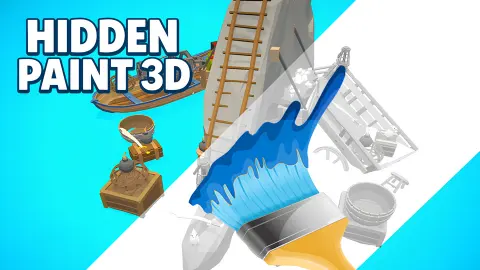
A hidden object game usually hides things in colour: a red scarf on a red sofa, a key among the cutlery. Hidden Paint 3D takes the colour off everything at once. Its scene is a small 3D model in shades of grey, standing on a mound of pale sand against a black background, and the only colour on screen is in the cards along the bottom that tell you what to look for.
Those cards are pictures, not words, and each one shows its object already painted. On our last visit they held a tied sack, a low workbench with a shelf under the top, and a round table on four thin legs. Under each picture sits a counter of how many you have found against how many are hidden, and all three started empty: 0/2, 0/3, 0/3.
Then we found one, and the game finally explained itself. Click the right object and it paints itself where it stands. The round table turned warm brown, top and legs, and stayed brown for the rest of the session. The three stone balls sitting on that table did not. Neither did the small bird-shaped figure standing on the workbench we had found a few minutes earlier. Only the thing on the card takes its colour; whatever it is carrying stays grey.
The game is credited to KreizLand. It was published in September 2025.
Here is the honest size of our acquaintance with it. We have been in this yard three times, and only on the third visit did anything at all turn colour: two objects out of the eight the cards were asking for.
That is why this page cannot tell you what the game does when a card fills, or where it takes you afterwards. What it can tell you is the thing that cost us two earlier sessions to work out: how the game says yes.
The yellow sparks are not applause
This is the trap, and it is the reason two of our sessions ended at zero. The scene throws orange light and rising yellow stars around generously, and none of it means you have found anything.
We watched a screen bright with stars while all three counters sat at zero. The stars come from the spots a hint has lit, and they keep coming for as long as the spot stays lit, which is until you deal with it. Three or four can burn at once, each left behind by an earlier hint.
The receipt is the counter. When our click on the round table landed, the table changed colour and the card under it went from 0/3 to 1/3, and the orange light on that spot went out. That is the whole feedback loop, and it is quiet enough that you can miss it if you are watching the fireworks.
The magnifier holds three hints, not a tally of what is left
The magnifier sits in the top right with a number on it. Untouched, that number is 3 and there is nothing beneath it.
Press it and two things happen at once. In the scene, one spot starts to glow orange and throw off stars. On the badge, the number drops by one and a second number appears below it, starting at 30 and counting down a second at a time. That second number is the wait for a hint to come back; they return one at a time, not all together. It does not stop while the settings window is open, so a trip to the volume sliders is free.
It is tempting to read that badge as the number of objects you still have to find, and it is not. Ours fell to zero and climbed back to three without a single counter moving, and pressing it never produced a list of anything. It is a stack of three favours, and the stack refills whether you deserve it or not.
In practice this makes the game generous. There is no shop, no coin price and no video to watch for a hint, at least none that appeared in any of our sessions. If you are patient, the corner will point at something every half minute for as long as you care to sit there.
The yard stays the same; the shopping list does not
The model shows a wooden hut with a rough roof on a low mound. Around it stand what looks like a cannon on a wheeled carriage, a large barrel, cauldrons on legs, storage jars, a long plank table, crates and a chest. It is the same yard every time we open the game, seen from one fixed angle. We have not tried dragging it, so we cannot say whether it turns.
The list is a different matter. Each of our three visits was handed a different set of cards, with different objects and different totals. So the eight things above are what one round asked for, not the contents of the scene.
The yard is also harder than its soft look suggests, because it is full of near-duplicates: tables, stools, benches and workbenches everywhere, all the same grey, several of them half behind something else. A card showing a four-legged wooden table narrows the search to about a dozen candidates. The round table was the one we got on sight, because its top is the only round one here.
The listing's own page describes another scene with an anchor and a boat. We have not reached it.
Hidden object scenes began as real models
The idea is older than the screen. Wikipedia traces hidden object games to print: the I Spy books and a regular feature in the magazine Highlights for Children, where the reader got a list and a cluttered picture. It names a 1991 title, Mother Goose: Hidden Pictures, as an early video game of the kind.
The I Spy pictures were not drawings. They were photographs by Walter Wick, who, by Wikipedia's account, built each scene by hand and could spend from several days to several weeks on one before photographing it. The object you hunted for was a real thing on a real table.
Hidden Paint 3D ends up in the same place by another road. Its scene is a model too, with objects standing on tables and roofs rather than painted into a flat picture. That is why our two finds felt fair: the table was standing somewhere, carrying its stones, not camouflaged by a trick of the brush. The same Wikipedia article lists a magnifying glass that highlights an item as a standard hint of the genre, which is exactly the tool in the corner here.
Who it is for
It suits anyone who likes to look without being hurried. No clock appeared, a wrong click cost us nothing, and the hints refill by themselves. A child who can match a picture to a shape can play it, since there is nothing to read in the scene and the reward is a thing turning from grey to colour.
It suits less well anyone who wants a story, a score to chase or a busy picture. There is one model at a time and a short list to work through, and, as we have shown, you can spend ten minutes in it and come out with almost nothing.
More games to try next
For hidden objects in flat, crowded pictures, there are Hidden Objects: Island Secrets and Hidden Object: Street Of Secrets. Find the Frog - Hidden Objects and Where Are the Puffies? hide one kind of creature in every scene, which is the easier version of the problem this one sets. If the colouring is what you came for, Coloring by Numbers. Pixel Room is the real thing. The rest are under puzzle games.
Screenshots
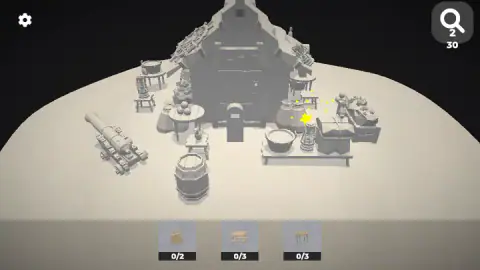
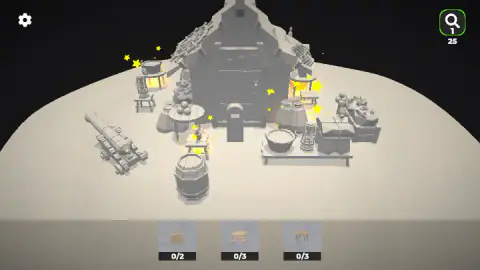
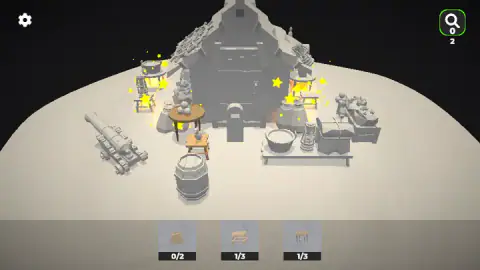
Taken by opening the game ourselves and letting it run — not supplied by the publisher, and not the same picture every other site shows.
How to play Hidden Paint 3D
- Read the cards along the bottom. The picture is the target, in the colour it will be. The second number is how many of that object are hidden in the scene.
- Hunt by shape. Everything in the model is the same grey, so you are matching outlines and proportions, never colours.
- Click the object itself, on the object, not on the ground beside it. It paints itself on the spot.
- Watch the counter, not the sparks. The counter under the card is the only thing that tells you that you were right.
- Press the magnifier in the top right when you are stuck. It lights one spot, and you still have to click what it lit.
What three visits taught us:
- The cards are not buttons. We clicked them more than twenty times between us. Nothing was selected, filtered, zoomed or revealed.
- A wrong click costs nothing. The cannon, the big barrel, the hut's dark doorway, the crates: no counter moved, no hint was taken, nothing flashed in refusal.
- A hint is not a find. The glow marks a place. You still have to click that place, which is the step we kept skipping.
- Look at what is holding what. Both of our finds were pieces of furniture with something standing on them. The clutter on top is a disguise, not part of the target.
- The gear is not a pause you need. It opens the volume sliders. Close it with CONTINUE; pressing Enter did nothing.
Controls
| Click an object that is pictured on a card | The object paints itself in colour where it stands and the counter under that card goes up by one |
|---|---|
| Click anything else | Nothing we could measure happened; no counter moved and no hint was taken |
| Click the magnifier (top right) | Spends one of three hints and lights a spot in the scene with an orange glow and rising yellow stars |
| Click the gear (top left) | Opens a window with a music slider, a sound slider and a CONTINUE button |
Features
- A 3D model shown entirely in grey: a hut on a mound of sand with a cannon, barrels, tables, cauldrons and crates around it
- Three picture cards instead of a word list; the scene we played asked for 2 sacks, 3 workbenches and 3 round tables
- A find is marked in colour: the object paints itself and stays painted for the rest of the session
- What sits on a found object does not paint: the stone balls on our table stayed grey under a brown top
- A magnifier that holds 3 hints and gives each one back after a countdown of 30 seconds
- No clock, no lives and no penalty for a wrong click in any of our three sessions
- Made by KreizLand
Game details
- Developer
- KreizLand
- Release date
- September 2025
- Last updated
- August 10, 2026
- Added here
- July 2025
- Technology
- HTML5 (Unity WebGL)
- Platforms
- Browser (desktop, mouse), Browser (mobile & tablet, touch)
- Saved progress
- Saving, when available, is managed by this game. Mava cannot confirm your level.
FAQ
How do you play Hidden Paint 3D?
You look at a 3D scene drained of colour and click the objects pictured on the cards along the bottom of the screen. Each card carries a counter such as 0/3, which is how many of that object you have found out of how many are hidden in the scene. A correct click paints the object where it stands and moves that counter up by one.
How do you know when you have found something in Hidden Paint 3D?
By colour, and only by colour. The object you clicked turns from grey to painted wood and stays that way, and the counter under its card goes up. The yellow sparks flying around the scene are not proof of anything: we spent most of one session with the screen full of them and every counter still at zero.
How do hints work in Hidden Paint 3D?
The magnifier in the top right corner holds three hints. Clicking it spends one and lights a spot in the scene with an orange glow and yellow stars, and a second number appears under the magnifier counting down from 30. That countdown is the wait for one hint to come back. A lit spot still has to be clicked: the hint shows you where, not what.
Is there a time limit or a penalty for wrong clicks in Hidden Paint 3D?
We saw neither in three sessions. There was no clock and no lives on screen, and clicking the cannon, the big barrel or the hut doorway cost no hint and moved no counter. The only number that counts down is the one under the magnifier, and that one works in your favour.
Why is everything grey in Hidden Paint 3D?
Because colour is the reward. The scene starts without any, and an object takes its colour at the moment you find it. It also makes the search harder than it sounds: the card shows a warm brown table, and the table in the scene is the same grey as the ground, the roof and the dozen other tables around it.
How many objects are there in the first scene of Hidden Paint 3D?
Eight on our last visit: two sacks, three workbenches and three round tables. That is what the three cards showed, and we found two of the eight. Our earlier visits to the same yard were given a different list, so treat eight as the size of one round rather than a fixed number.
Is Hidden Paint 3D a coloring game or a hidden object game?
It is a hidden object game. The game's own description presents it as a colouring game, but there is no palette, no brush and no picture to fill in. You search a scene for the listed objects, and the colour arrives by itself the moment you click the right one.
Who made Hidden Paint 3D, and can you play it on a phone?
It is credited to a developer called KreizLand, whose other listed games are mostly car-crash sandboxes and obstacle courses. It was published in September 2025. It is listed for PC, Android and iOS, in both landscape and portrait, but we have only played it on a desktop computer with the mouse.