





About Hard Puzzle: Color Lines
We finished level 1 of Hard Puzzle: Color Lines, and the game deserves most of the credit. Of the five colours on that board, four were joined by the light bulb button and not by us. The panel that came up afterwards counted thirteen moves and gave us nothing: the star counter in the corner read 0 when we arrived and 0 when we left.
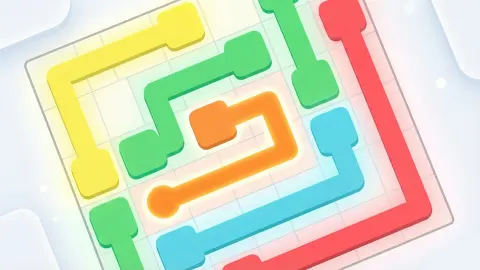
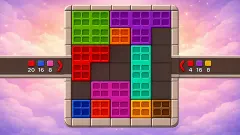
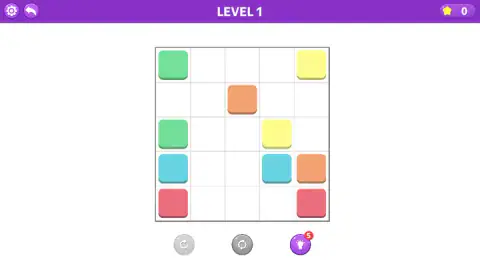
The rule, meanwhile, is one a nine-year-old can read off the screen. Level 1 is a grid of five squares by five with ten coloured blocks on it, two of each colour. Press on a block, drag, let go on its twin, and a thick line of that colour joins the pair. Green, yellow, orange, cyan, red.
What makes it a puzzle rather than a chore is what the lines do to each other. They cannot cross, so every square a line takes is a square no other line can have, and on this board there is nothing to waste. When we finally saw level 1 solved, we counted it: the five routes take three, eight, five, four and five squares. That is all 25. Not one white square was left over, which means there was never room for the scenic route our green line kept trying to take.
The game is credited to a developer listed as Ermac Alex. It was published in February 2026.
Now the honest part. We played for about ten minutes on a desktop computer with a mouse. We cleared level 1 using every one of our five hints, reached level 2, joined two of its pairs by hand with no hints left, and stopped there. This page describes the first two boards, the buttons and the menus. It does not describe the hard levels the title promises, because we never got near them.
The blue star is not a prize
This is the thing we would want to know before pressing anything. The purple light bulb under the board starts with a red 5 on it. Press it and the game does not nudge you: it joins an entire pair, end to end, and then puts a small blue star on each of that pair's two blocks.
That star is a receipt, not a reward. We watched the number fall from 5 to 4 and one pair light up with stars; by the time it read 2, three pairs carried them. The only pair on our finished board with no stars at all was green, the one we drew ourselves. So if you ever load a board and see stars on it, you are looking at work the game did.
Spend the fifth and the red number becomes a plus sign. Press the bulb after that and a panel headed OUT OF HINTS offers five more in exchange for watching an advert. It has a white X, so you can wave it away and carry on. That panel was the only advert button we met inside the game, and it only turned up because we had emptied the counter on a single beginner board.
What finishing a level looks like
The panel is headed "LEVEL COMPLETE!" and tells you, in so many words, that you completed the level in thirteen moves. Nothing on the board counts your moves or your time while you draw, so the number arrives as a verdict rather than a pressure.
Underneath there is a dark, unfilled star beside a sentence the game cuts off after the words "Complete the". Below that, a bar reading 1 of 5 with a present at the far end: five levels per gift, and we had just started the first run. A restart button sits in one corner and a NEXT LEVEL button in the other.
Press Next Level and you are on a new five-by-five board with five fresh pairs, arranged nothing like the first. Our level 2 ended with green and yellow joined, three pairs open and no hints left to cheat with. That is the real shape of the difficulty curve here: the rules never change, the board never grows on these early levels, and the squares just get harder to allocate.
Six packs, and stars to open the last two
Behind the back arrow there is a level list, and behind that a screen called Bundles. Its first page is headed Basic and lists six packs in order: Beginner, Easy, Not So Bad, Challenging, Pretty Hard and Very Difficult.
The first four are open from the start, each with a bar and a star goal. Beginner's reads 0 of 50 and the next three read 0 of 150. A player who finds Beginner too gentle can jump straight to Challenging without clearing anything.
The last two are padlocked, and Pretty Hard asks 50 stars. Given that completing level 1 with hints paid us none, those goals are a long way off for anyone who leans on the light bulb. Inside Beginner, level 1 carries an orange play arrow and every tile after it is padlocked, twenty of them before the list runs off the bottom of the screen. An arrow beside the Basic heading points to further pages of packs, which we did not open.
A puzzle older than the phone it is usually played on
The rule was not invented for a screen. Wikipedia files it under Numberlink: a grid, pairs of matching marks, and paths that join each pair without crossing or branching. It traces the idea to the American puzzle writer Sam Loyd, who printed a version in the Brooklyn Daily Eagle in 1897, and to the Englishman Henry Dudeney, whose 1917 book Amusements in Mathematics carried one called "A Puzzle for Motorists". Nikoli, in Japan, later made it a magazine regular.
The version most people know is a phone game, Flow Free, released by Big Duck Games in 2012, which swapped the numbers for coloured dots. Hard Puzzle: Color Lines has no connection with any of them. It is one more member of a large family, with square blocks in place of dots.
One line of that article explains our thirteen clumsy moves: a well-made puzzle of this kind has a single solution in which every cell is filled, and level 1 turned out to be exactly that. The same article notes that mathematicians class the general problem among the hard ones, where no quick method is known as boards grow. That is the fair reading of the title. Five by five is small enough to solve by eye, if your eye is better than ours; the difficulty arrives with size and with the number of colours.
Who it is for
It suits anyone who likes one clean rule and no clock, and nothing here punishes a wrong line beyond the space it steals. If you already play games of this family, the open packs let you skip the warm-up entirely. If you want action, a story or a score to chase, there is none: a board, a handful of colours, and a star counter that stays on 0 until you stop reaching for the bulb.
More games to try next
Turnline: Relaxing Puzzle is about lines too, but you rotate tiles until the network joins up. Connect Line works the same way, turning segments into one connected path. Mahjong Lines joins matching tiles in pairs, with the route between them as the constraint. Coffee Color Blocks is another small-board game where one colour in the wrong place blocks the rest. The rest are under puzzle games.
Screenshots
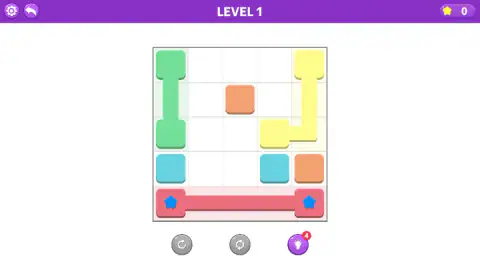
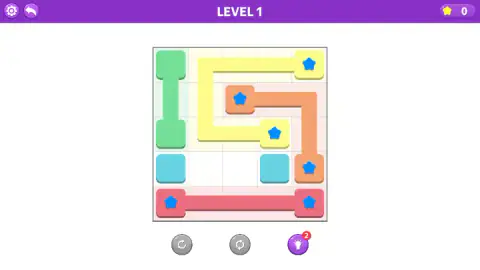
Taken by opening the game ourselves and letting it run — not supplied by the publisher, and not the same picture every other site shows.
How to play Hard Puzzle: Color Lines
- Pick a pack and a level. On a first visit that means Beginner, level 1. Every tile after it in the list has a padlock.
- Press on a coloured block and drag. A thick line of that colour follows you from square to square.
- Let go on the matching block. The pair is joined. If you let go anywhere else, the line stays where it stopped.
- Do the same for every colour. Lines cannot cross, and on level 1 the answer fills the whole grid, so a square you leave white is a square that will trap you later.
- Use the buttons under the board when you are stuck. The left one takes a move back, the right one clears the board, and the light bulb solves a pair outright.
What our session taught us:
- Draw the forced pairs first. Red sits in the two bottom corners, and the only sane route between them is the whole bottom row. Green sits twice in the left column with one gap between. Put those down and half the thinking is done.
- Count the squares before you draw. If the solution has to fill the grid, then a colour with two blocks three squares apart along a wall is almost certainly meant to go straight. Long, clever loops belong to the colours stuck in the middle.
- Watch the tint. Every square a line passes through takes a pale wash of that line's colour. White means free, so one glance tells you what is left.
- An unfinished line does not tidy itself away. Ours sat on the board, stub and all, holding squares another colour needed. Take it back or draw it again.
- You can walk away. We went out to the menus mid-level and found our lines waiting when we came back.
Controls
| Drag from a coloured block (mouse, or a finger on touch screens) | Draws that colour's line square by square; let go on the matching block to join the pair |
|---|---|
| Left round button under the board, one circular arrow | Greyed out while the board is empty, usable the moment a line exists: it takes your last move back |
| Right round button, two arrows chasing each other | Works from the first second, with or without lines on the board: it clears the board and starts the level again |
| Purple light bulb with a red number | Spends one hint, which joins a whole pair for you; when the number reaches zero it turns into a plus |
| Back arrow (top left) | Leaves the board for the level list and the packs; the lines you drew are kept |
| Gear (top left) | Opens Settings, with one switch for music and one for sounds |
Features
- A first board of five squares by five with five pairs to join, and a solution that fills all 25 squares with nothing spare
- Five hints to start with: each one lays a whole pair for you and marks both its ends with a blue star
- An offer to watch an advert for five more hints, which only appears once the counter has hit zero
- A level-complete panel that counts your moves, ours said thirteen, and fills a bar one level at a time towards a present
- Six packs on the first page, from Beginner to Very Difficult, four of them open from the start
- Levels that open one at a time: level 1 is playable and every tile after it carries a padlock
- Made by Ermac Alex
Game details
- Developer
- Ermac Alex
- Release date
- February 2026
- Last updated
- August 10, 2026
- Added here
- December 2025
- Technology
- HTML5 (2D)
- Platforms
- Browser (desktop, mouse), Browser (mobile & tablet)
- Classification
- Puzzle
- Saved progress
- Saving, when available, is managed by this game. Mava cannot confirm your level.
FAQ
How do you play Hard Puzzle: Color Lines?
Each board is a grid with pairs of coloured blocks on it. You drag from one block to the other of the same colour and a line follows your pointer from square to square. Lines cannot cross, so each route you draw decides what room is left for the others. The level is done when every pair is joined.
Do you have to fill every square of the board?
On level 1, yes. We finished it and counted: the five routes took three, eight, five, four and five squares, which is all 25 with none left over. That is how this family of puzzle is normally built, so expect the same discipline on later boards: a detour is not a style choice, it is a mistake.
How do hints work in Hard Puzzle: Color Lines?
The purple light bulb under the board carries a number, 5 when you start. Press it and the game joins one whole pair for you, then puts a small blue star on both ends of that pair. The star is how you tell its work from yours: a pair you drew yourself never gets one.
What happens when you run out of hints?
The red number on the light bulb turns into a plus sign. Press it then and a panel headed OUT OF HINTS offers five more in exchange for watching an advert. It has a white X in the corner, so you can close it and keep playing without one. That was the only advert button we met inside the game.
How many levels does Hard Puzzle: Color Lines have?
We cannot give a total. The first page of packs, called Basic, lists six: Beginner, Easy, Not So Bad, Challenging, Pretty Hard and Very Difficult. Beginner shows a goal of 50 stars and the next three show 150 each. An arrow points to more pages after Basic, which we did not open.
How do you earn a star in Hard Puzzle: Color Lines?
Not simply by finishing. We completed level 1 and the counter in the corner stayed at 0. The victory panel showed an empty star outline next to a line of text the game cuts short at "Complete the". Four of our five pairs had been laid by hints, so the likely price is finishing without them, but we have not earned one to prove it.
Does the game save an unfinished level?
It did for us within one session. We left level 1 half drawn, went back to the level list and the pack page, and came back in: our lines were exactly where we had left them. We did not test closing the browser and returning another day.
Who made Hard Puzzle: Color Lines?
It is credited to a developer listed as Ermac Alex. It was published on 10 February 2026. It is listed for PC, Android and iOS; we played it on a desktop computer with a mouse.