
About Stick Doors and Island
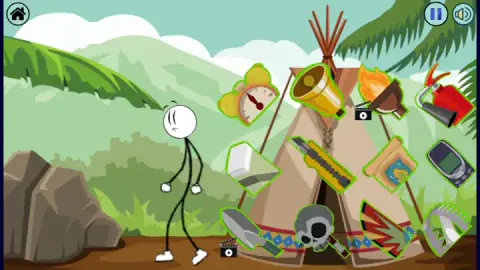
Most escape games ask you to search. You comb a room for a key, a combination, a loose floorboard. Stick Doors and Island does the searching for you. A stick figure steps out of a tent, twelve objects fan out in the air beside him, and the only question left is which one to take.
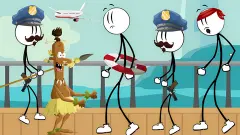
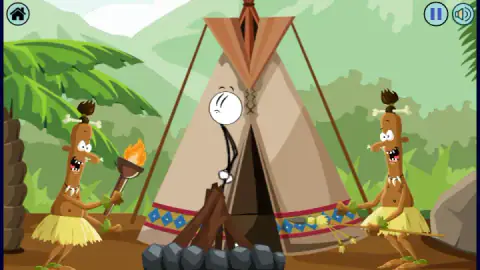
We took the alarm clock. A little later the stick figure was tied to a pole above a stack of firewood with an islander on each side, then the wood was alight and a large crying face filled the middle of the screen. Under it sat a single button, a curved arrow. Go again.
That is the whole game: pick, watch, fail, pick something else. The wrong answers are less a punishment than half of the content, short cartoon scenes you only get to see by guessing badly.
The game is credited to a developer listed as Starodymov Games. It was published in April 2025.
Now the honest part. We played for about four minutes on a desktop computer with the mouse. In that time we saw the island and nothing else: the tent, the capture scene twice, a map and a beach. We did not get off the island, and we did not open the locked rooms that the developer's description promises alongside it. This page tells you how the game works and what our first guesses were worth, not how it ends.
Twelve objects, and what we know about two of them
The fan of objects is the heart of the island scene, so it is worth going through. We could name ten of them: an alarm clock, a hand bell, a flaming torch, a fire extinguisher, a utility knife, a rolled map, an old mobile phone, a trowel, a skull and a toothed spring trap. The remaining two are a white block and a striped, feathered piece. We would be guessing at what they are, so we will not.
Some of these look like sense and some look like jokes, and the game does not tell you which is which. A clock seems harmless. It was the one that got our stick figure caught. A map seems like a thing you read and put away. It was the one that took us somewhere.
Two objects are marked differently from the rest. The torch and the trowel each carry a small clapperboard icon with a play symbol. In browser games that mark usually means the option shows a video before it does anything. We did not pick either, so treat that as our reading of an icon and not as a fact about the game.
That leaves ten objects we never touched. One of them may be a faster way out than the map, and several are surely new ways to fail.
The beach asks a different kind of question
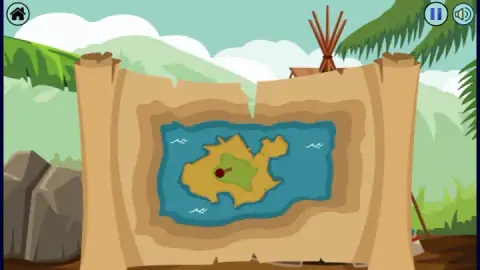
The map scene is brief. The scroll unrolls to show an island in blue water with a dark red mark near its middle, and then the view changes to the shore.
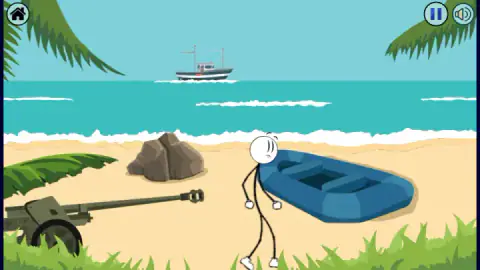
Here the picture is simple. A field gun stands on the left, pointing across the sand. There is a rock in the middle. The stick figure stands beside a blue inflatable boat, and out on the horizon a vessel sits on the water. Everything about the scene says the way off the island is in front of you, and that there is more than one thing you could do about it.
We tapped the gun and we tapped the boat. We did not leave the island, and we cannot tell you which of the two, if either, is the right call. What we can say is that the game had changed its question. At the tent it was "which of these twelve". On the beach it was "what would you do here".
Choosing your way off an island is how this format began
The pick-and-see structure is older than browser games, and it happens to have started on an island too.
According to Wikipedia's article on the Choose Your Own Adventure books, the idea came to Edward Packard from bedtime stories he told his daughters about a character called Pete, usually set on an isolated island. One night he ran out of things for Pete to do and asked the girls what they would do. Their answers pulled the story in different directions, and he invented an ending for each. The first book built that way, Sugarcane Island, came out in 1976.
The books settled into a pattern the same article describes: you read a few pages in the second person, face two or three options, and follow one until you hit an ending. Early titles had as many as 44 endings, good and bad in no fixed proportion, and the article counts reading them again as one of the things that set the books apart. Here the second reading is the curved arrow.
On screens, the best-known stick-figure game of this kind is The Henry Stickmin Collection, which its Steam page describes as a choose-your-own-path adventure where failing is part of the fun. Stick Doors and Island has no connection with that series or with the books. It belongs to the same family of design: the failures are written to be watched, and finding them all is a fair way to play.
Who it is for
It suits players who like a joke with a decision in front of it, and who do not mind being wrong on the way to being right. Each attempt is short, and nothing is lost by a bad guess except the walk back to the tent.
If you want an escape room in the strict sense, with locks, clues and things to combine, the island is not that. The developer's description says the game also has locked rooms; we did not see them and cannot say how they differ.
One more thing to know before you play. The islanders are drawn as an old cartoon cliché, in grass skirts with bones in their hair, and the failure we saw is the stick figure tied over their fire. It is played for a laugh, and some players will find it dated.
More games to try next
Wild Love is another island where the story turns on the decisions you make. Diner in the Storm is an escape told through choices and conversation. For escape rooms of the searching kind, 100 Doors Puzzle Box puts a puzzle in front of every door and The Escape Series has you hunt each room for clues and objects. The rest are under adventure games.
Screenshots

Taken by opening the game ourselves and letting it run — not supplied by the publisher, and not the same picture every other site shows.
How to play Stick Doors and Island
- Wait for the objects. The stick figure walks out of the tent and twelve items appear around it, each with a green outline.
- Click or tap one. He takes it in his hands and the other eleven vanish.
- Watch the result. The choice plays out as a short scene. There is no text to read.
- If the crying face appears, press the arrow. The black button with the curved arrow puts you back in front of the twelve objects.
- If the place changes, look around. A new scene brings a new decision, and it may not look like the last one.
What our session taught us:
- The alarm clock is a wrong answer. We chose it twice, to be sure, and got the same ending twice.
- The map moves you on. When we picked the rolled map, the stick figure held it, the map opened across the whole screen, and the next thing we saw was a beach.
- Not every decision looks like a menu. On the beach nothing floats in the air. The options are the objects in the scene itself.
- Expect to repeat the first step. After our attempt on the beach went wrong, we were back at the tent with all twelve objects, not back on the sand. If that holds every time, a mistake late in the chain costs you the whole chain.
Controls
| Click or tap an object | The stick figure takes it and the scene plays out; this is the only move the game asks of you |
|---|---|
| Curved arrow under the crying face | Appears after a wrong choice and takes you back to choose again |
| Click or tap things in the scene | On the beach there is no fan of objects: the options are the things lying on the sand |
| Pause and speaker buttons (top right) | Stop the scene and switch the sound |
| Home button (top left) | Leaves the scenario; we did not use it |
Features
- One decision at a time: twelve objects appear around a tent and you pick exactly one
- Wrong picks play a short cartoon scene and end on a retry button, with no lives and no timer on screen
- At least one pick moves the story to a second place, a beach with a boat and a field gun
- No text in the scenes we played, so there is nothing to read or translate
- Two of the twelve objects carry a small clapperboard icon; we left both alone
- Two settings according to the developer, locked rooms and the island; we played the island
- Made by Starodymov Games
Game details
- Developer
- Starodymov Games
- Release date
- April 2025
- Last updated
- August 10, 2026
- Added here
- May 2025
- Technology
- HTML5 (2D)
- Platforms
- Browser (desktop, mouse), Browser (mobile & tablet)
- Classification
- Adventure , Horror , Multiplayer , Puzzle
- Saved progress
- Saving, when available, is managed by this game. Mava cannot confirm your level.
FAQ
How do you play Stick Doors and Island?
A stick figure walks out of a tent and twelve objects appear in the air around it. You click or tap one, he takes it, and a short scene shows what that choice leads to. A wrong choice ends on a crying face with a retry arrow; a right one moves the story on.
Which object should you pick first on the island?
In our session the rolled map was the pick that moved things forward: the map opened across the screen and the next scene was a beach. The alarm clock was a wrong answer both times we tried it. We did not test the other ten objects, so there may be more than one way on.
What happens when you choose wrong in Stick Doors and Island?
You watch the consequence and then get another go. When we picked the alarm clock, islanders caught the stick figure and the scene ended with a large crying face and a round button with a curved arrow. Pressing it brought the twelve objects back. We saw no lives, score or timer.
What are the twelve objects in the island scene?
We could name ten: an alarm clock, a hand bell, a flaming torch, a fire extinguisher, a utility knife, a rolled map, an old mobile phone, a trowel, a skull and a toothed spring trap. The other two are a white block and a striped, feathered piece we could not identify with confidence.
Is Stick Doors and Island an escape room game?
Partly. The developer describes two settings, locked rooms and a desert island, and the goal in both is to find the ways out. On the island there is nothing to search for and no combination to work out: every option is shown to you and the puzzle is choosing between them. We did not play the rooms.
Does Stick Doors and Island have adverts?
Two of the twelve objects in the island scene, the torch and the trowel, carry a small clapperboard icon with a play symbol, the mark browser games often use for an option that shows a video first. We did not pick either one, so we cannot confirm what happens when you do.
Who made Stick Doors and Island?
It is credited to a developer listed as Starodymov Games. It was published on 14 April 2025. It is listed for PC, Android and iOS; we played it on a desktop computer with the mouse.