


About Stickman in space
A bone. A horseshoe magnet with a film clapper stuck to it. A red gas bottle with a flame already burning out of the top. A black helmet half-sunk in a crater, and a metal detector lying in the dust beside it. That is the equipment list for getting a man off a moon, and the game does not tell you which piece is the answer.
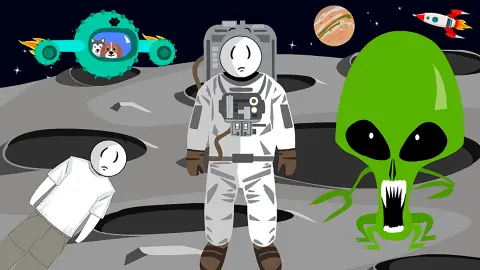
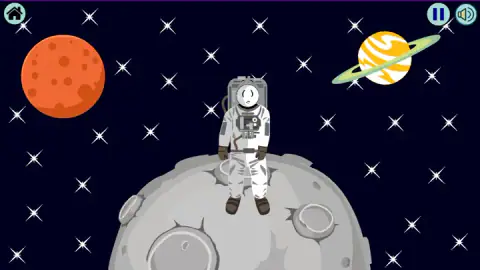
Most games about being stranded in space hand you a resource to manage: fuel, oxygen, hull, a countdown. Stickman in space hands you a shrug. There is no bar, no number and no clock on any screen in this page's pictures, and there was none on any screen we played. Instead there is an astronaut standing on a rock the size of a house, a scatter of objects revolving around his head, and a pointer.
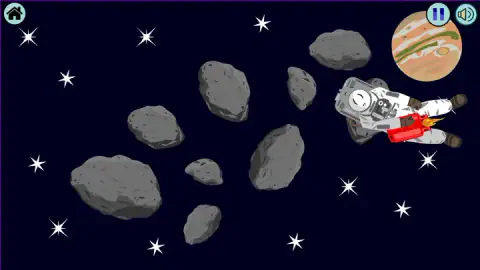
Click one and the game answers. The scene changes, the astronaut tries the thing, and you find out in about five seconds whether that was a way home. The red bottle is the clearest case: it hangs there above the moon doing nothing, and in the next scene he is flat out and gripping it with a flame streaming behind him, threading an asteroid field towards a banded planet. The junk is not scenery. The junk is the move.
The game is credited to Starodymov Games. This one went up in December 2024 and was last updated in August 2026.
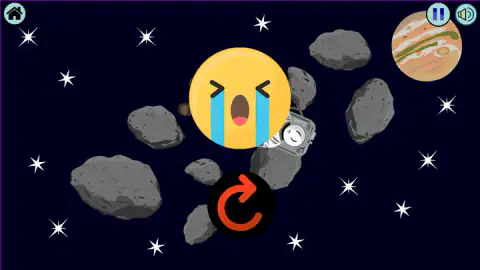
A word on how little we got out of it. We played on a desktop with a mouse for about four minutes, clicked at everything that looked clickable, and never once got off the moon. Every attempt we finished ended the same way, with a crying face the size of the screen. So this page can tell you exactly what the game asks of you and what being wrong looks like. It cannot tell you how many ways out there are, or how it ends.
Everything on the moon screen is a thing you could try
The moon itself is drawn small on purpose, a grey ball with a few craters, close enough to the bottom of the screen that the astronaut's boots and the horizon are in the same glance. Behind it: an orange planet on one side, a ringed one on the other, and a sky of four-pointed stars. Pretty, and completely empty of information.
So the objects carry the whole game. A gas bottle already alight. A beige handset with a single red button on it, the kind of thing a cartoon uses to detonate something. A magnet. A bone. A small yellow device with a dial. A metal detector and a tripod camera on the ground, and the helmet in the crater. None of them is labelled and none of them is explained, which turns the first minute into a sorting exercise: which of these is a vehicle, which is a tool, and which is a joke that will get him killed.
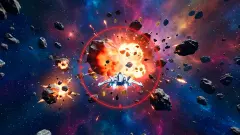
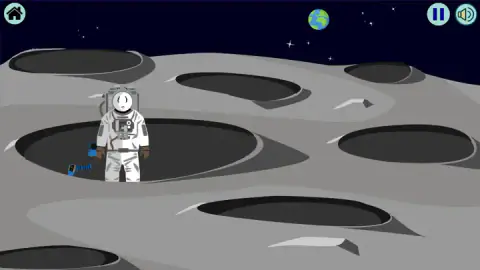
The scenes they open up are drawn in the same flat style but they are not the same place. One is a close-up of the lunar surface, pitted with wide black craters, with the Earth hanging small and blue over the horizon. One is an asteroid field. One is a long dark stretch with a spiral galaxy turning in the corner of it. You get to see them for a few seconds each, which is a strange kind of reward: the failure is also the tour.
Leaving the moon really is the cheap part
The joke in a gas bottle for a spaceship is that it is far too small. The physics says it is less far off than you would think.
The moon in the game is nameless, but the one it is drawn from pulls about six times more weakly than Earth does, and that changes the sum completely. To get away from Earth for good you need to be moving at roughly eleven kilometres per second. To get away from the Moon, a bit over two.
A fifth of the speed sounds like a modest saving until you remember that the energy you have to find goes up with the square of it. Per kilogram of astronaut, leaving the Moon is a small fraction of the same job done from here.
Apollo made the point in hardware. The part of the lunar module that brought two men back up off the surface had one engine, producing about three and a half thousand pounds of thrust, which is less than a small business jet. It could not be throttled. It had no backup of any kind: it was the only piece of the landing hardware without a spare, because the weight budget would not stretch to a second one. And it had no launch pad, either. It used the bottom half of the lander, still standing in the dust, as the thing to push off.
There is one detail the game gets quietly right. What the astronaut is strapped to in the asteroid scene is a sealed cylinder, not a torch. Fire needs oxygen, and there is none out there to borrow, so the only flame that works beyond the atmosphere is one that brings its own. That is the whole difference between a rocket and a bonfire, and it is the reason a bottle is a funnier guess than a stick with a rag on it.
Being wrong is the loop, not the end
In most games the failure screen is a pause: a score, a best, a button, a moment to feel the loss. Here it is a cartoon face. A yellow emoji, eyes screwed shut, blue tears flying, drawn so large that it blots out most of the asteroid field, with the astronaut visible behind a rock to one side with his eyes closed. Underneath it, a single black circle with an orange arrow curling back on itself.
Nothing is counted and nothing is kept. You are not told which objects you have already burnt through, so the game is only as organised as you are. That is a design decision with a cost and a benefit: it makes an afternoon of it for anybody who likes to work through a list, and it makes the whole thing feel loose if you are expecting to be guided.
It also keeps the tone light, which matters in a game about a man dying repeatedly on a moon. Nobody explodes. The screen cries for him.
More stick figures in trouble, by the same studio
Stick New Year in Prison is this game's twin with the walls closer in: same stickman, same business of choosing your exit from a bad place, except the bad place has bars. Stick Doors and Island runs the idea twice over, once in a locked room and once on a beach, and asks which door you believe. Halloween Stickman swaps the escape for revenge and lets you rewind time to get it. Stickman Punishment 2 keeps only the part where you pick an implement and watch what it does. And Pim Path is the studio in a completely different mood: no objects to weigh up, just spikes, blades and a trophy at the far end. The rest of the shelf is in adventure games.
Screenshots
How to play Stickman in space
- Click an object, not the man. Clicking the astronaut and clicking the ground under his boots did nothing for us, repeatedly. The things that react are the ones drawn separately from him.
- Look down as well as up. Some objects orbit the moon at head height. Others lie on the surface: a metal detector with a blue handle, a camera on a tripod, that black helmet in the crater.
- Wait a moment before you start. The number of things around the moon is not fixed. One of our screens showed the astronaut completely alone on it; another, a few moments later, had roughly a dozen objects in the air around him.
- Watch the scene out. Once you have chosen, there is nothing to press. The attempt plays itself, and the answer is whether he is still standing at the end of it.
- Take the orange arrow. When the crying face arrives, the black button with the looping arrow underneath it puts you straight back. There is no penalty attached to it that we could see.
What our run actually taught us:
- Nothing on screen is keeping score. No points, no timer, no lives, not even a level name. If you want to know how you are doing, the only measure is how many objects you have already ruled out, and the game does not remember that for you either.
- The keyboard is not part of this. We pressed keys throughout and nothing we pressed moved him or chose anything.
- Failing is cheap and quick. There is no wait, no death animation to sit through, no penalty screen. The emoji appears, you press the arrow, you are back.
- The ads live in the frame, not the game. Twice the picture dimmed behind a panel marked as an ad slot, and once a panel told us it was skipping the ad that time and offered a button to continue playing.
Controls
| Left click or tap | Everything. Click an object floating around the moon, or one lying on its surface, and the game plays out what happens |
|---|---|
| Orange looping arrow | Appears under the crying face after a failed attempt and puts you back |
| House icon (top left) | The only way out of a scene we found. We did not check where exactly it drops you |
| Pause and speaker (top right) | The two buttons that sit in the corner of every screen. We never opened the pause panel |
| Keyboard | Nothing we could get out of it. Nothing we pressed moved the astronaut or chose anything for us |
Features
- A stranded astronaut with no fuel gauge, no oxygen timer and no inventory bar: the things you can try are drawn floating around his head
- The junk is the puzzle — a red gas bottle already alight, a magnet stuck to a film clapper, a bone, a metal detector lying in the dust, a black helmet half-buried in a crater
- Objects carry over into the attempt: the same red bottle that hangs over the moon turns up again under the astronaut, flaming, in the asteroid field
- Four kinds of scene in four minutes: the moon itself, a close-up crater field with Earth overhead, an asteroid run, and a dark stretch with a spiral galaxy in it
- Failure is a cartoon rather than a punishment: a crying face the size of the screen, an orange looping arrow, and you are back
- No score, no timer, no lives counter, no level name. Nothing on any screen we saw tells you how you are doing
- Made by Starodymov Games
Game details
- Developer
- Starodymov Games
- Release date
- December 2024
- Last updated
- August 10, 2026
- Added here
- April 2025
- Technology
- HTML5 (2D)
- Platforms
- Browser (desktop, mouse), Browser (mobile & tablet, touch)
- Classification
- Adventure
- Saved progress
- Saving, when available, is managed by this game. Mava cannot confirm your level.
FAQ
How do you play Stickman in space?
You pick things. An astronaut stands on a small moon and a heap of objects floats around him, from a bone to a gas bottle with a flame on top. Clicking one plays a short scene of him trying it. Clicking the astronaut himself, or the moon under his boots, did nothing for us however many times we tried.
What are the controls in Stickman in space?
A pointer, and that is all. Left click or tap on an object, then watch. A house icon sits in the top-left corner and a pause and a speaker button in the top-right, on every screen. We never got the keyboard to do anything in four minutes of play.
What happens when you get it wrong in Stickman in space?
A yellow emoji the size of your screen appears in the middle of the scene, crying, with the astronaut tucked behind an asteroid beside it. A black round button with an orange looping arrow turns up underneath. Press it and you are back where you started, with nothing lost but the attempt.
Is there a score in Stickman in space?
Not one that we could find. Every screen we played and every picture on this page carries the same three buttons and no numbers at all: no points, no timer, no lives, no level name. The only feedback the game gives you is whether the scene ends with the astronaut still in one piece.
How many ways off the moon are there?
We cannot tell you, because we never found one. We played for about four minutes, clicked at everything that looked clickable, and every attempt we finished ended with the crying face. What we can tell you is that the objects are not decoration: one of them reappears as the vehicle in the next scene.
Who made Stickman in space?
Starodymov Games, according to the game's listing. This game was published in December 2024 and was last updated in August 2026. We found no studio website to confirm the name against a second source, so it rests on the portal alone.
Does Stickman in space work on a phone?
It is listed for Android and iOS as well as PC, and lists it as a landscape game, which matches the wide view we played in. A game driven entirely by tapping objects should survive the move to a touchscreen better than most. We only played it on a desktop with a mouse, so we have not checked it ourselves.
Are there ads in Stickman in space?
Yes, in the portal frame around the game rather than in the game itself. Twice during our run the picture dimmed behind a panel marked as an ad slot, and once a panel appeared saying it was skipping the ad that time, with a button to continue playing. Nothing was taken away from us for failing and nothing was offered for watching.