About Stick Duel: Medieval Wars
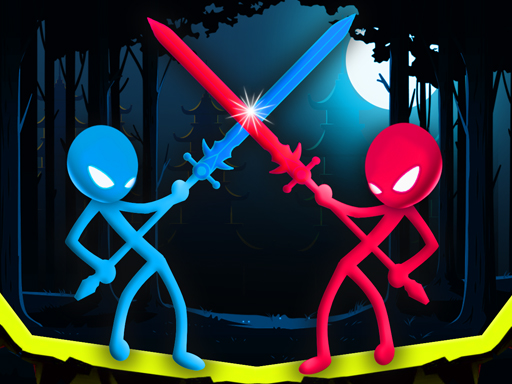
Most fighting games give you an attack button. Stick Duel: Medieval Wars does not have one. Two stickmen stand on little wheeled carts at opposite ends of an arena, each holding a polearm about as long as they are tall, and the only thing either player can do is spin the wheels. The weapon swings because the cart accelerates underneath it. Everything else — the arc of the blade, the recoil when steel meets steel, the moment your own axe drags you off your platform — is Box2D doing the maths.
That single decision is what makes it a duel rather than a mash. You cannot aim. You can only choose when to charge, when to reverse, and how much speed to carry into the meeting point. Charge too early and your haft is still trailing behind you when the other fighter arrives. Reverse at the right instant and your weapon whips forward on its own momentum with the full length of the shaft behind it. Two keys, and a surprising amount to get wrong.
Under the hood each fighter carries 100 health and loses it by contact rather than by hit count: while a weapon is touching an opponent, damage ticks away every frame. A graze costs a point or two. A square hit that pins the other stickman against the ground costs him the round. Contact with the head is worth three times contact with the body, which is the closest thing this game has to a critical hit and the reason experienced players aim high rather than fast.
HiHoy Games built it in Construct 3 and published it on 13 November 2020 — the date is stamped into the exported bundle as well as onto the GameMonetize listing. HiHoy is a three-person studio from Denizli, Turkey, working on browser games since 2014; the giveaway is inside the project file, where every object is named in Turkish (mizrak for the spear shaft, teker for the wheels, yapayzeka for the bot). Six years on it is still being played: Snokido counts 406,678 plays and rates it 88% from 649 votes, Silvergames has it at 4.3 out of 5 from 1,671 votes, and Miniplay at 4 out of 5 from 1,372.
Every weapon here is mounted on a stick, and that is historically right
The five weapon heads in this game are a sword, a curved glaive-style blade, a single-bit axe, a double-bitted axe and a war pick. Every one of them is bolted to a long haft. That looks like a stylistic shortcut. It is closer to the truth than the knight-with-a-sword picture most games sell you.
The spear remained the main weapon of the common medieval soldier for a simple reason: it needed only a small amount of steel, less smithing skill than a sword, and it was longer than anything the other side was likely to be holding. Spears were used in tight formations — the shield wall, the Scottish schiltron — and their shafts could be planted in the ground to stop cavalry. A sword was expensive, and for most soldiers it hung on the belt as a sidearm.
When plate armour matured, the answer was not a bigger sword either. It was the pollaxe, a 14th- and 15th-century weapon on a haft of roughly 1.5 to 2 metres — about the height of the man carrying it. Its head combined an axe blade deliberately smaller than a halberd's, so the impact concentrated into less steel; a hammer opposite the blade; a square-sectioned spike on top for thrusting; and a rear fluke for hooking and punching through a joint. Knights trained with it seriously enough that a 15th-century fencing manual for it survives, Le Jeu de la Hache. The halberd added a hook for the same reason: chop, thrust, and drag a rider off his horse.
So the game's design accidentally teaches the real lesson. Reach beats reflex. Leverage beats strength. And a war pick — the one weapon in the set that concentrates everything into a point — is exactly the answer to a helmet, which is why the head in this game takes triple damage while the torso shrugs. The carts even make the last historical joke: put a long point on something that moves fast and you have reinvented the couched lance, where the momentum of the mount, not the arm, delivers the blow.
What the code rolls: 16 arenas, five weapon heads and a coin-flip opponent
No portal lists this, so we pulled the exported Construct 3 project apart to check. The game contains 16 playable arenas, and after every knockout the next one is drawn at random rather than taken in order, so a match to five almost never repeats a battlefield. There are five weapon frames, and each fighter is dealt one at random at the start of every round — which is why you will sometimes face a double-bitted axe while holding a sword, and why the matchup changes even when the arena does not.
Backgrounds come in five palettes, and the fighters change colours with them: blue against orange, blue against green, red against blue. The opponent in 1P, as noted above, is a timer and a random choice between two directions. That is the whole bot. It makes single player a decent practice mode and a poor challenge, and it is the honest reason to grab a second person.
Two fighters, four keys, one keyboard
This is built as a couch game first. Both fighters live on the same keyboard, no menu diving, no controller pairing: A and D on the left, ← and → on the right. Rounds last seconds, a full match to five runs two or three minutes, and because neither player has an attack button there is nothing to memorise before a beginner can win. If you like the format, Drunken Duel and Drunken Duel 2 from the same studio strip it down even further to one key each, and 12 MiniBattles packs a dozen two-player rules into one page.
Play Stick Duel: Medieval Wars unblocked
This is the heaviest game on this shelf and the one least likely to feel like it. Counted file by file, the build is 163 files and 10.7 MB. But Construct fetches a layout's artwork only when that layout is needed, so what stands between you and the title screen is about 483 KB: the runtime, the project data and a WebAssembly build of Box2D. On a shared classroom connection the waiting moves to the start of an arena you have not seen yet, and there are sixteen of those. Each one hitches once, then never again.
Size on screen is the other thing to plan for. The canvas is 1280×640, the widest here, and a typical school laptop panel is 1366 pixels across, so the arena already fills nearly the whole width. Fullscreen buys you very little.
Then the keyboard, which is where searches for Stick Duel unblocked end in a complaint that the game is broken when it is not. Four keys are live at once: A and D for the left fighter, ← and → for the right. Budget membrane keyboards guarantee only a handful of simultaneous presses, and some combinations cancel each other silently. If one cart stops steering while the other player is holding a direction, that is a dropped key, not a bug. Another USB keyboard fixes it, and so does putting the more active player on the arrows.
Expect a pre-roll before the title screen and an interstitial when you choose 1P or 2P; once a round starts, nothing interrupts it. Nothing is installed and nothing is left behind. If the address itself is refused, ask a teacher instead of looking for a way round it.
More games by HiHoy Games
HiHoy has been making two-player browser duels since 2014, and the family is easy to recognise: physics, ragdolls, one or two keys per player. Start with Drunken Duel and its sequel Drunken Duel 2, both one-button western shootouts from the same studio. For more physics brawling try Drunken Boxing, and for a dozen quick two-player rules in one page there is 12 MiniBattles. If you would rather have a gun than a polearm, Stickman Gun Shooter 3D keeps the stick figures and swaps the melee. More two-player brawls of this kind live in the action category.
How to play Stick Duel: Medieval Wars
- Choose your mode. 1P puts you against the bot. 2P shares the keyboard. The button between them opens the control card.
- Learn your two keys. The fighter on the left moves with A and D. The fighter on the right moves with ← and →. On a touchscreen, each player gets two buttons on their own half.
- Drive into the other fighter. Damage is dealt whenever your weapon head, your haft or even your cart touches him. Watch the health bar at the top of your side of the screen.
- Empty his bar. He ragdolls off the cart, a star lights under your bar, and a new arena loads for the next round.
- Get to five stars. Five round wins ends the match and takes you to the results screen, where you can rematch or go back to the menu.
Tips worth knowing before your first match:
- Aim high. Contact with the head does three points of damage per frame against one point on the body. Approaching with the weapon tilted up is worth more than approaching fast.
- Your cart is a weapon too. The wheeled chassis has its own damage check. If your polearm ends up behind you after a clash, ramming still works.
- Reverse before you commit. Tapping the away key first makes the weapon trail behind, and it then swings through as you accelerate forward. That whip is the hardest single hit in the game.
- The bot is a coin flip. In 1P the computer picks a new direction — left or right, nothing else — every 0.3 to 0.8 seconds at random. It has no sense of range and no defence. Sit just outside its reach, let it wander in, and punish the swing.
- Read the arena first. A round on flat ground is a jousting run. A round in a V-shaped valley means gravity does half the driving, and it is easy to overshoot into your opponent's weapon rather than onto him.
Controls
| A / D (left fighter) | Spin the cart's two wheels left or right. Holding a key drives the cart and swings the weapon by momentum |
|---|---|
| ← / → (right fighter) | The same two inputs for the second fighter on the same keyboard |
| Touch | Four on-screen buttons, two on each side of the screen, one pair per player |
| (no attack key) | There is no strike button. The only thing you control is which way the wheels turn |
Features
- Five weapon heads — sword, curved glaive blade, single-bit axe, double-bitted axe and war pick — mounted on a two-metre haft and dealt at random to each fighter every round
- 16 hand-built arenas (flat ground, V-shaped valleys, closed bowls, ledges) and the next one is drawn at random after every knockout
- 100 health per fighter per round; a clean hit to the head costs three times what the same hit to the body costs
- First to five rounds takes the match, tracked by five stars under each health bar
- 1 Player against a bot, or 2 Players on one keyboard — A and D against the left and right arrows
- Loads in seconds from a single HTML5 page, with on-screen touch buttons for phones and tablets
Game details
- Developer
- HiHoy Games
- Release date
- November 2020
- Last updated
- October 14, 2023
- Added here
- March 2023
- Technology
- HTML5 (Construct 3, Box2D 2D physics, 1280×640 landscape)
- Platforms
- Browser (desktop), Browser (mobile & tablet, touch), Chromebook
- Classification
- Action , Multiplayer
FAQ
How do you win in Stick Duel: Medieval Wars?
Win five rounds. Each fighter starts a round with 100 health, and the round ends when one of them drops to zero and ragdolls off the cart. A star lights up under the winner's health bar, a new arena loads, and the first player to five stars wins the match.
Is Stick Duel: Medieval Wars a 2 player game?
Yes. Press 2P on the title screen and both fighters share one keyboard. The left fighter moves with A and D, the right fighter with the left and right arrow keys. On a touchscreen each player gets two buttons on their own side of the screen.
What are the controls for Stick Duel: Medieval Wars?
Two keys per player and nothing else. A and D drive the left fighter's cart, the left and right arrows drive the right fighter's. There is no attack button, no jump and no block — the weapon swings because the cart accelerates underneath it.
How many weapons and levels are in Stick Duel: Medieval Wars?
The game ships five weapon heads (a sword, a curved glaive blade, a single-bit axe, a double-bitted axe and a war pick) and 16 arenas. Both are drawn at random — a new weapon for each fighter and a new arena at the start of every round.
Who made Stick Duel Medieval Wars?
HiHoy Games, a small studio from Denizli in Turkey that has been publishing browser games since 2014 under the hihoy.com brand. The same studio made Drunken Duel, Drunken Duel 2, Robbery Duel, SuperHero Fighters and Stick Fighter 3D.
Can I play Stick Duel: Medieval Wars unblocked at school?
The game is one HTML5 page with no plugin, no installer and no account, so it runs on a school Chromebook or a locked-down office browser as long as the page itself loads. Everything happens inside the browser tab.
Does Stick Duel Medieval Wars work on a phone?
The build includes four on-screen touch buttons, one pair per fighter, and asks for landscape orientation. GameMonetize's own listing still flags the game as not mobile-ready, so treat phone play as workable rather than polished — a keyboard is the better experience.
Were medieval weapons really mounted on poles like this?
Most of them, yes. The spear stayed the main weapon of the common soldier because it was cheap, long and quick to forge, and the pollaxe of the 14th and 15th centuries put an axe blade, a hammer and a spike on a haft of 1.5 to 2 metres to break plate armour. The sword was usually a sidearm.