About Drunken Spin Punch
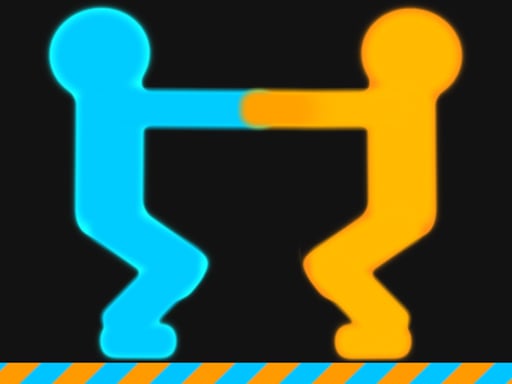
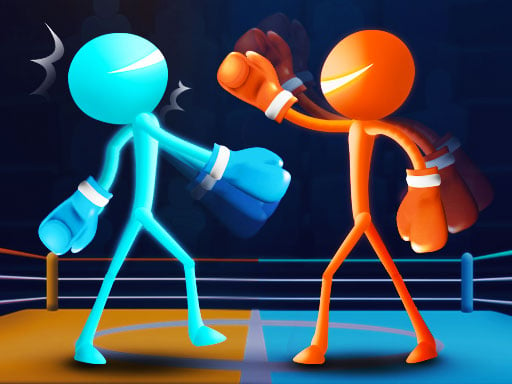
Every punch in Drunken Spin Punch is a spinning backfist. Not a jab, not a hook, not a light attack you can throw and take back: one commitment, the whole body turning with it. Take that idea, hand it to two ragdoll stickmen who cannot stand up straight, and you get a fight where neither fighter ever quite knows where their own fists are going.
That sounds like it would be pure chaos, and for the first thirty seconds it is. Then you notice the energy bar. Every spin costs a slice of it, and there is no way to spend a little — the punch is the punch. Empty your bar and your fighter hangs there like a coat on a peg, unable to attack or protect anything, while the other stickman winds up. Which turns the game into a question nobody expects from a ragdoll brawler: how much are you willing to spend on a punch that might hit nothing at all.
Under the hood it is a Construct 3 export running on Box2D, with each fighter built from five pin joints. That is the reason no two falls look the same and the reason the game is only a couple of hundred kilobytes of project data — it simulates the bodies rather than animating them. The fighters themselves are recycled from Drunken Boxing 2, which is a small joke on anyone expecting the sequel's boxing.
RHM Interactive OÜ made it — the Tallinn company that has run twoplayergames.org since 2008 — and for once the file agrees with the label: the build ships RHM's own trademark artwork and describes its Construct project as "Rhm games". That is worth stating, because the Drunken name is a publisher's imprint rather than one team's output, and Drunken Duel and Drunken Table Wars were built by HiHoy Games. It first appeared on the big portals in November 2021 and has held up: 4.2 out of 5 on the studio's own site, 86% approval from roughly 2,000 votes on Snokido, and 491,685 plays counted on Y8 alone.
The spinning backfist is a real punch, and boxing bans it
The move the whole game is built on has a name and a rulebook problem. A spinning backfist generates its power from rotation: the fighter pivots on the lead foot, turns the torso all the way through, and whips the back of the fist round into the target. Because the arm is travelling on the end of a rotating body rather than being pushed by the shoulder, it hits harder than almost anything thrown straight — and it arrives from the opponent's blind side.
It is a normal, legal technique in MMA, kickboxing, karate and taekwondo. In boxing it is illegal, and for two separate reasons. First, a boxer may only strike with the knuckle part of the front of the glove; hitting with the back of the hand is a foul. Second, you are not permitted to turn your back on your opponent, which the spin necessarily does. Both have been in the rules for about a century. Referees call it and can take a point for it.
Even where it is allowed, fighters throw it rarely. Shonie Carter's knockout of Matt Serra at UFC 31 in May 2001 — the first spinning backfist finish in UFC history — is still cited because so few land. The reason is the trade the technique makes: you commit your entire body, you lose sight of your opponent for a fraction of a second, and if the punch misses you are stationary, side-on and open.
That trade is exactly what Drunken Spin Punch models. The energy bar is not decoration; it is the price of commitment, converted into a number on screen. The game does not simulate what a spinning backfist looks like. It simulates what it costs.
Where Spin Punch sits in the Drunken series
RHM has built the same two-player skeleton — one keyboard, a few keys, a running score — around a different physical problem each time, and it is worth knowing which one you are picking.
- Drunken Boxing and Drunken Boxing 2 are the fast versions: short punches, frequent exchanges, energy that recovers quickly.
- Drunken Spin Punch is the slow, expensive version. Fewer punches, each one a gamble, longer gaps between them.
- Drunken Duel strips it down to one button and one bullet.
- Drunken Tug War removes striking altogether and makes it a pull.
- Drunken Slap Wars goes further still: the opponent is not allowed to defend at all, and your only job is timing.
- Drunken Wrestle puts the same ragdolls on a mat.
If you have played one and found it thin, the others are not more of the same — they are the same joke told about a different verb.
Drunken Spin Punch unblocked on a school laptop
The reason this game shows up on every "unblocked games" list is not a workaround, it is the build. It is one HTML5 page with a Construct 3 runtime, a WebAssembly physics library and a few hundred kilobytes of project data. No plugin, no installer, no account, nothing to sideload. Chrome, Edge, Firefox and Safari all run it, and so does a school Chromebook on the kind of connection that chokes on a Unity game. Press Play above and it starts inside this page; the fullscreen button on the toolbar gives you the whole screen if two people are sharing it.
More games by RHM Interactive
The rest of the shelf is worth a look if the physics amused you: Drunken Boxing, Drunken Boxing 2, Drunken Tug War, Drunken Wrestle and the one-key Drunken Slap Wars, plus Drunken Duel, which carries the series name but is HiHoy Games' work. RHM also made Boxing Random, where the rules change between rounds, and publishes 12 MiniBattles, which is twelve two-player games in one page. The rest of the ragdoll duels are in the action category.
How to play Drunken Spin Punch
- Choose a mode. 1P puts you against the CPU. 2P splits one keyboard between two people.
- Learn two keys before four. Left arrow swings the left fist, right arrow swings the right. That is the entire offence.
- Use up and down to manage distance. Leaning in closes the gap, pulling back takes you out of range — which is the closest thing to a dodge this game has.
- Watch your bar, not your opponent's. The energy meter on your side of the screen decides whether your next spin lands with weight or barely moves the other fighter.
- Reach five. Each knockdown scores a point and starts a new round. Five points ends the match.
Tips worth knowing before your first match:
- A missed spin is worse than no spin. You pay the energy either way, and the rotation carries you past your opponent, so you finish the swing facing the wrong direction with nothing in the tank. Throw when they are already committed, not when they are waiting.
- Alternate hands. Left, right, left keeps the body rotating instead of winding it up against itself, and it spreads the cost across both sides of the screen rather than emptying you in one burst.
- Retreat is a real move. Backing out of range costs no energy and lets the bar refill, and there is no other way to get it back. Standing still and waiting is a legitimate way to win a round against anyone who cannot stop swinging.
- Do not chase a downed fighter. The round is already over the instant they land. Anything you throw on the way down is energy you start the next round without.
- In 2P, the patient player wins. Two people mashing produces two limp stickmen and a very silly stalemate. The first one to stop swinging usually takes the round.
Controls
| ← / → (Player 1) | Swing the left or the right fist — each one is a full spin that drags your whole body around with it |
|---|---|
| ↑ / ↓ (Player 1) | Lean into your opponent to close the gap, or pull back out of range while your energy refills |
| A / D · W / S (Player 2) | The same four inputs for the orange fighter, on the same keyboard |
| Touch | Tap the left or the right side of the screen to swing that hand; the game runs on phones and tablets |
Features
- There is no jab and no guard — every attack is a spinning punch, so the fighter you control is always mid-rotation
- Two independent energy bars; a spin costs energy and an emptied bar leaves your stickman limp and defenceless until it refills
- First to 5 knockdowns takes the match, with a round counter and a score for each side
- 1P against the CPU or 2P on one keyboard, arrows against WASD, plus touch controls in landscape
- Built in Construct 3 on the Box2D physics engine, with the fighters assembled from five pin joints — which is why the falls never repeat
- The build reuses the fighters from Drunken Boxing 2, so it looks like the sequel and plays nothing like it
- Loads in a couple of seconds and runs on a school Chromebook; there is no account and nothing to install
Game details
- Developer
- RHM Interactive
- Release date
- November 2021
- Added here
- March 2021
- Technology
- HTML5 (Construct 3 with Box2D physics, 800×600)
- Platforms
- Browser (desktop), Browser (mobile & tablet, touch), Chromebook
- Classification
- Action , Multiplayer
FAQ
How do you win in Drunken Spin Punch?
Score five knockdowns. Every time your opponent hits the floor the round ends and your score goes up by one, and the first fighter to reach five wins the match. There is no timer, so a match lasts as long as it takes.
What are the controls for Drunken Spin Punch?
Player 1 uses the arrow keys and Player 2 uses W, A, S and D on the same keyboard. Left and right swing the matching fist, up and down move you in and out of range. On a touchscreen you tap the left or right side of the screen instead.
Why does my fighter stop swinging?
The energy bar is empty. Every spinning punch costs energy, and when the bar runs out your stickman goes limp for a moment and cannot attack or defend. Stop swinging, back out of range and let it refill before you commit again.
Is the spinning backfist a real punch?
Yes. It is a standard technique in MMA, kickboxing, karate and taekwondo, thrown by pivoting on the lead foot, turning the torso and whipping the back of the fist round into the target. Shonie Carter scored the first spinning backfist knockout in UFC history against Matt Serra at UFC 31 in May 2001.
Is the spinning backfist legal in boxing?
No. Boxing bans it twice over. You may only strike with the knuckle part of the front of the glove, which rules out the back of the fist, and you are not allowed to turn your back on your opponent. A referee will call it a foul and can take a point for it.
What is the difference between Drunken Spin Punch and Drunken Boxing?
Drunken Boxing gives you quick, short punches and a ring. Drunken Spin Punch replaces them with one all-or-nothing spinning attack, so exchanges are longer, misses are more expensive and the energy bar decides more of the match. Spin Punch also borrows its fighters from Drunken Boxing 2.
Can I play Drunken Spin Punch unblocked at school?
It is a single HTML5 page with no plugin, no download and no login, so it runs on a Chromebook or a locked-down browser as long as the site itself is reachable. The build is small, which is why it usually loads on slow school Wi-Fi when heavier games do not.
Who made Drunken Spin Punch?
RHM Interactive OÜ, a company registered in Tallinn, Estonia that has run the two-player portal twoplayergames.org since 2008. Its trademark artwork sits inside this build, so the attribution is solid here — which is not true of the whole series. RHM publishes the Drunken name but commissions some of it out: Drunken Duel and Drunken Table Wars were built by HiHoy Games.