About Drunken Tug War
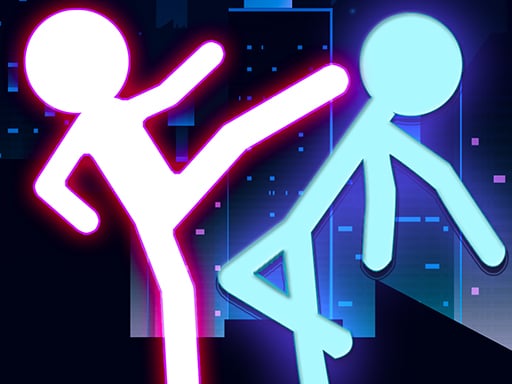
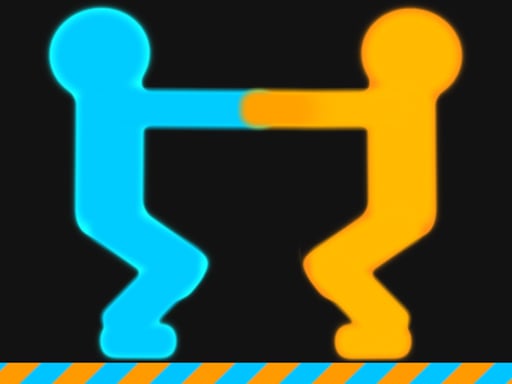
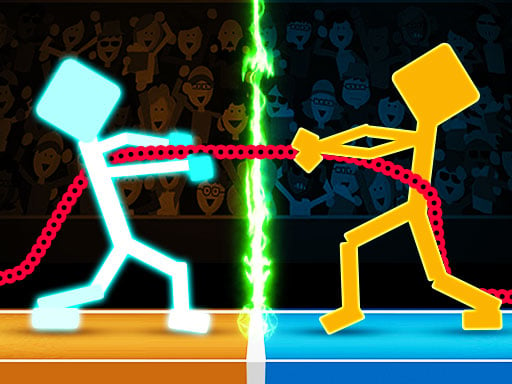
Most two-player fighting games on the web hand you four keys and hope you work out what three of them do. Drunken Tug War hands you one. Player 1 gets W, Player 2 gets the up arrow, and that is the complete control scheme. Everything else on screen — the rope, the two neon stickmen leaning back against it, the crowd in silhouette — is there to tell you what your one key just did.
Press it and your stickman hauls. Press it faster than the other player and the rope creeps your way, dragging their body across the floor towards your side of the arena. What stops this from being a pure speed contest is the thing sitting exactly where the two territories meet: a column of radioactive green light on the centre line. Contact with it drains your health bar, and an empty bar puts you out of the point. The player who is losing the pull is, by definition, the one being dragged through it. Falling behind does not just cost you ground — it starts costing you health, which is why a small early lead in this game snowballs faster than it looks like it should.
Points are quick and the match runs to five. RHM Interactive OÜ, the Tallinn company behind twoplayergames.org, published it through GameMonetize on 11 June 2021 at a wide 800×431. On the publisher's own portal it holds 4.2 out of 5 from 2,839 votes; SilverGames has it at 4.0 from 228, and GamePix at 7.4 out of 10. Those are strong numbers for a game whose entire input surface is one button.
Who built it is a separate question, and we will not pretend to have the answer. The Construct 3 project inside the file names no studio — only a first name, stefano, with the package id left at Construct's untouched default — and the project it was forked from is called Get On Top Touch, the publisher's own two-player port. That is consistent with an in-house job and it does not prove one. It matters because two of this game's shelfmates, Drunken Duel and Drunken Table Wars, openly carry HiHoy Games' package id inside their builds: the Drunken name is a publisher's imprint, not a single team.
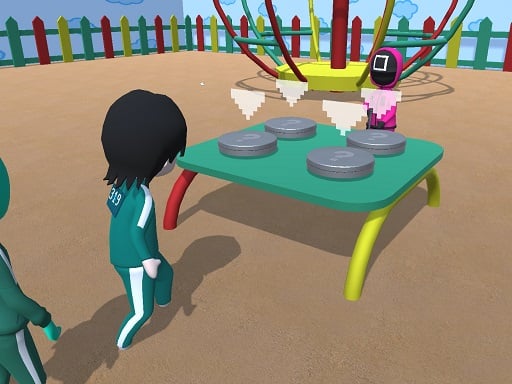
It is worth knowing where it sits in the family. Drunken Table Wars came first, in March 2021, and established the shape: one key each, drag the thing across the line, first to five. Tug War is the follow-up three months later, and the green strip is what it adds. The rest of the shelf — Drunken Boxing, Drunken Duel, Drunken Spin Punch — is built on hitting people. This one is built on out-lasting them.
Tug of war was an Olympic sport, and Britain still tops the medal table
The joke in this game is that it takes a real sport with a governing body and reduces it to a button. The real sport is more interesting than most people assume.
Tug of war was on the Olympic programme from 1900 to 1920 — six editions if you count the 1906 Intercalated Games — and it was classified under athletics. Team sizes moved around: six pullers in 1900, five in 1904, and eight from 1908 onwards. Because individual clubs could enter separately rather than one team per country, a single nation could sweep the podium: the United States took all three medals in 1904 and Great Britain took all three in 1908. Britain still leads the all-time table with two golds, two silvers and a bronze, and three British pullers — Frederick Humphreys, Edwin Mills and John James Shepherd — collected three medals each. The event vanished after 1920 not because anyone lost interest but because the IOC cut the programme to control the number of sports and athletes.
It never stopped being organised. The Tug of War International Federation, founded in 1960 and based in Jellum in the Netherlands, now covers 75 member nations, is recognised by the IOC through ARISF, runs indoor and outdoor world championships in alternate years, and has been part of the World Games since 1981. Under its rules a team is eight pullers under a combined weight limit, the rope is about 11 cm in circumference with no knots or hand-holds allowed, and the floor is marked with a centre line and two marks 4 metres to either side. You win when the mark nearest your opponents crosses the centre line. Dropping an elbow below the knee — "locking" — is a foul, and so is sitting down on the rope.
Look at that list again and you are looking at this game's arena: a centre line, a marked distance to drag someone over, and a rule that punishes you for what your body does while you pull. The one thing the game inverts is technique. In real tug of war, raw pulling speed is close to irrelevant; what wins is a low body angle, a solid anchor at the back of the rope and a coordinated cadence called by one person so eight people heave as one. Here, cadence is all you have, and there are no other seven people to blame.
Two players, two keys, one keyboard
Most local-multiplayer browser games make two people share a keyboard by giving one arrows and the other WASD, which means four fingers each and a lot of elbow negotiation. Drunken Tug War needs one finger each, on keys at opposite ends of the board. That is the practical reason it turns up so often on shared classroom and library machines: two people can play it comfortably on a laptop without either of them having to sit sideways.
It also means the skill gap is unusually flat. There is no combo to learn and no move list to memorise, so a first-timer can beat a regular. What separates players is stamina and the discipline to keep a rhythm when the rope is going the wrong way.
Play Drunken Tug War unblocked
The game is one HTML5 page. No installer, no plugin, no login, nothing that a school or office network filter treats as software. It runs in Chrome, Edge, Firefox and Safari, on a Chromebook as happily as on a desktop, and the 800×431 canvas is small enough that it loads on hardware that struggles with 3D browser games. Press Play above and it starts inside this page; use the fullscreen control on the toolbar if you want the arena bigger. On a tablet the touch controls take over — one side of the screen per player.
More games published by RHM Interactive
The Tallinn company has been putting out one-screen duels since 2008, some made in-house and some commissioned. The closest relative is Drunken Table Wars — same single key, same first-to-five, a table instead of a rope and bombs falling on it — which is HiHoy Games' work, as are the one-button gunfights Drunken Duel and Drunken Duel 2. From the rest of the shelf, Drunken Boxing and Drunken Boxing 2 are the punching version, and Drunken Slap Wars and Drunken Spin Punch the slapstick one. For more two-player chaos on one keyboard, 12 MiniBattles and Boxing Random are the obvious next stops, and the rest live in our action category.
How to play Drunken Tug War
- Pick your mode. The title screen offers 1P against the computer and 2P for two people on the same keyboard.
- Learn your one key. Player 1 pulls with W. Player 2 pulls with the up arrow. On a phone or tablet, each player taps their own side of the screen.
- Tap to pull. Each press is one heave on the rope. Sustained tapping moves the rope; stopping lets the other side take it back.
- Watch the centre line. The green strip damages whoever is standing in it. Your health bar is the second thing you are playing for, not just the rope.
- Reach five. Drag the other stickman fully onto your side to take the point. Five points ends the match.
Tips worth knowing before your first match:
- A steady cadence beats a burst. The rope reacts to a continuous stream of presses, not to a heroic ten-tap flurry followed by a pause. Find a rhythm your finger can hold for the whole point and hold it.
- The strip punishes the loser, so never sit level. Being exactly on the centre line is the worst place to be. If you are stuck there, it is better to commit everything to one direction than to trade evenly.
- Recognise a lost point early. Once your health has taken damage and you are still behind, the point is usually gone. Save your hand for the next one — the match is best of nine in practice, not one long war.
- In 1P, the CPU has a fixed cadence. It does not tire and it does not panic, so you cannot out-wait it. You have to out-tap it.
- Alternate two fingers. Single-finger mashing on one key is where hands give out first. Two fingers on W, or two on the arrow key, keeps the rate up across five points.
Controls
| W (Player 1) | Haul on the rope — one press is one pull, so the faster you tap the harder your stickman pulls |
|---|---|
| ↑ (Player 2) | The same single action for the second player on the same keyboard |
| Touch / tap | Each player taps their own side of the screen instead of a key |
| 1P / 2P | Chosen on the title screen — 1P puts the CPU on the other end of the rope |
Features
- One key per player and nothing else — the entire control scheme is a single button, so a stranger can join a match in about two seconds
- A radioactive green strip runs down the centre line and drains the health bar of whoever is dragged into it
- First to 5 points takes the match; points are short, so a full match runs a couple of minutes
- 1 Player against the CPU or 2 Players sharing one keyboard — W against the up arrow, no controller needed
- Neon stickmen, a crowd in silhouette and a floor split orange and blue, in a 800×431 letterbox that fits any laptop screen
- Rated 4.2 out of 5 from 2,839 votes on the publisher's own portal, twoplayergames.org
- Published by RHM Interactive on 11 June 2021, three months after Drunken Table Wars introduced the pull-across-the-line idea to the series
Game details
- Developer
- RHM Interactive
- Release date
- June 2021
- Last updated
- October 14, 2023
- Added here
- November 2022
- Technology
- HTML5 (2D, 800×431 landscape)
- Platforms
- Browser (desktop), Browser (mobile & tablet, touch), Chromebook
- Classification
- Action , Multiplayer
FAQ
How do you win in Drunken Tug War?
You win a point by dragging the other stickman across the centre line to your side of the arena. The first player to reach five points wins the match. Because the green radioactive strip sits on that centre line, the player being dragged also loses health on the way through.
What are the controls for Drunken Tug War?
Player 1 pulls with the W key and Player 2 pulls with the up arrow. That is the whole control scheme — one key each. On a touchscreen each player taps their own half of the screen instead.
What is the green area in the middle of Drunken Tug War?
It is a radioactive hazard strip sitting on the centre line. Touching it drains your health bar, and a player whose bar empties is knocked out of the point. Since the losing side of the pull is the one dragged through it, being behind costs you twice.
Can you play Drunken Tug War with one player?
Yes. Choose 1P on the title screen and the computer takes the other end of the rope. The two-player mode on a shared keyboard is the one the game was designed around, but the solo mode uses the same rules and the same single key.
Is Drunken Tug War a 2 player game on one keyboard?
Yes, and it needs less keyboard than almost any other two-player browser game. One player uses W, the other uses the up arrow, so two people can sit at the same laptop without their hands overlapping.
Can I play Drunken Tug War unblocked at school?
It is a single HTML5 page with no download, no plugin and no account, so it runs on a school Chromebook or a locked-down office browser as long as the site itself is reachable. The 800×431 canvas is small enough to load quickly on old hardware.
Was tug of war really an Olympic sport?
Yes. Tug of war was on the Olympic programme from 1900 to 1920 and the medals count in the official record. Great Britain leads the all-time table with two golds, two silvers and a bronze, and three British pullers won three medals each.
Who made Drunken Tug War?
It is published by RHM Interactive OÜ, an Estonian company in Tallinn that has run the two-player portal twoplayergames.org since 2008, and that is the part every source agrees on. The developer is not documented anywhere: the Construct 3 project inside the build credits a bare first name, stefano, and leaves the package id at Construct's default. RHM does commission Drunken games from outside studios — Drunken Duel and Drunken Table Wars are HiHoy Games' — so we name the publisher and say plainly that the rest is unknown.