






About Master of Numbers
Most number runners teach one habit: pick a lane and eat everything in it. Master of Numbers lets you do exactly that on its second level, and then charges you for it. We ran straight down the middle, took every number in front of us, and lost by 4 points.
The Master of Numbers game is simple to describe. You are a blue number on a pale track in the sky, and you run forward by yourself. Other numbers stand in your way. Touch one that is your size or smaller and it is added to you. The game paints the rule on the track: numbers you can take are blue, the rest are red.
The game is credited to Eccentric Studio Games. It was published in February 2025.
An honest note before the rules. We played for about ten minutes on a desktop. We cleared level 1 once, in an odd way that gets its own section below. Then we tried level 2 over and over and never cleared it. We did not see level 3, we bought no upgrade and we watched no video.
The red walls drain you one point at a time
A wall is not a gate you pass through in a blink. It is a block, and your number has to grind through it. While it does, both figures count down together: the label on the wall and the number you are carrying.
We watched it happen more than once. In one run our number read 49 while it sat between two walls, and their labels read -7 and -46.
In another run we were down to 32. The left wall had gone, and the right one read -36.
This matters for how you steer. A wall you only clip still bills you for every point of contact. And a wall you cannot afford does not bounce you back. It keeps draining. The runs in which we touched both walls ended on the DEFEAT panel.
Level 2 in numbers: 56 against 60
Level 2 opens with three identical lanes. Each one is a column that counts up from 1 to 10. Take a whole column and you arrive at the walls carrying 56.
The walls are a pair. The left one reads -10 and the right one reads -50. Together they ask for 60.
That is 4 more than a lane gives you. Going down the middle touched both walls, and that is the run we kept repeating.
Here is what each route left us with:
| Route at the first walls | What it left us |
|---|---|
| Down the middle, touching both | Nothing: defeat |
| Right side, through -50 | 6 |
| Left side, through -10 | 46 by our arithmetic; we never took it |
The right side is a trap of its own. We came out of it as a 6. Four numbers stood behind the walls and the smallest of them was a 10, so all four were red for us. That run ended a moment later.
The same four numbers looked different from higher up. When we were carrying 49, three of them were blue and only the biggest, a 160, stayed red. So the cheap wall does two jobs: it costs less, and it leaves you big enough to collect what stands behind it.
Further on there is a second pair, -100 on the left and -20 on the right. The cheap side has swapped. We saw those walls only from a distance.
One more thing we noticed and did not use. When our number reached 11 in the centre lane, every number left in the two side lanes had turned blue. Nothing says you must stay in one lane, so there is more than 56 on that floor for a player who weaves. We never tried it.
You can finish level 1 without picking up a thing
Our first level went wrong in a useful way. The number slid to the far left edge of the track and stayed there. It ran past rows of 1s and rows of 2s. It passed a long gap in the middle of the floor and a column that doubles from 2 up to 128. It touched none of them.
It reached the finish still a 1. Behind the checkered line stand green steps, and the first is marked 100. Our number stopped against it. The panel said "YOU WON" and paid a single bill, with a green button offering to double it for a video.
So crossing the line is not the hard part. The game's instructions say the goal is to arrive with the biggest number you can, and that there are walls to break at the finish. We read the green steps as those walls. With a 1 we broke none, and we cannot tell you what a bigger number earns.
START NUMBER and INCOME: two prices and an empty purse
Before each run two buttons sit under your number. START NUMBER offered to raise our starting number from 1 to 2 for 200 bills.
INCOME offered to raise the payout from x1.0 to x1.1. Its price was 500.
Our purse read 0 on level 1 and 1 after it. At that rate the first upgrade is a long way off, which is the best argument for arriving at the finish with a real number.
On level 2 both buttons had changed. The prices were gone and each read "Free" beside a small TV icon. We took that to mean free in exchange for a video, and left them alone. A slot-machine icon sits in the top right corner before a run. We did not press it.
Master of Numbers or The Biggest Number
The same studio has a second number runner in our catalogue, The Biggest Number. The two share the idea and even the layout of level 2, with its three columns and its -10 and -50 walls.
The difference we can vouch for is the purse. The Biggest Number handed us 300 coins before the first run, enough to buy a higher start at once. Master of Numbers starts you at 0. Here the first level has to be earned with the number you were given.
Who it is for
It suits a child who can add and compare and wants to do it at speed, and an adult who likes spotting the catch in a level. The sums never go beyond "is that one bigger than me". The planning does.
It is less kind to anyone who dislikes repeating a level. A defeat puts you back at the start with a 1, and level 2 does not forgive a careless line. The game is laid out for an upright phone screen. We played it on a wide monitor, where the track sits in the middle with empty sky on both sides.
More number games to try
Cube Snake 2048 moves the same eat-what-is-smaller rule into an open arena. Correct Math drops the running entirely and gives you three seconds per sum. The rest are in the kids games category.
Screenshots
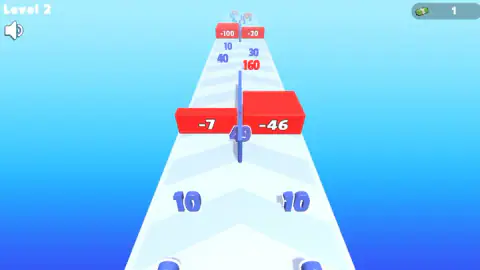
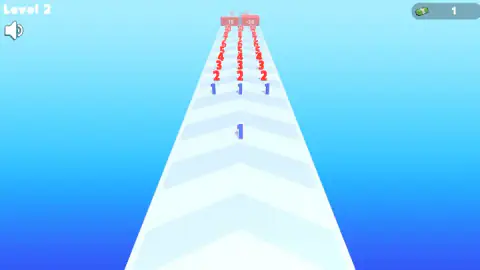
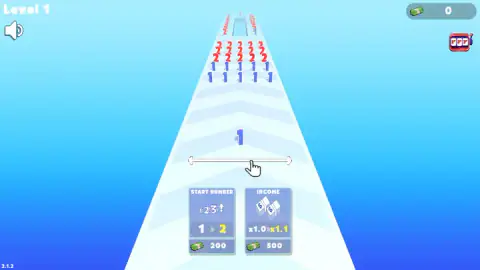
Taken by opening the game ourselves and letting it run — not supplied by the publisher, and not the same picture every other site shows.
How to play Master of Numbers
- Press on the track, near the white bar with two arrows, and drag left or right. The run starts and your number moves forward on its own.
- Slide over blue numbers. Each one is added to yours.
- Keep off red numbers. The game's instructions say a red number bigger than yours ends the run.
- When red walls block the track, choose a side. A wall takes points away instead of adding them.
- Reach the checkered line. A panel then pays you in bills.
Tips from our session:
- Start at the bottom of a column. On level 2 each lane counts up from 1 to 10, and only the first number is blue. Take it and the next one turns blue, and so on up.
- Look at the wall labels from a distance. They are readable from the start of the level, well before you reach them.
- Do not ride the divider. A thin blue fin separates the two walls. Our number sat on it and both walls drained us at once.
- SKIP is the free answer. After a defeat the panel offers a revive for a video. SKIP sends you back to the start of the level with your bills untouched.
Controls
| Press on the track and drag left or right | Starts the run and slides your number sideways; it moves forward on its own |
|---|---|
| START NUMBER and INCOME (before a run) | Two upgrade buttons under your number; we did not buy either |
| CLAIM (after a win) | Takes the bills you won; the green button beside it doubles them for watching a video |
| SKIP (after a defeat) | Turns down the revive and sends you back to the start of the level |
Features
- A number that runs forward by itself while you slide it across the lanes
- Blue numbers are your size or smaller and are added to you; red ones are bigger, until you outgrow them
- Red walls that drain your number point by point as you push through them
- A level 2 where one full lane gives you 56 and the two walls in front of it ask for 60
- Two upgrades, START NUMBER for 200 bills and INCOME for 500, against a purse that starts at 0
- A defeat panel with a choice between SKIP and a revive paid for with a video
- Made by Eccentric Studio Games
Game details
- Developer
- Eccentric Studio Games
- Release date
- February 2025
- Last updated
- August 10, 2026
- Added here
- April 2025
- Technology
- HTML5 (3D)
- Platforms
- Browser (desktop, mouse), Browser (mobile & tablet)
- Classification
- Arcade , Educational , Kids , Puzzle
- Saved progress
- Saving, when available, is managed by this game. Mava cannot confirm your level.
FAQ
How do you play the Master of Numbers game?
You are a blue number on a track. Press on the track and drag left or right to steer; the number runs forward by itself. Every blue number you touch is added to yours, red walls take points away, and the level ends at a finish line with green steps behind it.
What do the blue and red numbers mean in Master of Numbers?
Blue means the number is your size or smaller, so you can pick it up and it is added to yours. Red means it is bigger than you at this moment. The colours change as you grow or shrink. We saw the same 40 painted blue when we were carrying 49 and red when we were down to 32.
What do the red walls do in Master of Numbers?
They subtract. A wall marked -50 takes 50 points off your number, one point at a time, while you push through it, and its own label counts down as it goes. If your number runs out before the wall does, the run ends on the DEFEAT panel.
How do you get past the walls on level 2 of Master of Numbers?
We did not manage it, so this is arithmetic and not a result. One full lane takes you from 1 to 56, and the first two walls read -10 and -50. Running down the middle touched both walls and left us with nothing. The -50 side left us with 6. The -10 side alone should leave 46.
What do START NUMBER and INCOME do in Master of Numbers?
They are the two upgrades shown under your number before a run. START NUMBER offered to raise our starting number from 1 to 2 for 200 bills, and INCOME to raise the payout from x1.0 to x1.1 for 500. Our purse started at 0 and held 1 bill after the first level, so we bought neither.
Is Master of Numbers a math game for kids?
The sums are small. The only question the track asks is whether a number is bigger than yours, and the colours answer it for you. The harder part is planning, because a wall has to be paid for with what you have collected. Some buttons offer a bonus for watching a video, and they can be ignored.
Is Master of Numbers free, and who made it?
It is free and runs in the browser with nothing to install. The game is credited to Eccentric Studio Games. It was published in February 2025.