









About The Biggest Number
Most runners ask you to dodge. The Biggest Number asks you to do sums at running speed, and the odd part is that the sums are not the hard bit. Our first sitting ended about ten times in a row with the same panel, YOU LOST, "Fell into the void", and a final number that never got past 11. The arithmetic was fine. We kept sliding off the floor.
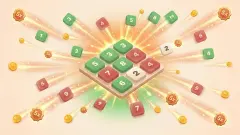
You are a blue number on a pale track that floats in the sky. It runs forward by itself. Other numbers stand on the track in rows and columns, and the rule is one line long: anything your size or smaller can be picked up and is added to you, anything bigger cannot. The game paints that rule for you. Numbers you can take are blue and the rest are red, and the colours change as you grow.
The game is credited to Eccentric Studio Games. It was published on 23 August 2026.
What we played, so you can weigh the rest: three sittings on a desktop, two short ones in early October and a longer one, ten minutes of it, on 22 October. Between them we cleared the first level once and lost the second twice.
That long sitting never got off level 1. Its best run ended on 14, and it spent its ten minutes on the ways the game stops you rather than the way it ends: the void, the pause sign, and an upgrade offered free that never arrived. We have not seen level 3, and we have not played on a phone.
Why a column of small numbers is worth more than it looks
The track is not scattered at random. Its numbers stand in ladders, and the ladders are built so that each rung is within reach once you have taken the one before.
Level 2 opens with three columns that count from 1 up to 10. Starting at 3, the first three rungs are blue and the other seven are red. Take those three and you are carrying 9, so the 4 has turned blue, and so on up.
A whole column is worth 55, the old schoolroom sum of the first ten numbers. From a start of 3 that makes 58, and one more 10 makes 68, which is the number we were carrying when we reached the first gates. The sum is our reading of the track; the game keeps no tally on screen beyond the number itself.
Level 1 has a second kind of ladder: a column that reads 2, 4, 8, 16, 32, 64, 128, each number double the last. Doubling has a neat property: every rung is two more than all the earlier rungs put together. So if you arrive with as little as 2 of your own, each rung you take makes you exactly big enough for the next.
So walk a ladder from the bottom: miss the small rungs and the big ones stay red.
The gap on level 1 hides a similar choice: a column of plain 2s on the left strip, odd numbers climbing to 17 on the right. We took the left and came out with 16.
What the gates do
Most of the gates we have met were red and subtracted. The first pair on level 2 reads -10 on the left and -50 on the right. The second pair reads -100 and -20. The cheap side swaps over, so staying in one lane costs you the big one sooner or later.
Between the two pairs, the floor behind each gate holds different numbers. Behind -10 we saw a 10 and a 40. Behind -50 stood a 30 and a 160, and the 160 was red for us. So a gate is a price and a shop at once, and the dearer door may lead to more than it cost, if you are big enough to pick it up.
Gates that add are real too, which took us three sittings to see. On level 1 a pair of them stood side by side, each marked with a plus and a figure small enough to look like loose change next to the hundreds further up the track. A plus gate is the only thing on that floor you can walk through without thinking; everything else is a decision.
Two ways to lose, and one we cannot explain
"Fell into the void" is the plain one. Your number left the floor. It is the only way we have ever lost on the first level, and the long sitting lost that way again and again, with finals of 9, 10 and 14.
Level 2 beat us differently. Twice the panel read "The number broke", and both times the number under it was 7. Once it came a little past halfway, in front of the -100 gate. Once it came within sight of the arch, among red numbers of 16, 64 and 400. The developer's instructions say a larger red number stops your run, and that fits the second loss. We cannot say for certain what broke the first.
Where the coins go
You begin with 300 coins. Finishing a level pays your final number in coins: 376 for 376 in our case.
| Upgrade | Step | Price |
|---|---|---|
| START NUMBER | 1 to 2 | 200 |
| START NUMBER | 2 to 3 | 400 |
| INCOME | x1.0 to x1.1 | 800 |
We bought both steps of START NUMBER and never had enough for INCOME. One extra point at the start sounds small, but it decides which rungs are blue when you reach the first ladder. Our one clear of level 1 came after the first purchase, not before it.
Those prices are not the whole story, and that is the most useful thing the latest sitting taught us. In that run the same two steps were not for sale: each button carried a red FREE tag and a small video symbol, so the way to grow was to watch a clip rather than to pay. We took the offer, the game answered that no video was ready, and the step stayed unbought. Read that panel before you spend a coin: the step above the one you can afford is sometimes the cheaper of the two.
Four buttons sit on the left edge: a circular arrow, a speaker, a trophy and a target. The developer mentions achievements and leaderboards; we did not open either.
Who it is for
It suits a child who has just learned to add and wants to feel fast at it, and an adult who wants two minutes of route planning. The sums never get harder than "is that one bigger than me". It is a poor fit if you want a test of reflexes: the track is short, and the reading matters more than the dodging.
More games to try next
Cube Snake 2048 uses the same "only take what is smaller than you" rule in an open arena. If the mental arithmetic is the draw, Brain Buster is a timed duel of sums and Correct Math is a quick three-answer quiz. The rest are under puzzle games.
Screenshots
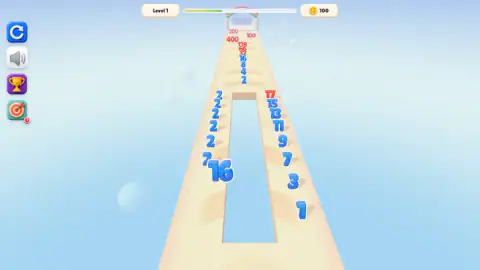
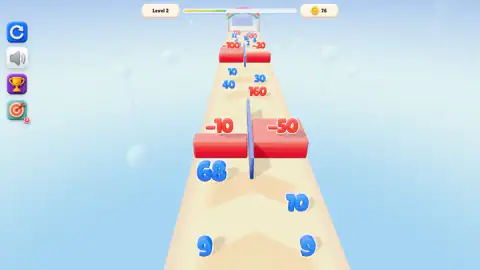
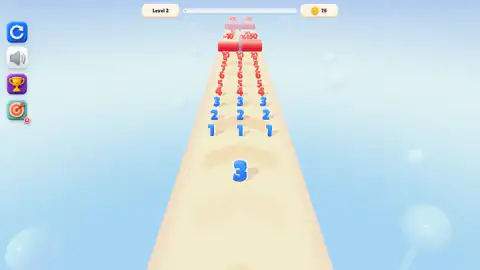
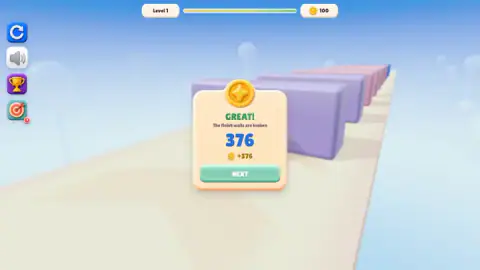
Taken by opening the game ourselves and letting it run — not supplied by the publisher, and not the same picture every other site shows.
How to play The Biggest Number
- Press "Let's Play!", then read the panel before you move. The title card is a big blue 9 over a purple button. One click later, two buttons sit under your number: START NUMBER and INCOME. A red price means you can afford it, a grey one means you cannot, and sometimes the price is replaced by FREE and a small video symbol.
- Steer sideways, and let the track come to you. The game shows you how with a thick orange double arrow in the middle of the lane and a hand pointing at it. Click or drag it left and right; your number handles the running.
- Take blue, leave red. A blue number is added to yours. A red one is bigger than you, for now.
- Pick a gate. Some gates add and some subtract, and where the track splits around a thin divider you have to go through one of the pair.
- Reach the walls. The level ends at a rainbow arch with a line of thick walls behind it. The panel then shows your final number and pays coins.
What three sittings taught us:
- If nothing is moving, read the middle of the screen. A grey sign, "Click to keep playing", parks the run until you click the track. While it is up the game ignores everything else, which is how a paused game gets mistaken for a broken one.
- Nudge, do not shove. The runs in which we held a direction for a full second kept ending in the void. Short nudges kept us on the floor.
- Choose a side before the gap. Level 1 has a long hole down the middle of the track with a strip of floor on each side. Changing your mind halfway is how you fall in.
- Red is not forever. At a starting number of 1, the rows of 2s on level 1 are red. After we paid to start at 2, the same rows were blue.
- Losing is free, and pays nothing. TRY AGAIN puts you back at the start of the level with the same coins you had.
Controls
| Click or drag left and right on the track | Slides the number sideways while it runs forward on its own. This is the control the game teaches, with a double arrow and a hand pointing at it |
|---|---|
| Click the track while "Click to keep playing" is showing | Sets the run going again after a pause. Nothing else moves the number while that sign is up |
| Left / Right arrow keys, or A / D | The same sideways move, listed in the developer's instructions. Short taps steered for us in one sitting and did nothing in another |
| Click START NUMBER or INCOME (before the run) | Buys a higher starting number or a bigger coin payout, with coins or with a short video when the button says FREE |
| Click TRY AGAIN or NEXT | Restarts the level after a loss, or moves to the next one after a win |
Features
- A number that runs by itself down a floating track while you slide it left and right
- Numbers your size or smaller are blue and add to yours; bigger ones are red until you outgrow them
- Gates that change your number: a pair that adds on level 1, and -10, -50, -20 and -100 on level 2
- A finish line of walls, and a coin payout equal to the number you arrive with: 376 for us on level 1
- Two upgrades, START NUMBER and INCOME, paid for with coins or handed over free in exchange for a short video
- A pause sign, Click to keep playing, that parks the run until you click the track again
- Made by Eccentric Studio Games
Game details
- Developer
- Eccentric Studio Games
- Release date
- August 2026
- Last updated
- August 24, 2026
- Added here
- July 2026
- Technology
- HTML5 (3D)
- Platforms
- Browser (desktop, keyboard or mouse), Browser (mobile & tablet, touch)
- Classification
- 3D , Arcade , Educational , Puzzle
- Saved progress
- Saving, when available, is managed by this game. Mava cannot confirm your level.
FAQ
How do you play The Biggest Number?
Your number runs forward by itself and you slide it left and right. Blue numbers are your size or smaller, and touching one adds it to yours. Red numbers are bigger than you and some gates subtract, so you steer around both and try to reach the finish walls with as large a number as possible.
What are the controls in The Biggest Number?
The game teaches one control: a double arrow in the middle of the track with a hand pointing at it, which you click or drag sideways. The developer's instructions also list the arrow keys, A and D, and a swipe on a phone. Short arrow taps steered for us in one sitting and did nothing in a later one, so if the number ignores you, look for the grey sign reading Click to keep playing and click the track.
Why do I keep losing with Fell into the void?
The track floats in the sky and has a long gap down the middle on level 1, and a number that leaves the floor is gone. It was the only way we ever lost on that level, with finals of 9, 10 and 14 on our worst runs. Pick a side of the gap early and stay on it, and steer in short nudges rather than one long push.
What do START NUMBER and INCOME do in The Biggest Number?
START NUMBER raises the number you begin every run with. Going from 1 to 2 cost us 200 coins and from 2 to 3 cost 400. INCOME raises the coin payout from x1.0 to x1.1 and was priced at 800. On a later sitting both of those steps came up free in exchange for a short video instead of coins, so the panel is worth a look before you spend anything.
How do you earn coins in The Biggest Number?
By finishing a level. We reached the end of level 1 with 376 and the result panel paid exactly 376 coins. Lost runs paid nothing: our purse stayed at the same figure after every YOU LOST panel.
What is the biggest number you can reach in The Biggest Number?
We do not know of a ceiling. Our best finish was 376 on level 1, starting from 2. The numbers lying on that track add up to far more than that, so a cleaner run would end higher.
Does The Biggest Number have shields, magnets and multiplication gates?
The developer's description lists a shield, a magnet, spinning saws and gates that add, multiply and divide. We have since met the adding gates, as a pair on level 1 marked with a plus, and the subtracting ones on level 2. The shield, the magnet, the saws and the multiplying gates may come later in the game; we have not been past level 2.
Who made The Biggest Number?
It is credited to Eccentric Studio Games. It was published on 23 August 2026. It is listed for PC, Android and iOS; we played on a desktop computer.