







About Stickman Crowd Runner 3D
Sixty-odd attempts at the first level, and most of them ended identically. A skull, the words WIPED OUT, and a line underneath reading Sunny Start: you made it 24% of the way. Five seconds, start to finish. The same quarter of the same road, over and over.
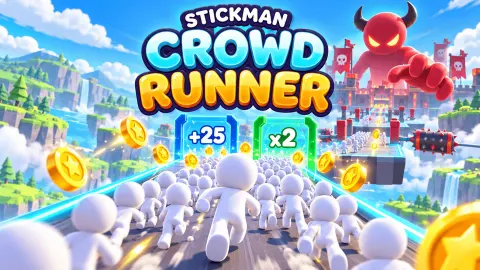
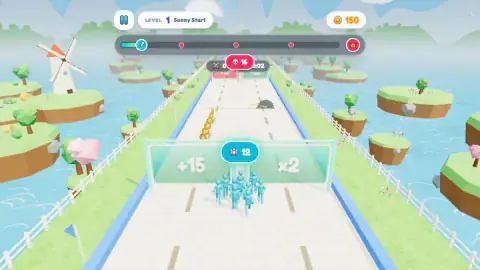
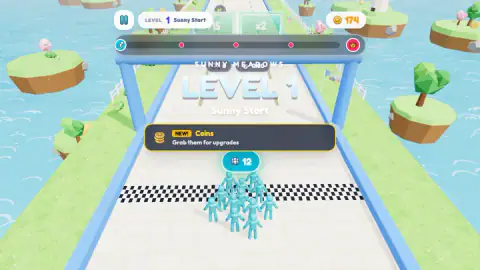
That rut has one cause, and the game tells you what it is on the way past. You drag a crowd of pale blue stickmen down a paved track that runs between floating islands, and a bubble above them counts how many you have. Gates stretch across the road in two halves, each printed with a sum — add this many, or multiply by that. Pick a half and your crowd changes size as it runs through. Further on, a rival mob is waiting, and a red pill at the top of the screen tells you in advance how many of them there are.
So the whole game is one question asked repeatedly: which half of the gate leaves you with more runners. At the first gate of level one, the left panel reads +15 and the right reads ×2, and the bubble over your crowd reads 12. Those two doors are not equal, they are three runners apart, and the advice the game itself hands you on the defeat screen points at the wrong one.
One thing before the rest, because it shapes this page. We never finished level one. Our best attempt stopped at 74 per cent, we never opened the shop or bought an upgrade, and we never saw a boss or a second world.
The first gate is a sum, and the game's own tip gets it backwards
Between attempts, the defeat card shows a hint in a lightbulb box, and one of them reads, word for word: Take ×2 and ×3 gates early, while your crowd is small.
Do the arithmetic on the gate that card sends you back to and the first half of that sentence falls apart. You arrive with twelve runners. The addition door gives twenty-seven. The doubling door gives twenty-four. The plain sum wins, and it wins precisely because the crowd is small.
The reason is a single crossing point, and it is easy to find. Doubling adds as many runners as you already have, so a ×2 gate is worth exactly your current crowd, while a +15 gate is worth fifteen no matter what. The two are equal at fifteen runners. Below that the addition is better; above it the multiplier runs away and never looks back.
The general form is just as short. An addition gate worth A beats a multiplier of N until your crowd passes A divided by N minus one. Against that same plus fifteen, a tripling gate needs only seven and a half runners to overtake it — which is why, with twelve in the bubble, ×3 is a fine choice and ×2 is a waste of a door.
So the honest version of the tip is the opposite of the printed one: multiplication is what you save for once the crowd is already big. Early, while you are small, additions are usually the better buy, and the only early multiplier worth crossing the road for is a large one.
Twenty-four per cent, five seconds, and the mob that is always waiting
The number on every defeat card was the same because the obstacle is the same. A red pill at the top of the screen counts the enemies ahead, and before the first clash of level one it reads sixteen. You start with twelve. Twelve against sixteen is a loss every time, and it resolves in about five seconds.
Which turns the first gate from a flourish into the level's lock. Take the addition and you arrive with twenty-seven against sixteen. Take the doubling and twenty-four still clears it. Take neither and the run is over, and the card afterwards puts it kindly — Enemy mobs charge you, so pick your gates before they arrive.
Our best attempt showed what the level looks like once that lock opens. The crowd peaked at sixty-seven, the counter in the corner climbed as it ran, and a banner dropped across the screen reading "INCOMING!" with the words 45 enemies charging under it. That clash cost us roughly half the crowd in a couple of seconds, and the one after it took the rest. The card called it fourteen seconds and 74 per cent of the way, which remains the furthest we got.
A second hint explains where the spare bodies come from: Run into grey bystanders to recruit them. Grey figures stand along the track, and collecting them is free growth that costs you nothing but a line through the right lane.
What a run pays, and the screens that ask for a video
Coins are the only currency, and the game is straightforward about them. Our purse stood at 219 before the long attempt and 270 after it, because the defeat card totted up the run and printed +51 coins kept in gold. Gold pieces lie in trails along the track and combos pay on top, so a run that lasts twice as long pays considerably more than twice as much.
Spending them is the part of the game we cannot report on. The defeat card nags about it in so many words — Upgrades make every run easier. Spend those coins! — and the game's own description lists a shop with four lines in it, covering starting squad size, coin income, tackle power and how long power-ups last. We never opened it, so take that list as the game's, not ours.
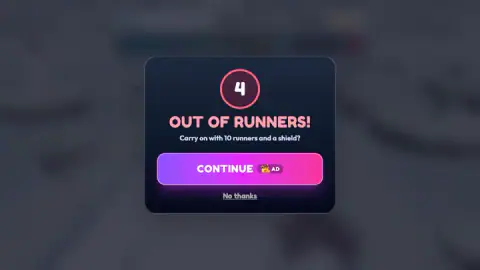
The adverts deserve a plain answer too. An advert slot sits between runs: once a panel appeared over the defeat card, and several times the game instead printed a notice reading "We skipped the ad this time – enjoy the game!" with a button to continue. The other two video prompts are offers rather than interruptions. The "OUT OF RUNNERS!" card asks whether you want ten fresh runners and a shield, with a countdown ring ticking while you decide and a CONTINUE button tagged with a film clapper and the word AD; an underlined "No thanks" turns it down. The Daily Gift panel works the same way, offering a plain claim of one hundred coins or a doubled two hundred behind a video, on a seven-day ladder that ends at seven hundred and fifty.
Everything beyond that is the game talking. Its description promises six worlds, each ending in a boss, along with subtraction and division gates, flip-gates, mystery portals, shields and coin magnets, and a title screen that confirms part of it: ENDLESS and BOSS RUSH sit behind padlocks reading "Unlocks at level 16" and "Unlocks at level 21". One of the defeat hints even coaches the fight we never got to — Tap fast in boss fights to rally your crowd and dodge fewer slams. We can vouch for the meadow, the gates and the mob. The rest is a promise we did not collect.
More crowds, runners and stickmen
If it is the growing army you came for, Soldiers Runner gathers troops on the move and spends them on a wall at the end of each level, and Stickman Simulator: Final Battle swaps the running for picking the squad before the two sides meet. Resize Stickman keeps the stick figure and the three-dimensional track but gives you one stranger power, your own size, while Parkour Runner 3D is the pure version of the same forward sprint with nothing to count. The rest are in action games.
Screenshots

How to play Stickman Crowd Runner 3D
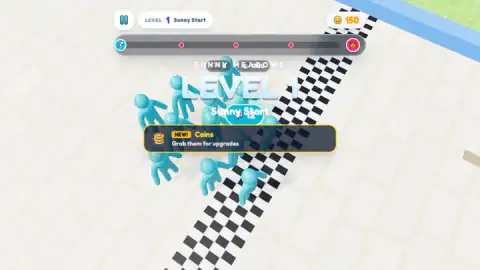
- Close the Daily Gift panel if it is up, then press the green PLAY LEVEL 1 button on the title screen.
- Drag left or right to steer. The game prints the instruction itself on a wide button reading "DRAG TO STEER", with "or hold A / D" in small type underneath.
- Read the bubble over your crowd, then read both halves of the gate ahead, and steer through the half that leaves you with the larger number.
- Keep steering through hazards — a red wrecking ball swings across the track, and spiked barriers sit in one lane or the other.
- Hit the enemy mob with more runners than it has. If you run out, a card offers you ten fresh runners in exchange for a video, and "No thanks" declines it.
What only sitting in front of it teaches:
- The crowd number is the only input the sum needs. It sits on screen directly above your runners, so you never have to guess — you just have to look before the gate instead of at it.
- Pink means worse, not negative. We met a pink gate reading "+2" beside a green one reading "+35". The colour is the game's verdict on the pair, so when both halves are green you are on your own.
- The coin trail runs down one lane only. Chasing it commits you to that side of the road long before the gate arrives, which is expensive whenever the better half turns out to be the other one.
- Clashes are chain reactions. Beating enemies back to back stacks a combo counter, and a four-chain printed itself across our screen as "COMBO x4 · +12 coins".
- The pause panel is harmless. Headed "LEVEL 1 PAUSED", it holds RESUME, RESTART, HOME and switches for sound and music. Nothing is lost while it is open.
Controls
| Drag with the mouse | Steers the crowd across the lanes. The game prints this itself on a button reading DRAG TO STEER, and it is the control we used all session |
|---|---|
| Hold A or D | The keyboard version of the same steer, printed in small type under that button |
| Left or right arrow | Listed by the game as the same steer. In our run, pressing them changed nothing we could see on screen |
| Click, Space, Enter, W or the up arrow | Starts the run. The game's listed instructions also give these as the rapid tap that rallies the crowd in a boss fight, which we never reached |
| The pause button, Esc or P | Opens a panel headed LEVEL 1 PAUSED with RESUME, RESTART and HOME, plus switches for Sound and Music |
| Drag, swipe or tap a finger | The touchscreen equivalents, per the game's own listing. We played with a mouse, so this is the listing's claim rather than ours |
Features
- Every gate is an arithmetic choice, and the two halves are often both good: we met plus fifteen against times two, and times three against times two
- Your crowd size rides above you in a bubble, which is the only number you need to pick a gate correctly
- A gate panel turns pink when the game thinks it is the worse door, not when the number is negative — we saw a pink gate reading plus two beside a green one reading plus thirty-five
- Level one is called Sunny Start, and a mob of sixteen enemies reaches you about a quarter of the way along it
- The defeat card is a report, not a score: how far you got as a percentage, your peak crowd, how many you beat, your time and the coins you keep
- Beating enemies in a chain stacks a combo, and the combo pays: a four-chain was printed on screen as twelve coins
- ENDLESS and BOSS RUSH sit on the title screen behind padlocks that read Unlocks at level 16 and Unlocks at level 21
Game details
- Developer
- Partner studio
- Release date
- October 2026
- Last updated
- October 25, 2026
- Added here
- October 2026
- Technology
- HTML5 (3D)
- Platforms
- Browser (desktop), Browser (mobile & tablet, touch)
- Classification
- 3D , Action , Arcade , Educational
- Saved progress
- Saving, when available, is managed by this game. Mava cannot confirm your level.
FAQ
How do you play Stickman Crowd Runner 3D?
You drag your crowd of stickmen left and right down a running track while the game carries them forward by itself. Gates across the road add to, subtract from or multiply your crowd, and a bubble above the runners always shows how many you have. Rival mobs charge you head on, and you survive a clash by arriving with more runners than they have.
Should you take the plus gate or the times gate in Stickman Crowd Runner 3D?
It depends only on how big your crowd already is, and the sum is quick. A doubling gate beats a plus fifteen gate once you have more than fifteen runners, and loses to it below that. With the twelve runners you start level one with, plus fifteen gives twenty-seven and times two gives twenty-four, so the plain addition is the better door.
Why do runs in Stickman Crowd Runner 3D keep ending at 24%?
Because that is where the first enemy mob meets you, and a starting crowd of twelve cannot beat the sixteen the game sends. The defeat card names the exact spot each time, and it comes up after about five seconds. Growing your crowd at the gate before that point is the whole of the fix.
What does WIPED OUT mean in Stickman Crowd Runner 3D?
It is the defeat screen, shown when the last of your runners is gone. It reports how far along the level you got as a percentage, your peak crowd size, how many enemies you beat, how long you lasted and how many coins you keep from the attempt. A hint box underneath offers a different piece of advice each time, and a TRY AGAIN button restarts the level.
What is OUT OF RUNNERS in Stickman Crowd Runner 3D?
It is an offer, not a game over. When your last runner falls, a card asks whether you want to carry on with ten fresh runners and a shield, with a countdown ring ticking down while you decide. The button that accepts it is tagged with a film clapper and the word AD, so it is a video offer, and an underlined No thanks declines it and sends you to the defeat screen instead.
Are there ads in Stickman Crowd Runner 3D?
Yes, and an advert slot sits between runs. During our session an advert panel appeared over the defeat card, and several times the game instead printed a notice saying it had skipped the advert this time, with a button to carry on playing. Separately, the continue offer and the daily gift both have optional video buttons that you can simply decline.
How do you unlock Endless mode in Stickman Crowd Runner 3D?
By reaching level 16. The title screen shows ENDLESS and BOSS RUSH side by side behind padlocks, with the lines Unlocks at level 16 and Unlocks at level 21 printed under them. A third bar on the same screen tracks progress towards the next character skin and says it is won by winning levels. We never got past the first level, so none of the three opened for us.
Is Stickman Crowd Runner 3D free, and who made it?
It is free and runs in a browser with nothing to install. The studio behind it is not recorded anywhere we can check, so this sheet names no author rather than guessing one. It reached our catalogue on 24 October 2026, which makes it days old at the time of writing rather than a back-catalogue title.