
About Shadow Stick Ninja
A stick figure stands on a ledge with a bow. The sun is going down behind purple hills, the trees are bare silhouettes, and across the ground below, skeletal hands are pushing up out of the earth. On another ledge stands a second stick figure in green goggles, red braces and a propeller cap.
Drag back. Let go. MISSION COMPLETE, and on to the next one.
The next one writes a line across the bottom of the screen: Use baloon to lift the stickman. Spelled exactly like that, with one L. The sunset has gone and a green night has replaced it, under a crescent moon and two constellations drawn as joined-up dots. The same goggled figure is down there again — but he is standing between two upright wooden posts, and the game is not asking you to hit him.
That is the turn this game takes, and it takes it early. The first level teaches you a catapult: pull back from the archer, the angle and length of the pull become the power and the arc, release and watch. The second keeps the catapult and swaps the goal, which is a bigger change than it sounds.
The game is credited to Yes2Games and has been available since February 2026. Our own session ran about four minutes on a desktop: we cleared the opening level, we were moved on, and we spent everything left trying to lift that stickman without ever managing it. We never saw an ending, and nothing below pretends otherwise.
The second level stops being a shooting game
On the first level the goal is the oldest one there is. Man with bow, man without bow, gap in between.
On the second, the posts arrive: two upright wooden planks on a white ledge with the target between them, and underneath, that misspelled instruction. The posts are the point. They are not cover in the usual sense — you can see him perfectly well — but they are furniture, and furniture turns a shot into a problem. Something has to go up, or around, or underneath.
This is also where the arrow column stops being decoration. On the sunset level the balloon circle read zero, so the idea was unavailable. On the green night it read five, and the instruction arrived in the same breath. The game stocks you for the solution it has in mind, then names it.
What success looks like we cannot tell you. We dragged at every angle we could think of, and the target stayed on the ground or went over sideways and stayed there. The game's description says the balloon arrows attach to enemies and carry them upward; that is their account, not ours, because we never saw it happen.
What a balloon can actually lift
Picking a person up with balloons has a real history, and its numbers are why the game's version reads as a cartoon.
On 2 July 1982 a Californian named Larry Walters tied 42 helium weather balloons to a lawn chair in a Los Angeles backyard and cut himself loose. He had meant to drift a few hundred feet. He rose to roughly 16,000 feet, into the approach airspace of a major airport, and came down three quarters of an hour later only by shooting balloons out with a pellet gun. He landed in power lines and was fined, on appeal, fifteen hundred dollars.
Those were not party balloons. They were eight feet across, and he used dozens. The sport that flight accidentally founded runs on the same arithmetic: two British pilots crossed the English Channel under four hundred of them. Lift is slow and stubborn for a reason you can say in a line — a balloon holds air lighter than the air around it, and what it carries is the difference between those two weights, which for a hand-sized balloon is about the weight of a letter.
Shadow Stick Ninja gives you one pink balloon on the end of an arrow and expects it to pick up a grown stick figure. That is physics as a punchline, and it is the right call: the game is not simulating lift, it is using lift as a verb, so a level can have a goal other than hitting. What it keeps honest is the part you can feel — weight, swing, things falling over and staying fallen.
Four circles, and the count is decided before you start
The column down the left edge is where this game keeps its difficulty. Four circles, top to bottom: a white arrowhead on black, a golden bow with an arrow already nocked, a dark bomb with an orange fuse and a skull on it, and a pink-and-white hot-air balloon complete with a basket. Each wears a small red badge.
The second is the one that behaves like an ammunition counter. It read ten on the sunset level before we fired anything, and nine immediately after our first shot. On the green night it started at five and was down to three by the last time we looked.
The top circle is the strange one. It is ringed in gold, which everywhere else in game design means selected, and its badge reads 1 — on the first level, on the second, and after every shot we took. We fired, the second counter dropped, this one did not move. Rather than invent a rule for it, we will say plainly that it is an open question.
The bomb stayed at zero throughout. The game's listing describes bomb arrows as the option that breaks obstacles, which, given those wooden posts, sounds like the tool a later level hands you. On the two we saw, it was a locked door with a window in it.
Ten stages, and all of them had padlocks
The stage screen is the only part of this that looks like a different game: flat blue, white clouds, the word STAGE across the top. Underneath sit ten rounded tiles in two rows of five, and on our first look every single one carried a yellow padlock. A white triangle waits at the left edge, the gesture of a screen with more pages than it is showing.
So you walk through this in order, and those ten tiles are a chapter rather than the whole book. We cleared the first level and stalled on the one after, so we will not guess at a total. What the opening two promise is a shape: ledges, posts and a figure, a fixed handful of arrows, and a sentence telling you what counts as finished. That is a puzzle format, whatever the bow suggests.
More games by Yes2Games
The same studio has a few things on our shelves, and they are not what you would predict from an archer in a dark wood. Fortress Clash is the nearest relative, trading arrows for a siege. Logic Islands is a pencil-and-paper puzzle on the Nurikabe rules, walls to keep connected and islands to keep exact. Merge Mania is numbers against the clock.
If it is the stranded stickman that brought you, Save the Dummy runs the same trick from the other side: a figure is stuck, and you draw the shapes that get him out. Stick Duel: Medieval Wars keeps the loose, tumbling bodies and adds a second player on the same keyboard. The rest is in shooting games.
Screenshots
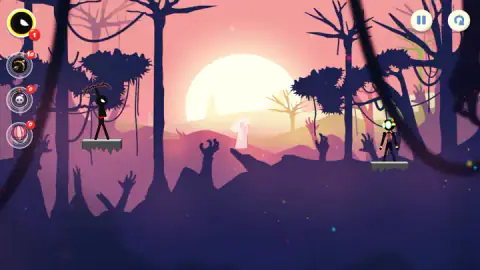
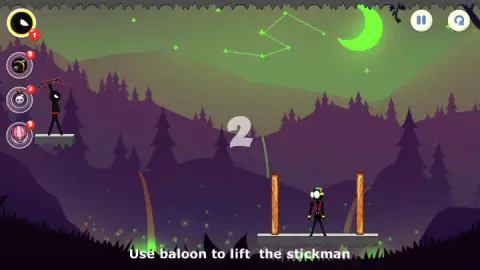
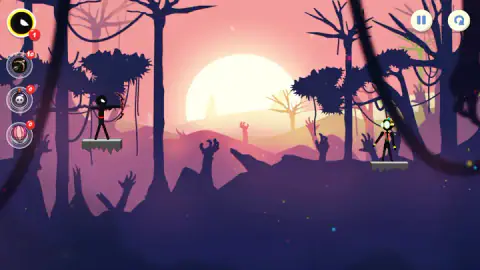
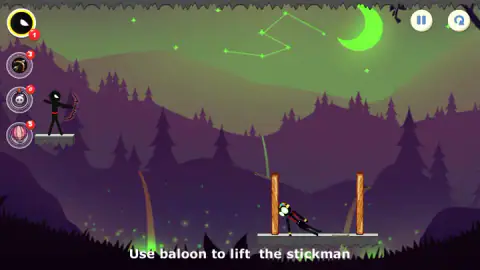
Taken by opening the game ourselves and letting it run — not supplied by the publisher, and not the same picture every other site shows.
How to play Shadow Stick Ninja
- Drag backwards from the archer and let go. There is no power bar and no charge-up. The length and the angle of your drag are the shot, so a short flat pull is a weak flat arrow.
- Read the line along the bottom before you aim. It is not decoration. On the second level it told us to lift the target rather than hit him, and everything the first level taught pointed at the wrong result.
- Pick your arrow before you draw, from the column on the left. Four circles, each with a red number, and that number is what the level has given you.
- Use the restart button in the top-right corner freely. It puts the counts back to where they started, which makes a wasted arrow cheap rather than fatal.
- Keep your hands off the keyboard. We tried the arrow keys and several letters, and nothing happened at all.
What the session taught us:
- The counts are dealt, not earned. The bomb circle read zero on both levels we played: drawn, labelled, empty. Which arrows you get is part of the level's design, like the posts and the ledges.
- The balloon is not a weapon, so stop aiming it like one. Our instinct was to send it at the target the way we had sent the arrow. Lifting needs the thing to connect and then stay connected while physics does the rest.
- The target is the same character every time. Goggles, red braces, propeller cap, in the sunset and in the green night alike: the level is what is new, not the enemy.
- A hit does not tidy anything away. The figure went over sideways and stayed where he fell, flat between his two posts. Bodies here are loose weight, not scenery.
Controls
| Click and drag back from the archer, then release | Fires. How far and at what angle you pull sets the power and the direction, the way a catapult does |
|---|---|
| The four circles down the left edge | One per arrow type, each with its own red number. Pick the type before you shoot |
| Two blue bars in a cream circle, top right | Pause. It sits close enough to the edge of the play area to catch a stray click |
| Circular arrow in a cream circle, top right | Restarts the level from the beginning, with the ammunition back at its starting counts |
| Arrow keys and letter keys | Nothing we could see or hear. This is a game for one hand on a mouse |
Features
- Four arrow types stacked down the left, each carrying a red count that the level deals you rather than one you earn
- The bomb showed zero on both levels we played, so an arrow type can be visible, named and completely unavailable
- A written objective that can replace hitting the target: the second level told us to lift the stickman instead
- Two hand-drawn backdrops in the first two levels, a sunset full of rising hands and a green night under a crescent moon
- The same costumed target both times, in goggles, red braces and a propeller cap, so you always know who you are aiming at
- A stage screen of ten tiles, every one padlocked on our first look, with an arrow at the edge for further pages
- Available since February 2026 and badged E10 and over
Game details
- Developer
- Yes2Games
- Release date
- February 2026
- Last updated
- August 10, 2026
- Added here
- November 2025
- Technology
- HTML5 (2D physics)
- Platforms
- Browser (desktop), Browser (mobile & tablet, touch)
- Classification
- Shooting
- Saved progress
- Saving, when available, is managed by this game. Mava cannot confirm your level.
FAQ
How do you play Shadow Stick Ninja?
You stand on a ledge on the left with a bow, the target stands somewhere to the right, and you drag backwards from the archer and release to fire. The further and steeper you pull, the harder and higher the arrow goes. Before you shoot you can pick an arrow type from the four circles down the left edge, each of which has its own limited count for that level.
What are the four circles down the left side of the screen?
They are the arrow types, and the red number on each one is how many of that type the level has given you. On the two levels we played the top one was ringed in gold and read 1, the second was a bow and arrow that counted down as we fired, the third was a bomb that read zero both times, and the fourth was a pink balloon that read zero on the first level and five on the second.
What does 'Use baloon to lift the stickman' mean?
It is the objective printed along the bottom of the second level, misspelled on screen with one L. Instead of knocking the target down you are meant to get him off the ground with a balloon arrow, which the game's description says attaches to an enemy and lifts him into the air. We never managed it in the time we had, so we can tell you the instruction exists but not what success looks like.
Can you play Shadow Stick Ninja with the keyboard?
Not as far as we could tell. We worked through the arrow keys and several letter keys and nothing on screen moved and nothing played. Everything that happened in our session happened because of a mouse drag or a click, which also matches the control notes the listing gives.
How many levels does Shadow Stick Ninja have?
We cannot tell you a total. The stage screen shows ten tiles in two rows of five, with an arrow at the side that suggests more pages behind them, and on our first look every one of the ten carried a yellow padlock. We cleared the opening level and stalled on the one after it, so we never saw how far the list runs.
Who made Shadow Stick Ninja?
The game is credited to a studio called Yes2Games, which also has Fortress Clash, Logic Islands and Merge Mania on our shelves. No studio name appears on screen while you play. It has been available since February 2026 and was last updated in August 2026.
Is Shadow Stick Ninja suitable for children?
It is rated E10 and over, which is the rating it carries on the game's own listing page. There is no blood and the figures are plain black silhouettes, but the first level is set among skeletal hands reaching out of the ground and the target does flop over like a rag doll when an arrow lands. The aiming itself is forgiving enough for a younger player, since nothing is timed and you can restart a level from the button in the corner.
What is the difference between the arrow types in Shadow Stick Ninja?
The game's description lists three kinds and gives each a job - a plain arrow for a direct hit, a bomb arrow for blast damage that breaks obstacles, and a balloon arrow that attaches to an enemy and carries him upwards. That is their account rather than ours. What we saw first hand is that the screen shows four circles, not three, and that the counts attached to them change from one level to the next.