







About Ricoshield
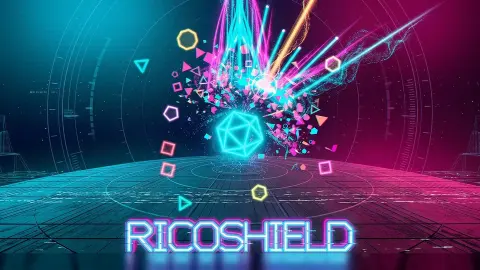
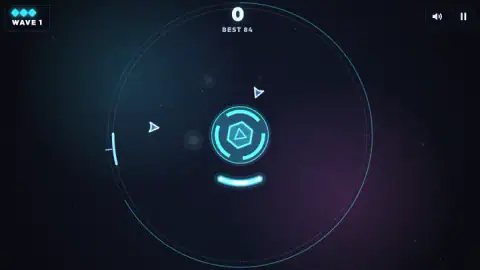
Most arcade shooters give you a gun and a stream of targets. Ricoshield takes the gun away. You have a core in the middle of a dark, round arena, a short curved guard that slides around it, and white arrowheads closing in from several sides at once. The only ammunition you will ever have is the thing trying to break your core.
Catch an enemy on the guard and it is knocked back out as a bolt, which can take out whatever is behind it. Miss, and it reaches the core. That is the whole loop, and it is why the game is called what it is: the shield is the weapon, and every kill is a ricochet.
We played it again on a desktop with a mouse, across about ten runs. Every one ended with the words CORE BREACHED, and none got past wave 2. What that bought us was the upgrade card, over and over with different cards on it, and a stack of results screens to compare.
The game is credited to Goliath Studios and was published in September 2026.
Fourteen points an enemy, and the count that sits apart
Four results cards side by side say more about the scoring than the screen does while you play:
| Score | Destroyed | Perfect | Survived |
|---|---|---|---|
| 70 | 5 | 2 | 24s |
| 42 | 3 | 0 | 23s |
| 38 | 3 | 2 | 23s |
| 14 | 1 | 0 | 22s |
Three of those four land exactly on fourteen points per enemy destroyed; the fourth does not, so fourteen is the usual rate rather than a promise. Either way it tells you something useful: your score counts kills, not seconds. All four lasted about as long and scored five times apart.
The third column is the one to notice. DESTROYED and PERFECT are counted apart, which means there is a good way to stop an enemy and not just a way. The guard has a brighter white middle, and a catch made there is the perfect one.
That is not decoration. One of the upgrades, Echo, reads: «PERFECT deflects fire an extra bolt.» The results card is teaching you to aim for the middle of the guard long before you meet the card that pays you for it.
The upgrade card is the other half of the game
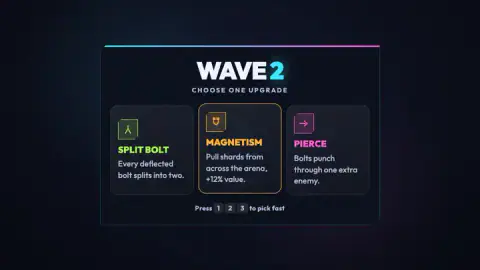
At the start of wave 2 the action stops and three cards appear under the words CHOOSE ONE UPGRADE. You keep one. At the foot of the card the game adds: «Press 1 2 3 to pick fast.»
Across our runs thirteen different upgrades came up, and we were never offered the same three twice. Once you pick, its name stays written across the middle of the arena in big faded letters for the rest of the run, so you always know what to expect from your own bolts.
| Upgrade | What the card says it does |
|---|---|
| Seeker | Bolts curve toward the nearest enemy |
| Pierce | Bolts punch through one extra enemy |
| Split Bolt | Every deflected bolt splits into two |
| Echo | A perfect catch fires an extra bolt |
| Heavy Bolt | Bolts deal more damage and are bigger |
| Chain Arc | Bolts throw lightning to a nearby enemy |
| Overcharge | Every sixth catch sends out a shockwave ring |
| Gravity Well | Enemies slow down once they get close |
| Quicksilver | The guard turns faster |
| Thorns | The core burns anything that touches it, then recharges |
| Fortify | Name only; we never got the card that explains it |
| Momentum | Your combo drains more slowly |
| Magnetism | Pulls shards to you from across the arena and makes them worth more |
The order above is the useful one. The top half makes a single catch do more work, which matters because catches are rare: our best run destroyed five enemies in twenty-four seconds. Gravity Well and Quicksilver instead answer the problem a new player actually has, an arrowhead arriving on the side you are not facing.
The arena tells you how close you are to losing
Three small diamonds sit beside the wave number in the top left corner. All three were lit in wave 1. In our wave 2 pictures one run had two and another had one, so they fall during a run rather than marking which wave you are in. Our reading is that they are what the core has left.
What makes that readable at speed is the colour. While the diamonds hold, the core and the guard glow blue. In the run where one was left, both had turned pink and a red circle had drawn itself round the arena. The game never writes «last chance» anywhere; it changes colour, in the one place you are already looking.
One thing we could not settle: a short lit segment sits somewhere on the thin ring at the edge of the arena, in a different place every time we looked. We do not know what it marks, and we would rather say so than guess.
Ten best runs, in the spirit of 1978
When a run ends, the results card does not only print your score and your best. It says where the run landed among your own ten best. Ours reached #2 of your top 10 at best, and a run that scored nothing at all still took a place in the list, because the list was not full yet.
That idea has a long history. Space Invaders, the 1978 hit, kept only the single top score on the machine. Star Fire, licensed to Exidy at the end of that year, is generally credited as the first arcade game to let the best players type their initials into a table. Those tables were wiped every time the machine was switched off.
Ricoshield keeps the table and drops the strangers. You are compared with yourself, run by run. That suits a game whose runs end in well under a minute: one best score stops moving once it is high, while a top ten still tells you that a middling run was your fifth best that day.
Shards, the Hangar and the advert that did not arrive
Every run pays out shards, and here is the odd part: every card we saw paid the same amount. The run that scored 70 and the run that scored 14 ended with the same figure. Whatever shards are for, finishing earns them, not finishing well. Magnetism offers to pull them in from across the arena, so there is more to them during a run than that flat payout, but we never saw the number move.
Beside the payout the card offers Watch Ad · Revive, which we never pressed, Double Shards, a Hangar button carrying a small count that changed between runs, Ranks and Daily, none of which we opened. Once, between runs, a card appeared over the results saying it had skipped the advert this time, with a Continue playing button under it.
The listing describes more than we met: armoured enemies that only a ricochet can kill, other cores, and a ring round the arena in later waves. We never got past wave 2, so we saw none of it. The keyboard did nothing for us beyond the 1, 2 and 3 keys, and we did not play on a phone.
More arcade defence and shooting games
Ricoshield suits anyone who likes short, sharp runs and a number to beat, and nobody who wants a trigger: you never aim or fire at will. For upgrades picked mid-run against waves of aliens, try Space Survivor. Bounce Up builds a run from upgrades too, with balls and pegs instead of bolts. Space Destroyer is a classic top-down shoot 'em up where you do have a gun. For the same plain shapes and quick reactions, Geometry Vibes asks you to dodge rather than catch. The rest are under shooting games.
Screenshots
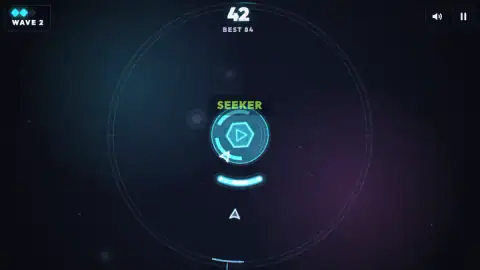

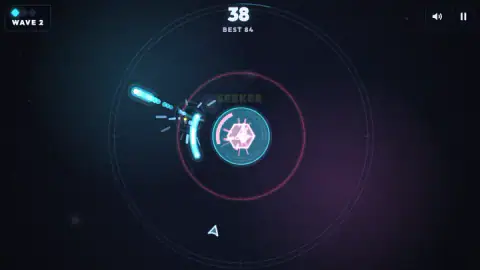
Taken by opening the game ourselves and letting it run — not supplied by the publisher, and not the same picture every other site shows.
How to play Ricoshield
- Start a run. Wave 1 begins at once, with the score at the top of the screen and your best under it.
- Move the mouse. The guard, a short glowing bar, swings around the core to face your pointer.
- Put the guard between the core and each incoming arrowhead. A caught enemy flies back out as a bolt.
- Aim to catch enemies on the white middle of the guard. The results card counts those as PERFECT.
- At the start of wave 2, pick one of three upgrades by clicking a card or pressing 1, 2 or 3.
What our runs taught us:
- Watch the gaps, not the nearest enemy. The arrowheads come from several sides at once, and the guard covers a small slice of the circle. The one you are not facing is the one that hurts.
- Small moves. The guard follows the pointer around the core, so a short flick of the mouse is a big swing on screen.
- Check the colour of your own core. It glows blue while you are safe and pink when you are one hit from losing.
- Do not rush the upgrade card. The game waits for you, and you will not be offered that exact set of three again.
Controls
| Move the mouse | Swings the guard around the core so it faces the pointer |
|---|---|
| Click an upgrade card, or press 1, 2 or 3 | Picks one of the three upgrades offered at the start of wave 2 |
| Pause button, top right | Pauses the run |
| PLAY AGAIN | Starts a new run from wave 1 straight from the results card |
Features
- A single round arena with a hexagonal core in the middle and a short curved guard that orbits it
- Enemies shaped like small white arrowheads that close in from several sides at once
- A guard with a brighter white middle, and a PERFECT count on the results card for catches made there
- One upgrade chosen from three cards at the start of wave 2, with its name left written across the arena for the rest of the run
- Thirteen different upgrades turned up across our runs, and the three on offer were never the same twice
- A core that turns from blue to pink, with a red circle round the arena, when only one of its three diamonds is left
- A results card with score, best, rank among your own ten best runs, enemies destroyed, perfect catches and seconds survived
- A flat payout of shards on every run, plus Hangar, Ranks and Daily buttons beside it
Game details
- Developer
- Goliath Studios
- Release date
- September 2026
- Last updated
- September 4, 2026
- Added here
- August 2026
- Technology
- HTML5
- Platforms
- Browser (desktop)
- Saved progress
- Saving, when available, is managed by this game. Mava cannot confirm your level.
FAQ
How do you play Ricoshield?
You guard a core in the middle of a round arena. Move the mouse and a short curved guard swings around the core to face it. Enemies fly in from several sides; catch one on the guard and it is knocked back out as a bolt that can hit others. If enough of them reach the core, the run ends with CORE BREACHED.
Is there a gun in Ricoshield?
No. The only way to hurt anything is to catch an enemy on your guard and send it back out. That is the idea behind the name, a shield that makes ricochets.
What does PERFECT mean in Ricoshield?
The guard has a brighter white middle. Catching an enemy there counts as a perfect catch, and the results card lists those separately from the enemies you destroyed. One of the upgrades, Echo, fires an extra bolt on every perfect catch, so the distinction pays off rather than just being recorded.
How many upgrades does Ricoshield have?
We saw thirteen different ones across our runs: Magnetism, Seeker, Overcharge, Pierce, Echo, Gravity Well, Split Bolt, Quicksilver, Momentum, Heavy Bolt, Thorns, Chain Arc and Fortify. Three are offered at the start of wave 2 and you keep one. The three were never the same twice, so the full set may well be larger.
When do you get upgrades in Ricoshield?
At the start of wave 2 the action stops and three cards appear under the words CHOOSE ONE UPGRADE. Click one, or press 1, 2 or 3 as the card suggests. After you pick, the upgrade's name stays written in large faded letters across the middle of the arena for the rest of the run.
How many points is each enemy worth in Ricoshield?
Most of our results cards worked out at fourteen points per enemy destroyed: one enemy scored 14, two scored 28, three scored 42 and five scored 70. One card broke the pattern with 38 for three enemies, so treat fourteen as the usual rate rather than a fixed rule.
What does "#2 of your top 10" mean in Ricoshield?
Every run is ranked against your own ten best, not against other players. When a run ends, the results card says where it landed in that list. Early on the list is not full, so even a run that scores nothing takes a place in it.
Who made Ricoshield?
The game's listing credits Goliath Studios. It was published on 3 September 2026.