
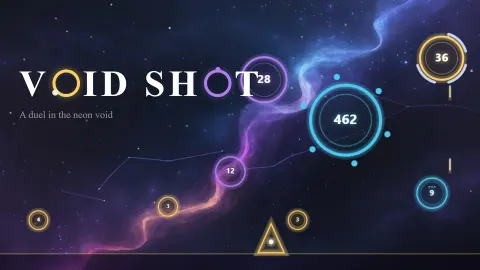











About Void Shot
Most shooters in a browser hand you two things: a way to point the gun and a button to make it go off. Void Shot takes both away. The cannon sits on a thin gold rail across the bottom of the screen, fires on its own from the moment a wave begins, and every shot leaves straight up. No trigger, no angle. The only thing you decide is where along that rail you are standing when the next shot goes.
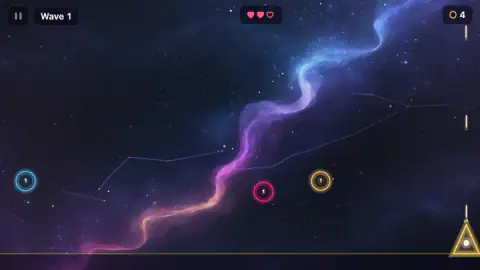
That should make it less of a game than a screensaver, and it does the opposite. Because the shots travel vertically and only vertically, hitting something means being directly underneath it at the right moment. The targets are rings — cyan, magenta, gold, purple — that drift down out of the starfield with a number printed in the middle. Let one reach the gold rail and it costs you a heart. You get three, and they sit along the top of the screen where you can watch them go.
The game is credited to Vorval and was published in July 2026 and updated the day after. That listing is also the only place we could find the name: no studio site, no second portal with a different credit, nothing to check it against. Take the developer as one source rather than three.
Here is what this page is built on. We played several runs across about four minutes, on a desktop, with the mouse and the arrow keys, and we cleared no waves at all. Everything below either happened on our screen or was printed on it by the game, and where we did not get far enough to know something, the page says so.
The cannon only shoots up, and that is the whole design
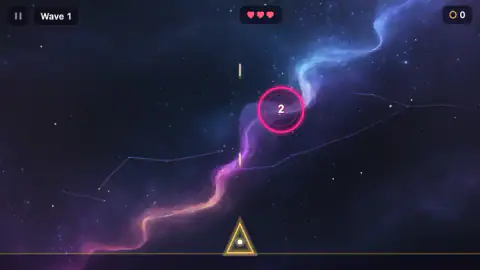
One moment from our run explains the game better than any description could. A single magenta ring marked 2 hangs in the middle of the screen, the cannon sits centred at the bottom, and two shots are climbing between them in a perfectly straight vertical line. Not a spread, not a cone, not an arc. A column.
Once you see that, every decision in the game follows from it. Your firepower is a line of fixed width that you drag left and right along the bottom. Everything above you is either in that line or it is not. There is no partial credit for being nearly underneath something, no way to cover two columns at once, and no way to answer a ring on the left and a ring on the right except to pick one and accept what the other does to you.
What that buys is a very clean kind of tension. The thing you are short of is never ammunition, because the cannon never stops. It is attention, spent as position. Each ring you stand under is a ring you chose over another one, and the cost of choosing wrong shows up at once: the ignored ring keeps sinking, and the gold rail does not move.
Where the one-axis shooter comes from
The rail at the bottom of this screen is nearly fifty years old. Taito released Space Invaders in 1978, designed by Tomohiro Nishikado, and it set the pattern: a laser base running left and right along the bottom, a gun that only fires upward, and enemies that descend. The arrangement got a name of its own — the fixed shooter — and the name is literal. The direction of fire is fixed and your movement is one-dimensional. Galaxian and then Galaga kept the same rail.
The most-told story about that game is a happy accident, and it is worth knowing because Void Shot inherits its logic. The original machine drew the aliens one at a time and could not keep up with a full screen of them, so the formation crawled. As you shot them, the machine had less to draw and the survivors sped up. The difficulty curve was a side effect of the hardware rather than a rule anyone wrote, and Nishikado's account is that he kept it because it played better that way.
What Void Shot changes is the trigger. In the original you had a fire button, and firing was rationed: one shot of yours could be in the air at a time, so a miss was a real loss. Here firing is free, constant and automatic. Taking the button away sounds like a simplification and is really a substitution — the scarce resource moves from shots to standing room, and the game gets harder to play well rather than easier.
What the screen is telling you
The counter in the top-right corner holds the coins from this run. It starts at zero and climbs while you play; the best we managed was seventeen before the last heart went, and the end screen repeats that total beside a coin icon. The title screen carries a coin figure of its own, next to your best wave, which is where a banked total would live — though with nothing cleared we never watched it change.
The rings carry two pieces of information, and we are confident about one. The number in the middle is printed plainly, and the only values we saw were 1 and 2. The size is a separate matter: two cyan rings both marked 1 sat on screen at noticeably different sizes, one almost down at the rail. Whatever the size means, it is not the number, and we would rather say so than invent a rule for it.
When the run ends
Losing is announced in spaced-out capitals — LOST IN THE VOID… — over a very large figure for the waves you reached, with the word WAVE underneath. Ours read one. Below it came a line of stars around the words "New best!", and under that a badge reading Rank #2. One wave was enough to put us second on whatever board we were measured against, which says more about the game's age than about our play.
Then the offers: a revive and a doubling of that run's coins, both tagged as ads and both saying watch ad in plain text underneath, with UPGRADES below them and a yellow PLAY AGAIN under the panel. Nothing there is disguised, and nothing interrupted a wave while it was running. Between PLAY AGAIN and the next wave sits an ad slot, and twice it did something worth reporting: instead of an ad we got a note from the game saying it had skipped the ad that round, with a button to carry on. Twice in four minutes is not a rate, so how often that happens is one more thing we cannot tell you.
More arcade games like Void Shot
Roads Off Fury is the closest relative in our catalogue: the car drives itself, the minigun fires itself, and all you control is the angle of the barrel — the same trick rotated ninety degrees. Ship & Fish drops the shooting and keeps the positioning, steering a small boat through traffic that crosses from both sides. Geometry Rash shares the neon and cuts the controls down to one button, and Jumper Jam gets six whole towers out of two keys. The rest are in arcade games.
Screenshots

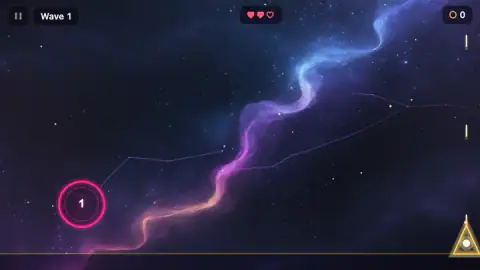
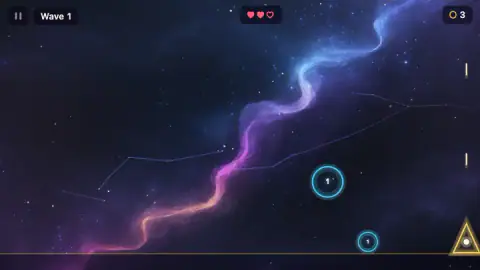
How to play Void Shot
- Press PLAY. The title screen carries the game's own summary of its controls, printed in one line under the buttons: Drag to move — the cannon fires by itself. That is the whole manual.
- Move the cannon. On a desktop the mouse slides it along the bottom rail, and the arrow keys do the same in steps. When the wave starts the game puts up its own reminder, Mouse or ← → keys. On a phone you drag anywhere and the cannon follows your finger.
- Get under a ring. You are not aiming, you are queueing. The shots are already leaving, so a ring dies when it and the cannon share a column of the screen.
- Read the height, not the number. The rail along the bottom is the losing line. A ring near the top is a problem for later; a ring near the rail is a heart about to be spent.
- Pause with the button in the top-left corner. It opens a panel marked PAUSED, with separate switches for Sound and Music, a CONTINUE button and a MENU button.
Tips from playing it:
- Stop treating it like a twin-stick shooter. Our first instinct was to chase rings sideways, and it is exactly the wrong instinct. Moving is how you aim, so every time you slide across to a new target you stop shooting the one you were already under.
- The corners are traps. A ring at the very edge of the screen can only be answered from one side, and while you are parked out there the middle is unguarded. Our runs ended with the cannon pinned against the right-hand edge, which is not a coincidence.
- You can see your own fire rate. The shots show up as short vertical dashes climbing the screen, evenly spaced. The gap between two of them is the time between two shots, which tells you whether a ring that is already low can still be killed.
- Nothing warns you about the hearts. No sound plays when one goes. The row at the top is the only notice you get, so look at it between rings rather than after the run.
Controls
| Mouse move | Slides the cannon along the rail at the bottom of the screen |
|---|---|
| ← / → | The same movement from the keyboard, in steps |
| Drag (touchscreen) | Drag anywhere and the cannon follows your finger |
| Fire | There is no fire key. The cannon shoots upwards on its own, continuously, from the moment the wave starts |
| Pause button (top left) | Opens a panel marked PAUSED with separate switches for Sound and Music, a CONTINUE button and a MENU button |
Features
- No trigger and no angle: the cannon fires straight up by itself, so your only input is which column of the screen it is standing in
- Targets are neon rings that drift down out of the starfield, each one with a number printed in its middle
- A gold rail runs across the bottom; a ring that reaches it costs you a heart, and you start a run with three
- Coins are counted during the run and totalled on the end screen — our best run banked 17 of them
- An UPGRADES screen is reachable from both the title screen and the end screen, so coins are clearly meant to be spent between runs
- A leaderboard that gave us Rank #2 for reaching one wave, which says more about the game's age than about our play
- Credited to Vorval, published in July 2026
Game details
- Developer
- Vorval
- Release date
- July 2026
- Last updated
- July 12, 2026
- Added here
- May 2026
- Technology
- HTML5 (2D, landscape and portrait)
- Platforms
- Browser (desktop, mouse or arrow keys), Browser (mobile & tablet, touch)
- Saved progress
- Saving, when available, is managed by this game. Mava cannot confirm your level.
FAQ
How do you aim in Void Shot?
You do not aim, you position. The cannon fires straight up and only straight up — the shots leave in a vertical line directly above it, which you can watch on screen. Hitting a ring means standing in the same column as the ring at the moment a shot reaches its height. Moving sideways is the whole of your aiming.
What are the controls for Void Shot?
On a desktop you slide the cannon with the mouse, or move it in steps with the left and right arrow keys; the game prints the reminder "Mouse or ← → keys" when a wave begins. On a phone or tablet you drag anywhere on the screen. There is no fire button of any kind, and a pause button sits in the top-left corner.
What do the numbers inside the rings mean in Void Shot?
Every ring has a number printed in the middle of it. We only ever saw ones and twos, and our read is that it is how many hits that ring still needs, which would make a 2 a ring you have to stay under for longer. The game never says so in as many words, so treat that as our reading rather than a stated rule. The ring's size is a separate thing: we saw large and small rings both carrying a 1.
How many lives do you get in Void Shot?
Three, shown as hearts along the top of the screen. You lose one when a ring gets past the cannon and touches the gold rail at the bottom. Nothing sounds when it happens — we only noticed we were down to two hearts by glancing at the top of the screen — so the heart row is worth checking on purpose.
What are the coins for in Void Shot?
They go to an UPGRADES screen, which you can open from the title screen and again from the screen you get when a run ends. That placement is the game telling you coins are a between-runs currency rather than something you spend mid-wave. We never bought anything, so what the upgrades cost and what they change is a gap in this page rather than something we are going to guess at.
Does Void Shot have ads?
Nothing interrupted a wave while we were playing. The end screen offers two things in exchange for watching one — a revive and a doubling of the coins from that run — and both are labelled as ads in plain text, so neither is a trap. There is also an ad slot between pressing PLAY AGAIN and the next wave: twice it came up with the game's own note saying it had skipped the ad that round, and we cannot tell you how often that happens.
Does Void Shot work on a phone?
It is listed for Android and iOS as well as PC, and lists it in both landscape and portrait, which is unusual and fits a game whose only control is a finger sliding left and right. The title screen's own one-line instruction is written for touch first: drag to move, and the cannon does the rest. We played it on a desktop, so the phone version is something we are reporting rather than something we tested.
Who made Void Shot?
It is credited to Vorval and was published in July 2026, updating it the following day. That listing is the only source we could find: no studio site, no second portal carrying a different credit, nothing to check it against. Note also that a separate game called VOIDSHOT exists on an indie-games site — a Windows first-person arena shooter from another studio entirely — and it is not this one.