








About SHADOW NODE
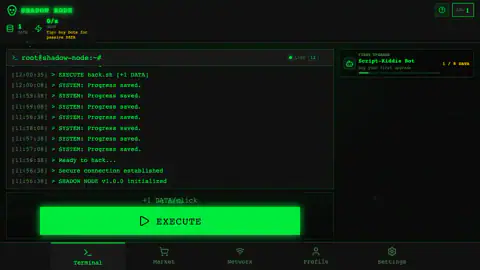
Under the counters on the opening screen, in amber, SHADOW NODE prints a line of advice about itself: Tip: buy bots for passive DATA. Directly below it sits a bright green button that fills a third of the screen, labelled EXECUTE, with +1 DATA/click written above it. The game has given you one thing to press and, in the same breath, told you that pressing it is the wrong way to play.
That contradiction is the whole genre in two lines of interface, and this game states it more plainly than most. Press EXECUTE and the counter goes up by one. Press it ninety times, as we did, and the counter reads ninety — while the other number in the header, the one measuring what arrives without you, still reads 0/s. Everything in SHADOW NODE is arranged to move you from the first number to the second.
NETBYTE made it, and it was published in August 2026. The fiction is standard cyberpunk — a green-on-black terminal, a skull for a logo, scripts with names like hack.sh — and it is fiction throughout: nothing you press has any connection to anything outside the tab. Our session ran about four minutes on a desktop, which was enough to reach the Black Market and nowhere near enough to reach the end of anything.
The arithmetic the tip is telling you about
Here is why the game argues against its own button. A click pays you once. An item pays you forever.
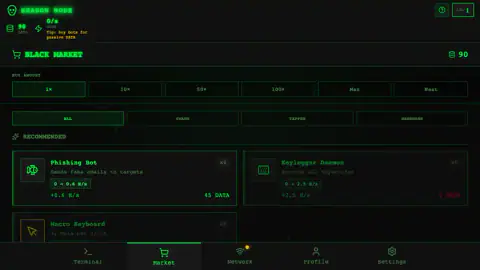
The first card in the Black Market is a Phishing Bot, described on its own face as sending fake emails to targets, and the card is unusually honest about the deal: it moves your rate from 0 to 0.6 a second, and it costs 45 DATA. That is forty-five presses of a button. At 0.6 a second the thing earns its own price back in about seventy-five seconds, and then it keeps going, for as long as the tab is open and — the game claims — for a while after it closes.
So the button is a loan against the first purchase, and after that it is a rounding error. This is the shape of every incremental game ever written: a resource you can earn by hand, a second resource that is really a rate, and a steadily widening gap between what a hand can do and what a rate can. The second card on the shelf, a Keylogger Daemon, is listed at 2.5 a second — four times the first one — which tells you how fast the ladder is meant to climb. Its price was printed in a red zero we could not make sense of, so we are not going to quote you one.
The vocabulary is borrowed wholesale from somewhere real. Hash rate, written H/s, is a term from cryptocurrency mining, where it counts how many guesses a machine makes every second while trying to win a lottery of arithmetic. Miners quote it the way drivers quote horsepower. SHADOW NODE takes the unit, the abbreviation and the logic — more hardware, more per second — and hangs a hacking story on it. Which brings us to the one genuinely odd thing we saw: the log announced INSTALLED: Script-Kiddie Bot [+0.15 H/s], and the rate display in the header carried on reading 0/s for the rest of our session. Most likely it rounds to whole numbers and a fifteen-hundredth of a hash never made it over the line. We cannot prove that, so we are telling you what we saw instead.
The log does the storytelling, and the prompt gives the game away
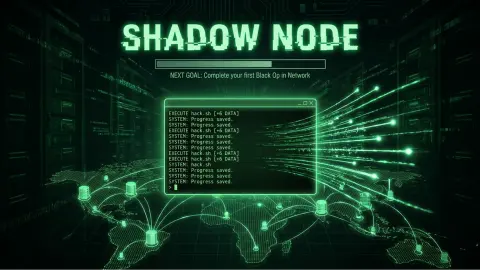
The middle of the screen is a terminal panel, and it is the best thing in here. It is headed root@shadow-node:~#, with a green dot beside it marked LIVE and a number that climbed as we played — 12, then 27, then 40, then 50, where it stopped, which looks like the number of lines it keeps before the oldest fall off the top.
That heading is a joke for anyone who has used a command line, and it is worth unpacking because the game never does. A prompt of that shape reads who you are at which machine, then where you are standing — ~ is the shorthand for your own home folder — and then one character that says what you are allowed to do. A $ means an ordinary account. A # means the administrator: the account with no restrictions, the one that can delete anything. SHADOW NODE puts the # on screen before you have earned a single point. You do not break into the machine over the course of the game. You start already owning it, and the rest is shopping.
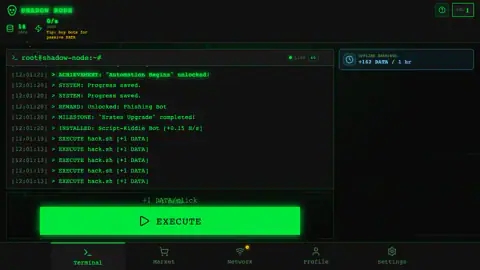
Everything the game has to tell you arrives as a line in that log, stamped with the clock: SHADOW NODE v1.0.0 initialized, Secure connection established, Ready to hack..., then an endless column of executions, then the occasional coloured line when something happens — an achievement in bright green, a reward in red. No pop-up window ever interrupts you. It is a cheap trick and a good one: the fiction is not narrated at you, it is printed, and you read it the way you would read any other output scrolling past.
The seams show, mind. One of our milestones came up as MILESTONE: "Erstes Upgrade" completed! — German, in an otherwise entirely English game, meaning simply first upgrade. A translation file that did not quite land, showing through a hole in the curtain.
Where we stopped, and what we are not claiming
Four minutes, level 1, ninety DATA, two of the five tabs. We installed the first helper from the side panel and bought nothing at all in the Black Market — all three cards on its shelf still read x0 when we left. We never opened Network, Profile or Settings.
The game's own listing promises a prestige reset, a trace meter and a currency called Dark Matter. We reached none of the three and will not describe what we did not see. What we can tell you is the shape of the thing: bulk-buy buttons that go to a hundred at a time, four categories of item, a tab that lights up with a notification you cannot yet answer. That is a game built for weeks of short visits, and our visit was one of them.
More things to leave running
Heist Idle is the closest neighbour in subject — the same genre with the crime made literal rather than digital. Idle Game Dev Simulator runs the identical loop with the fiction turned inward, and is the better pick if you like watching a screen fill up with text. Click Click Clicker and Click That Button are the genre reduced to its one honest question, with no story hung on it at all. Black Hole: Eat the Universe is what happens when an incremental game picks the largest possible units instead of the smallest. The rest are in clicker games.
Screenshots
How to play SHADOW NODE
- Click the middle of the opening screen to get through to the terminal. It took us a handful of clicks before the green button appeared.
- Press EXECUTE. Each press adds one DATA and writes its own line into the log above:
EXECUTE hack.sh [+1 DATA], stamped with the time. - Watch the narrow panel on the right. Ours read FIRST UPGRADE · Script-Kiddie Bot with a progress bar and the figures 1 / 8 DATA — that bar is your real target, not the counter.
- When the bar fills, the panel grows an Install button. Press it. The log answers with four lines at once: an achievement, a milestone, a reward and the installation itself.
- Open the Market tab for the Black Market, where the rest of the game lives.
Things we only found out by being there:
- The side panel is the game's agenda, and it changes. While we were poor it advertised the first upgrade. The moment we took it, the panel swapped itself for a clock and a different pitch: OFFLINE EARNINGS · +162 DATA / 1 hr.
- It saves every thirty seconds and tells you so. The log is littered with
SYSTEM: Progress saved.lines, and their clock stamps are exactly half a minute apart. You can close the tab without ceremony. - The LVL badge in the top right is a readout, not a door. We clicked it; nothing opened.
- Set the buy amount before you shop, not after. The Market has a row of 1x, 10x, 50x, 100x and Max buttons at the top, and it is sitting right there before you have enough DATA to need it.
- The Network tab grows a yellow dot once the first upgrade lands. We ran out of session before opening it, so what it wants is still a question.
Controls
| Click or tap EXECUTE | Adds one DATA and prints a line in the terminal log. The label above the button tells you the current rate — ours read +1 DATA/click all session |
|---|---|
| Click the Install button on the right-hand panel | Takes the upgrade the game is currently nagging you about. The panel only grows that button once you can afford it |
| Terminal, Market, Network, Profile, Settings | The five tabs along the bottom. Terminal is where you press the button, Market is where you spend what it gave you |
| The 1x / 10x / 50x / 100x / Max row in the Market | Sets how many copies of an item one press buys, so a later purchase does not need a hundred separate clicks |
| ALL / SWARM / TAPPER / HARDWARE | Filters the Market. Swarm items raise the automatic rate, Tapper items raise what a click is worth, going by what the cards themselves say |
| The "?" in the top right | The game's own help. The LVL badge beside it is a readout, not a button — we clicked it and nothing opened |
Features
- One button does the whole game: EXECUTE pays +1 DATA a press, and every press prints its own timestamped line in the log
- The game's opening advice contradicts its own main button — an amber tip under the counters reads: Tip: buy bots for passive DATA
- A side panel names one goal at a time: ours tracked a first upgrade at 1 of 8 DATA, turned into an Install button when the bar filled, then switched to showing offline earnings
- The terminal is the narrator: achievements, milestones, rewards and installations all arrive as coloured lines in a scrolling log rather than as pop-ups
- It saves itself every thirty seconds and says so each time, so closing the tab costs you nothing
- A Black Market with four filter tabs and bulk-buy buttons up to 100x and Max — built for a save that will one day have thousands of items in it
- Market cards state exactly what they change: a Phishing Bot moves the rate from 0 to 0.6 a second, a Macro Keyboard adds +2 to each click
- Five tabs, two of which we never needed in four minutes — the shape of a game meant to be returned to, not finished
Game details
- Developer
- NETBYTE
- Release date
- August 2026
- Last updated
- October 23, 2026
- Added here
- July 2026
- Technology
- HTML5
- Platforms
- Browser (desktop), Browser (mobile & tablet, touch)
- Classification
- Clicker
- Saved progress
- Saving, when available, is managed by this game. Mava cannot confirm your level.
FAQ
What kind of game is SHADOW NODE?
It is an idle clicker dressed as a cyberpunk hacking fiction. You press a button marked EXECUTE to earn a resource called DATA, then spend DATA on items that earn it for you automatically, and the loop widens from there. Nothing in it is a test of reflexes or skill; it is a game about arithmetic and patience.
How do you play SHADOW NODE?
Click the green EXECUTE button on the Terminal tab. Each press adds one DATA and prints a line in the log above it. Once you have eight DATA, the panel on the right offers you your first automatic helper; from then on the Market tab is where everything you earn gets spent.
What is hash rate in SHADOW NODE?
It is the game's name for how much DATA arrives per second without you touching anything, written as H/s. Clicking does not raise it; buying items does. The Market cards are explicit about the trade — a Phishing Bot is listed as taking you from 0 to 0.6 a second.
Is SHADOW NODE free, and does it work on a phone?
It is free, it runs in the browser on this page, and there is nothing to install. It is listed for desktop, mobile and tablet alike, and the layout — a tall column of panels over a five-tab bar — is clearly built with a phone in mind. We played it with a mouse, so how it feels under a thumb is its claim rather than ours.
Who made SHADOW NODE and when did it come out?
A developer listed as NETBYTE. It was published in August 2026 and was last updated a week later. We could find no studio website, so that author page is the only thing to point at.
Does SHADOW NODE keep earning while the tab is closed?
It says it does. Once we had taken the first upgrade, the side panel swapped its contents for a clock and the line +162 DATA / 1 hr. We played a single four-minute session and never came back to a filled-up counter, so that figure is the game's promise, not something we have checked.
Does SHADOW NODE save your progress?
Yes, and it is unusually loud about it. A line reading SYSTEM: Progress saved. appears in the terminal every thirty seconds, which you can time off the clock stamps on the log lines themselves. Closing the tab mid-run should cost you half a minute at worst.
How long does SHADOW NODE take?
There is no ending to reach, which is the point of the genre. Our four minutes took us to level 1 and ninety DATA, which is barely the first rung: the Market's bulk-buy row goes up to a hundred at a time and Max, and nobody designs that button for a save worth ninety of anything.