




About Logic Islands
The puzzle in Logic Islands is named after a wall nobody can see. In Japanese folklore the nurikabe is an invisible barrier that blocks travellers on a road at night, and in 1991 a Japanese puzzle magazine borrowed the name for a grid game where your job is to draw the walls. Logic Islands is that game, with a toolbar, a tutorial and six worlds of boards.
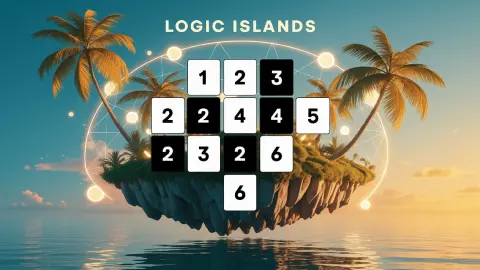
It looks like a number puzzle and plays like a map. Each number on the grid is an island, and the number is its size in squares. Everything that is not island becomes wall, and the wall has rules of its own: it has to stay in one piece, it has to keep the islands apart, and it can never pile up into a solid two-by-two block. You are not adding numbers. You are working out where the coastline goes.
We should say plainly how our own session went. We did the whole tutorial on the first board, World 1-1, then spent about seven minutes on it and did not solve it. When we stopped, one of our walls sat on a square that belonged to the big island. It is a four-by-four board with three numbers, and it still caught us out, which tells you something about the genre.
Logic Islands is made by sublevelgames, the studio behind Dot and Dot and Cube Sort. It came out in July 2025. It is in English and is laid out tall and narrow, for a phone held upright.
Nurikabe: where the rules come from
The game describes itself as inspired by Nurikabe, and the Classic world is exactly that puzzle. According to the Wikipedia entry on Nurikabe, it was created for the Japanese publisher Nikoli and first appeared in March 1991, in issue 33 of its magazine Puzzle Communication Nikoli. Nikoli is the same publisher that gave Sudoku its name. Nurikabe also turns up in English puzzle books as Islands in the Stream or Cell Structure.
The original rules are three, and they map one to one onto the box in the corner of every Classic board. Each number is an island of that size, with one number per island. All the black squares, the sea, must join into a single body of water. And there may be no pools, meaning no two-by-two block of black.
Each rule exists for a reason you feel while playing. Without the no-pool rule, you could flood any spare area with wall and never think. Without the connected-wall rule, islands could be sealed off in little pockets and the puzzle would have many answers instead of one. Together they squeeze the grid until there is only one way to fill it, and that single answer is what lets you solve a board by reasoning instead of guessing.
Logic Islands calls the sea walls, which fits the folklore better than the original did. The game also names the 2024 puzzle game Islands of Insight as an influence.
Solving World 1-1, step by step
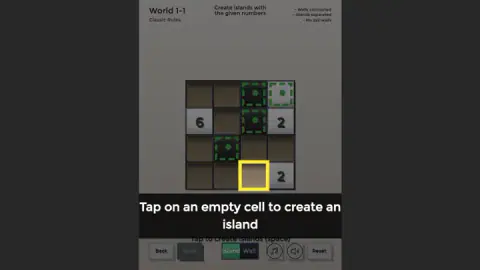
World 1-1 is a four-by-four grid. There is a 6 on the left of the second row, a 2 at the right end of the second row and another 2 in the bottom right corner. Four squares are already filled: three walls running down the middle and one island square above the top 2. The tutorial walks you through half of it. Here is the reasoning for the whole board.
The top 2 is already finished: the given island square above it makes two. Now look at the square between the two 2 clues, on the right of the third row. It touches both, so it must be wall. That wall needs to join the others, and the only way is the square to its left, so that is wall too.
The bottom 2 now has one place to grow, the square to its left. With that settled, the square left of it, at the bottom of the second column, must be wall to keep the 6 apart from the 2. The 6 takes everything left over: the top two squares of the first and second columns and the bottom two of the first column.
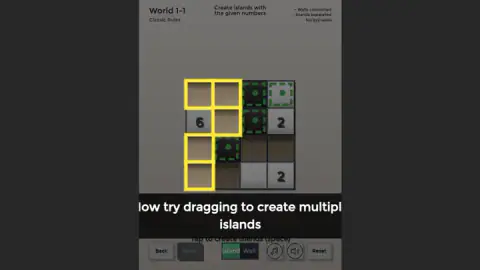
That gives ten island squares and six walls, and no two-by-two block of wall anywhere. We had a wall on the square just right of the 6, which is island in the answer. The tutorial had even highlighted that square while teaching the drag, and we still got it wrong.
Six worlds, and how they open
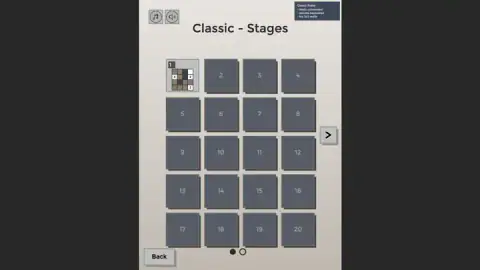
Select World shows six tiles: Classic, Modern, Strict, Minimal, Orb and Yin-Yang. Each locked tile carries its key in small red letters, and the key is always 10 stages of the world before. You need a quarter of Classic, not all 40 stages, to open Modern. The last one is odd: the lock on Yin-Yang asks you to clear a world called Hardcore, and there is no world by that name on the screen. Orb sits in fifth place, so that is the one to clear.
We never got past the first board, so the rest is what the game says. It puts 240 puzzles across the six worlds, which matches 40 per world. Each world changes the rules: the later ones add ice blocks, one-way arrows and orbs, and Yin-Yang adds a connection rule named after the black-and-white symbol. Classic is the pure Nurikabe the others build on, and it is the place to learn the habits in the tips above.
More from sublevelgames
If filling a whole grid by reasoning is the part you enjoy, Dot and Dot from the same studio asks you to cover every square too, this time with paths between matching dots. Arrow Escape 3D and Cube Sort are two more of its puzzles, both on a cube you turn. For another Japanese grid puzzle driven by number clues, try Nonogram. There are more in our puzzle games.
Screenshots
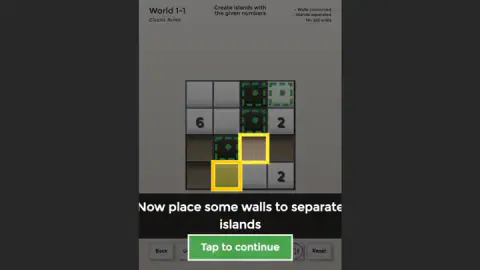
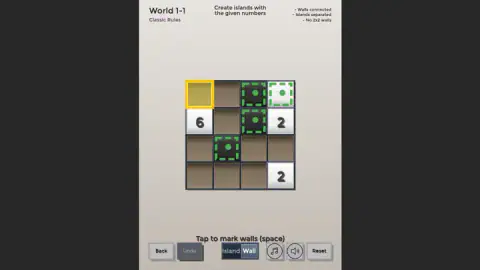
Taken by opening the game ourselves and letting it run — not supplied by the publisher, and not the same picture every other site shows.
How to play Logic Islands
- Pick a world, then a stage. The first screen, Select World, shows six worlds. Only Classic is open at the start, with a counter reading 0/40. Inside it, stage 1 is the only tile you can press.
- Read the numbers. Each numbered square is the start of an island, and the number is how many squares that island must have in total, the numbered one included.
- Fill squares. Tap an empty square to fill it, or drag across several. The switch at the bottom, Island or Wall, decides what you are placing. A line above it reminds you which mode you are in.
- Keep to the three rules. They sit in the top right of every board: walls connected, islands separated, no 2x2 walls.
- Fill every square. The tutorial ends with the instruction to solve puzzles by filling all cells correctly. A board is done when every square is either island or wall and none of the rules is broken.
Tips from our session:
- Count the board first. Add up the numbers and subtract from the number of squares. On World 1-1 the clues add up to ten on a board of 16, so exactly six squares are wall. If you have placed a seventh, something is wrong.
- Look for squares between two numbers. A square that touches two different islands can only be wall, because filling it with island would join them. This is the first move on most boards.
- Leave the green dashed squares alone. Some squares start filled in, framed with a green dashed line and a dot. They are part of the puzzle, not a suggestion.
- Mark walls you are sure of, not islands you hope for. Our mistake was a wall placed on a hunch. One wrong wall breaks an island's count and you will not see it until the end.
- Use Undo before Reset. Undo stays grey until you have made a move, then takes back one step. Reset clears the whole board.
Controls
| Click or tap an empty square | Fills it with whatever the Island / Wall switch is set to |
|---|---|
| Click and drag | Fills several squares in one stroke, as the tutorial shows |
| Island / Wall switch (Space, according to the on-screen hint) | Changes what your clicks place, island or wall |
| Undo button (Z, the game says) | Takes back the last move; the button stays grey until you have made one |
| Reset button (R, the game says) | Clears the board back to its starting clues |
| Double-click, Ctrl+click or double-tap | Fills a connected area in one go, according to the game's instructions |
Features
- Each puzzle is a grid of squares with a few numbers on it, and every number is the size of the island that grows from it
- Three rules sit in the top corner of every board: walls connected, islands separated, no 2x2 walls
- The first board, World 1-1, is four squares by four, with the clues 6, 2 and 2
- Some squares start filled in for you, marked with a green dashed frame and a dot
- Classic, the first of six worlds, holds 40 stages on two pages of 20
- Each new world opens after 10 stages of the one before: Modern, Strict, Minimal, Orb and Yin-Yang
- A short tutorial on the first board teaches tapping, dragging and the Island / Wall switch
Game details
- Developer
- sublevelgames
- Release date
- July 2025
- Last updated
- October 1, 2026
- Added here
- June 2025
- Technology
- HTML5 (2D)
- Platforms
- Browser (desktop, mouse and keyboard), Browser (mobile & tablet, touch, portrait)
- Classification
- Puzzle
- Download size
- 1.1 MB
- Ad requests
- 2 (few)
- Has a save
- Yes
- Saved progress
- Saving, when available, is managed by this game. Mava cannot confirm your level.
Measured by opening the game ourselves on 2026-09-11, not taken from the feed. Twelve seconds on a phone-sized screen, with ad requests counted and blocked rather than loaded.
FAQ
How do you play Logic Islands?
Every board is a grid with some numbered squares. Each number is an island of exactly that many squares, and every other square has to become wall. The walls must form one connected piece, two islands may never touch side by side, and no two-by-two block may be all wall. You fill squares with a tap, a drag, or the Island / Wall switch at the bottom.
Is Logic Islands the same as Nurikabe?
Its Classic world uses the Nurikabe rules. Nurikabe is a Japanese logic puzzle published by Nikoli since 1991, and its three rules (one connected sea, one number per island, no two-by-two pools) are the same three printed in the corner of every Classic board. The game says its later worlds add new rules on top.
How do you solve World 1-1 in Logic Islands?
Start with the square between the two 2 clues: it touches both, so it must be wall. That wall can only join the others through the square to its left, so that is wall too. The lower 2 then has one place left to grow, and the 6 takes the whole left side apart from the square at the bottom of the second column. You end with ten island squares and six walls.
How many levels does Logic Islands have?
The first world, Classic, has 40 stages, shown on two pages of 20. The game says there are six worlds and 240 puzzles in total. We only played the first world, so we have not seen the other five boards ourselves.
How do you unlock the other worlds in Logic Islands?
Each world opens after you clear 10 stages of the previous one, so you do not need to finish all 40 Classic stages to reach Modern. The order is Classic, Modern, Strict, Minimal, Orb and Yin-Yang. The lock on Yin-Yang names a world called Hardcore, which is not on the list, so expect Orb to be the one it means.
What do the green dashed squares mean in Logic Islands?
They are squares the puzzle fills in for you before you start, three walls and one island on the first board. Treat them as fixed clues and build around them rather than trying to change them.
Who made Logic Islands and when did it come out?
Logic Islands is by sublevelgames, the studio behind Dot and Dot, Cube Sort and Mahjong Chef. It came out in July 2025. It is in English only.
Can you play Logic Islands on a phone?
Yes. It is listed for Android and iOS as well as PC, and the screen is tall and narrow, made for holding a phone upright. The game says a tap toggles a square and a double tap fills an area. We played it on a computer.