









About Dot and Dot
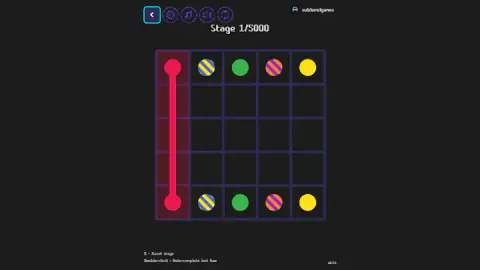
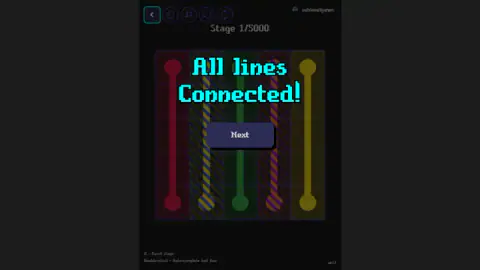
The first stage of Dot and Dot comes apart in five straight lines. Five coloured dots sit along the top row of a small grid, the same five along the bottom, and all you do is drag each one straight down its own column. The words All lines Connected! land across the board in cyan letters, a Next button appears under them, and that is stage one.
Look at the board behind those letters, though, because it is the whole game in one picture. Every column is solid colour from top to bottom. Not a single square is left bare. That is the rule the opening stage teaches without saying it out loud, and the game's own instruction line is blunt about it: connect dots of the same colour, and there should be no empty spaces on the map.
So joining a pair is not the job. Covering the grid with joined pairs is the job. Five straight lines work on the first board because five columns of five squares are exactly what five pairs can fill. The moment the board stops being that tidy, the shortest route is the wrong answer.
The watermark in the top right corner of every screen reads sublevelgames, and the game is credited to the same name. That double credit is as far as we got: no studio site, no store page, no other portal.
It has been available since June 2025.
Here is what this page is: an account of one session on a desktop with a mouse, ten minutes long. We cleared the first stage, pressed Next, and the second stopped us dead — we never got a single line onto it. So we went back to the menu and opened Loop Mode instead. In that whole session the game made one sound, the one it plays as it opens: nothing for the solved stage, nothing for a drag that would not take.
The rule that decides every stage: no empty squares
Plenty of puzzles ask you to join matching pairs. This one asks you to tile a board with the paths, and that single extra condition changes what skill you are using.
Without it, a stage is a tangle of short routes and you are mostly checking that nothing crosses. With it, the question becomes arithmetic before geometry: the lengths of all your paths have to add up to the squares available. Give one pair a shortcut and you have stolen squares from a pair that now cannot reach.
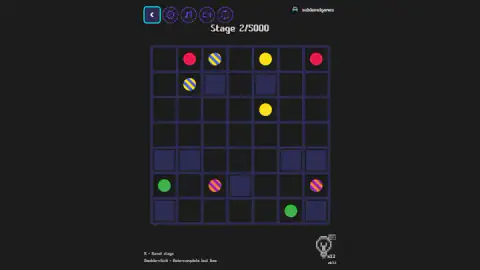
The second board shows what that looks like one stage later. It is seven squares across and seven down, and nine of them are walled off — solid blocks your line cannot enter, sitting mid-board as often as at the edge. The dots no longer line up on the rim either. Every wall shortens the total you have to fill and closes a route at the same time.
That is why the first stage is such a good teacher and such a bad warning. Five straight lines fill a square board perfectly, so you clear it without noticing you were solving two problems at once. We did not clear the second.
Loop Mode, and the diamond that is not a circle
The menu offers Normal Mode, Loop Mode and Bridge Mode side by side, each with a counter of its own. Normal runs to 5000 stages, the other two to 1,500 apiece. Those counters double as your save: the number on the Normal button ticked over by itself once we cleared the first board, and the game came back there each time.
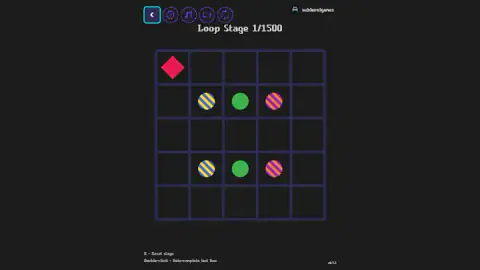
So we opened Loop Mode to see what the name buys you. The header changes to read Loop Stage, the board is five squares square again, and the dots are laid out quite differently: three pairs — blue-and-yellow striped, green, pink-and-orange striped — sit one directly above the other in the second and fourth rows, with empty rows above, between and below them. Nothing touches the edge.
And in the top left corner there is a red diamond — the only piece on that board which is not a circle, with no twin of its shape to join it to. We did not clear a Loop stage, so we are not going to tell you what it does. What we can say is that it is there on the very first board of the mode, which is where a game puts the thing it most wants you to work out. Bridge Mode we never opened.
A counter that size tells you what kind of game this wants to be. Nobody finishes five thousand boards. It is built to be opened for a few minutes at a time, for months, which is why the stage number is the only progress the screen shows — no stars, no medals, no chapters.
Where this puzzle comes from, and why it has no shortcut
The pencil-and-paper version has a name: Numberlink, published by Nikoli, the Japanese house that also gave sudoku its name and its following. The rules are the ones you have been playing — join the matching pairs with paths that never cross — and the stricter published versions add exactly the condition Dot and Dot uses: the paths have to cover every cell. Puzzle historians trace it back to a Sam Loyd puzzle from the 1890s.
Computer scientists have studied it properly, and it turns out to be hard in the technical sense: the same family of problems as the famous ones nobody can crack, including the version that forces you to fill the whole board. There is no formula that solves an arbitrary Numberlink grid. Past a certain size, the only general method is informed trial and error.
That is what makes it a good phone game. A puzzle with a shortcut gets boring the day you learn the shortcut; this one cannot be reduced to a trick, so a bigger grid stays interesting in a way memorised patterns never would. The format reached most people through Flow Free in 2012, which uses the same cover-the-board rule. Dot and Dot is that lineage, with striped dots, walls and a counter that does not end.
Hints, and what we could not check
Hints are the game's only currency. A small bulb in the bottom right corner of the board counts them, and the daily reward card is where they come from: a ladder of seven days that opens at three hints and pays fifteen on the last. Ours never moved, because we never spent one, so what a hint shows you is something we cannot tell you.
The game's own description promises three more things that never appeared on our screen, so we name them as promises rather than features: a colour-blind mode that labels the dots with letters, a warning when you draw a U-turn, and removing a line with a right-click.
More puzzles where you draw the line
Hard Puzzle: Color Lines is the closest relative we have: matching colours joined by drawn paths, with the free space shrinking as the colours multiply. Connect Line comes at the family from the other side — the segments are already there and you rotate them until the network joins up — and Turnline: Relaxing Puzzle is the calm version of that twisting. If the Nikoli connection caught your eye, Nonogram is the other great Japanese grid puzzle, where numbers along the edges hide a picture. And 3D Dots joins dots in mid-air. The rest are in puzzle games.
Screenshots
How to play Dot and Dot
- Deal with the daily reward card first. The game opens on a panel headed Daily Reward, a row of seven days and a green Claim button. The mode menu is behind it and stays there until the card is gone.
- Pick a mode. Three buttons: Normal, Loop and Bridge, each with its own stage counter underneath. Normal is the one that opens on stage one.
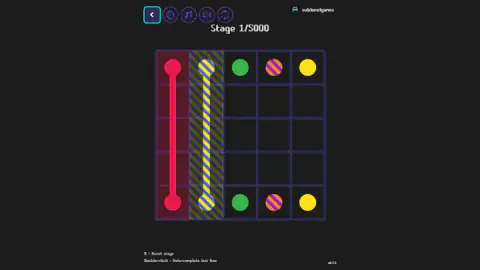
- Drag from a dot to its twin. Press on one, pull the line through the grid square by square, let go on the matching dot. The path follows your pointer, so corners and hooks are drawn, not chosen.
- Fill the board, not just the pairs. A stage ends when every square has a line through it. If a square is still dark, you are not finished, however neat the lines look.
- Press Next. The win screen gives you one button and it leads straight to the next board.
What the session taught us:
- Watch the wash, not the line. Every square a path crosses takes on a dim tint of that path's colour. That tint, not the line, is the thing to read: a running map of what is still bare, which is the only question that decides the stage.
- Read the bottom left corner once. Two shortcuts live there, in small grey letters, and the game never mentions them again: R wipes the stage clean, and a double-click auto-completes the last line you have left.
- Match the pattern, not the colour. Two of the five dot types are striped rather than solid. The blue-and-yellow striped dot is not the plain yellow one, and on a small board that mistake costs you the solution.
- Dragging is the only thing that works. Clicking a dot where it stands did nothing for us, and neither did a drag that stopped short of its twin.
Controls
| Drag from a dot to its twin | Draws the line. Press on one dot, pull through the grid square by square and let go on the matching one |
|---|---|
| Double-click | Finishes the last remaining line for you. The game prints this in the corner of every stage |
| R | Resets the stage and clears every line you have drawn, also printed in the corner |
| Back arrow, top left | Leaves the board and puts you back on the mode menu, with your place kept |
| The four round buttons beside it | A gear, music, sound and a pair of circling arrows, all reachable from inside a stage |
| Space | Nothing we could hear. This is a game you play with a pointer |
Features
- Stage one is a five by five grid with five pairs to join, and the counter above it reads 5000 stages in Normal Mode
- A pair joined is not a stage solved: the lines have to cover every square on the board before it clears
- Every square a line crosses is tinted in that line's colour, so what you have covered and what is still bare reads at a glance
- Three modes on the menu - Normal, Loop and Bridge - each with its own stage counter and its own saved place
- Loop Mode runs to 1,500 stages of its own and puts a diamond on the grid among the circles
- By the second stage of Normal Mode the grid is seven squares across, with nine of them walled off mid-board
- Two shortcuts printed in the corner of every board: R wipes the stage, a double-click finishes the last line for you
- The daily reward card pays in hints, opening at three on the first day and fifteen on the seventh
Game details
- Developer
- sublevelgames
- Release date
- June 2025
- Last updated
- August 10, 2026
- Added here
- June 2025
- Technology
- HTML5 (2D)
- Platforms
- Browser (desktop, mouse), Browser (mobile & tablet, touch)
- Classification
- Puzzle
- Download size
- 0.5 MB
- Ad requests
- 2 (few)
- Has a save
- Yes
- Saved progress
- Saving, when available, is managed by this game. Mava cannot confirm your level.
Measured by opening the game ourselves on 2026-09-11, not taken from the feed. Twelve seconds on a phone-sized screen, with ad requests counted and blocked rather than loaded.
FAQ
How do you play Dot and Dot?
You drag a line from each coloured dot to the dot that matches it, routing it through the empty squares of the grid without crossing another line. A stage is only finished when every square on the board has a line running through it, so joining all the pairs by the shortest route usually leaves you short.
Why does the stage not finish when all the dots are connected in Dot and Dot?
Because there is a second condition: no empty spaces. The board has to be completely covered by your lines, which means some pairs have to be joined the long way round. From the second stage onwards a few squares are walled off and cannot be crossed at all, so the count of squares you actually have to fill is not simply the size of the grid.
How do you reset a stage in Dot and Dot?
Press R. The game prints the shortcut in small letters in the bottom left corner of every board, along with a second one: a double-click auto-completes the last line you have left to draw. Neither is mentioned anywhere else, so it is worth reading that corner once.
How many levels does Dot and Dot have?
The counter above the board reads Stage 1 of 5000 in Normal Mode, which is the mode the menu opens on. Loop Mode and Bridge Mode carry 1,500 stages apiece on their own counters. We played the opening stages of Normal Mode and the first board of Loop Mode.
What is Loop Mode in Dot and Dot?
It is the second of the three modes on the main menu, with 1,500 stages of its own and a header that reads Loop Stage rather than Stage. Its first board is five squares square, the three pairs sit one above the other in the second and fourth rows instead of on the rim, and a red diamond occupies the top left corner. That diamond is the only piece on the board that is not a circle and the only one without a partner of its shape. We did not clear a Loop stage, so we cannot tell you what it does.
What are the hints in Dot and Dot and where do they come from?
A small bulb in the bottom right corner of the board keeps count of them; ours stood at thirteen and never moved. They come from the daily reward card that greets you when the game opens, a ladder of seven days that starts at three hints and pays fifteen on the last one. The card has to be claimed or closed before you reach the mode menu.
Does Dot and Dot work on a phone?
The game's own instruction line names a mouse or a touchscreen, and it is listed for PC, Android and iOS. Everything here is a single drag from one dot to another, which is the kind of input a thumb handles well. We played it on a desktop with a mouse, so we cannot vouch for how it feels in the hand.
Who made Dot and Dot?
sublevelgames, whose name sits as a watermark in the top right corner of every screen in the game and whose listing gives thirty-eight titles. The game was published in June 2025 and carries a rating of 4.2 from around 1,180 players. We found no studio site and no other portal carrying it.