

About Connect Associations
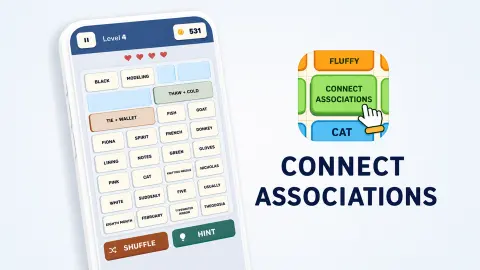
Most word puzzles built on hidden categories ask you to commit to all four words at once. Pick four, press a button, find out whether you were right. Connect Associations asks you to commit to two. You join one word to another and the board answers on the spot: either the two fuse into a single wider card, or the card you aimed at turns red and nothing moves.
That answer is the whole game. You never have to hold a complete group in your head: you find a pair you are sure of, add a third word, then a fourth. The fourth turns the card into a coloured bar with the category written across it and its four words listed small underneath, which is the first time the game names the theme.
The game is credited to Whalebox. It was published in August 2026.
We came back to it on 20 October and played for about ten minutes on a desktop, with the mouse. We cleared level 1, reached level 2 and made one join there before we stopped. We never pressed SHUFFLE or HINT, and we never opened the pause panel. So this page explains the rule, the first two boards and what the game does when you are wrong, then says where our knowledge ends.
Level 1 is half solved before you start
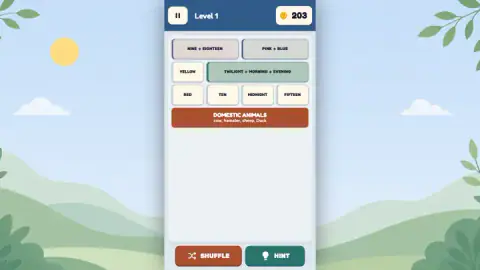
The first board holds sixteen words in four themes, and it does not hand them over as loose cards. Several groups arrive already under way. PINK shares a card with BLUE. TWILIGHT shares one with MORNING. Three farm animals sit together on a third, waiting for a fourth.
The tutorial uses that trio. A hand points at it and a banner reads «Tap this word, then tap the highlighted word». The highlighted word is DUCK. Join them and the card becomes a rust-coloured bar reading DOMESTIC ANIMALS, with cow, hamster, sheep and Duck listed in small type beneath the name. A second lesson, by our notes, asks you to drag instead: pull EVENING onto the pair that already holds TWILIGHT and MORNING. That is the game showing you that both gestures reach the same place.
After that you are on your own with colours, numbers and times of day. YELLOW and RED go to the colours. MIDNIGHT closes the times of day. TEN, FIFTEEN and a card already holding NINE and EIGHTEEN close the numbers. By our notes the four finished bars read BASIC COLORS, PARTS OF THE DAY, NUMBERS and DOMESTIC ANIMALS, which is about as gentle as a category puzzle gets. Nothing here is meant to catch you out: the level exists to teach the gesture and the shape of a finished group.
We reloaded the page halfway through, and the game came back on its own title card with a purple «Let's Play» button. Behind it the board was exactly as we had left it, finished bars and all, with the coin counter unchanged.
A red card is an answer, not a punishment
Level 2 is where the puzzle starts arguing with you, and the way it argues is the most useful thing we learned.
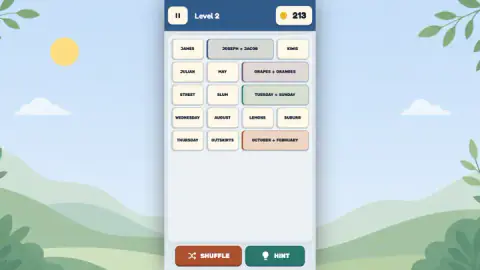
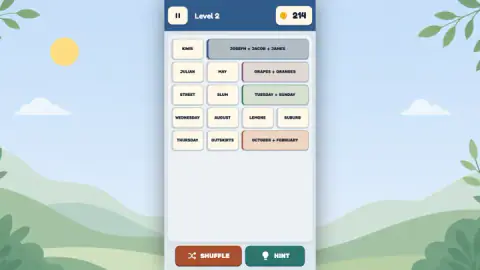
Twenty words sit on the board. That is five themes, and all but one of them arrive part-built: JOSEPH with JACOB, GRAPES with ORANGES, TUESDAY with SUNDAY, OCTOBER with FEBRUARY. Loose among them are KIWIS, LEMONS, WEDNESDAY, THURSDAY, AUGUST, JULIAN and MAY, plus STREET, SLUM, SUBURB and OUTSKIRTS: the places people live, the one theme with no head start.
We dropped JAMES onto JOSEPH and JACOB. It took: the card widened to read JOSEPH + JACOB + JAMES, KIWIS slid up into the space JAMES had left, and the coin counter ticked over from 213 to 214.
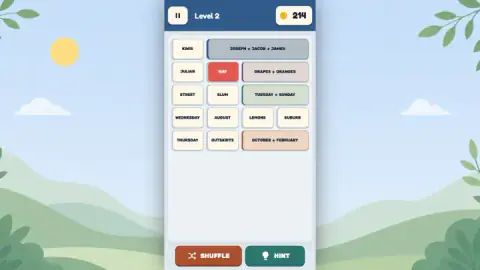
Then we tried to finish those names with MAY, which looks like a first name and is one in plenty of places. The card turned solid red. Nothing else happened. No counter dropped, no card vanished, no group came apart. We tried again and it turned red again.
That refusal is information you cannot get any other way. MAY is not a name here, so MAY is a month, which puts OCTOBER, FEBRUARY, MAY and AUGUST together and rules AUGUST out of the names as well. One loose word is then left that can finish the J names, and it is JULIAN. Four themes fall out of a single rejected pair. A puzzle that made you guess all four at once would have charged you a life for the same discovery.
That is our reading of the board rather than something we played to the end, because we stopped with the places and the fruit untouched. But the reading is forced, and the red card is what forces it.
Coins, the victory panel and the offer we did not take
A coin counter sits in the top right corner, beside the level number and the pause button, and it only ever went up while we played. Every correct join was worth one coin: we watched it climb from 213 to 214 at the moment the three J names landed on a single card.
Finishing a whole board pays considerably more. The counter was still on 203 with the first level unfinished, and the second level opened on 213.
Clearing level 1 brought up a panel with stars across the top and the line «All groups found». It listed a reward, a daily streak, the time the level had taken and a count of mistakes. Underneath sat a green button to carry on, and beside it an offer to double the reward by watching an ad. We did not take it. What the coins are for we still cannot tell you: we never found a shop and never pressed the hint button, so if hints are what coins buy, we did not see the transaction. The page the game sits in also drops in a break now and then, with a card you click to resume; that belongs to the portal, not to the puzzle.
What we still have not seen
The developer's own instructions mention two things that never appeared on either of our boards. One is ice: frozen words that correct joins elsewhere are supposed to break. The other is a limit on wrong pairs, with each one costing an attempt. We saw no ice, no attempts counter and no penalty of any kind for the joins the board refused: the red card was the entire consequence. We pass both on as the developer's claim.
We do not know how many levels there are. We did not press SHUFFLE or HINT, so we cannot say what a hint reveals, what it costs, or whether rearranging a board is free. We did not open the pause panel, and we played on a desktop only, although the game is listed for phones and tablets too.
Who it is for
It suits anyone who likes category puzzles but dislikes being punished for thinking out loud. You can test one link at a time, the half-made groups keep a board from ever looking blank, and nothing counts down while you look at it.
It suits less anyone who wants a hard board from the first screen. Level 1 is a tutorial made of everyday words, and the idea that makes the game interesting, a word that could sit in two themes, only turns up on the level after it.
More games to try next
For the same business of linking words by meaning in a different shape, Words and Bubbles merges bubbles into categories and Word Associations Solitaire deals the words out as cards. Word Solitaire is a second card take on the idea. If you would rather build words than sort them, CrossTile has you fit letter fragments into a crossword grid. The rest are under puzzle games.
Screenshots
How to play Connect Associations
- Read the whole board before you touch it. Every card is a word, or several words already joined with a plus sign between them.
- Join two words that share a theme. Click one and then the other, or drag one card onto the other. Both gestures do the same thing.
- Watch the card you aimed at. A join that works makes one wider card. A join the game refuses turns that card red and changes nothing else.
- Grow the group to four. A pair accepts a third word and a trio accepts a fourth.
- Close the board. The fourth word turns the card into a named bar, and the level ends when every word sits inside one.
What two boards taught us:
- Start from the cards that are already joined. They are free information: a trio names its own theme and leaves you one word to find.
- Count to four. Every group we saw held exactly four words, so a theme you can already see four members of cannot take a fifth.
- Treat a red card as a clue. It costs you nothing and it rules a word out of the group you were building.
- Expect the board to rearrange itself. Every join removes a card and the rest slide up to fill the gap, so a word you had located is rarely where you left it.
- Check that a drag landed. Several of ours joined nothing at all and had to be repeated. A drag that misses is not a refusal: only a refusal turns a card red.
Controls
| Click a word, then click a second word | Joins the two into one wider card if they share a theme |
|---|---|
| Click and drag a word onto another word or onto a joined card | Does the same join in one gesture; both gestures behave identically |
| Aim at a word that does not belong | The target card turns red and the board stays exactly as it was |
| Click SHUFFLE or HINT (under the board) | The two help buttons on every level; we did not press either in our session |
| Click the pause button (top left) | Pauses the level; we did not open it |
Features
- You commit to two words at a time, not four: a pair takes a third, a trio takes a fourth, and the fourth closes the group
- A finished group becomes a coloured bar that names the category and lists its four words underneath
- A refused join turns the target card red and changes nothing else, so a wrong guess costs you no ground
- Every correct join paid one coin: the counter went from 213 to 214 the moment three names shared a card
- Some groups arrive half made: level 1 opened with pairs and a trio already joined, and level 2 with four groups started
- Sixteen words in four themes on level 1, twenty words in five themes on level 2, with the rows reflowing after each join
- SHUFFLE and HINT under every board, a pause button above it, and no clock anywhere on screen
- Made by Whalebox
Game details
- Developer
- Whalebox
- Release date
- August 2026
- Last updated
- August 6, 2026
- Added here
- June 2026
- Technology
- HTML5
- Platforms
- Browser (desktop, mouse), Browser (mobile & tablet, touch)
- Classification
- Puzzle , Word & Trivia
- Saved progress
- Saving, when available, is managed by this game. Mava cannot confirm your level.
FAQ
How do you play Connect Associations?
The board is a set of word cards hiding several themes. You join two words that belong together, by clicking one and then the other or by dragging one onto the other, and they become a single wider card. Keep adding words until the card holds four. It then turns into a coloured bar with the name of the category, and the level ends when every word sits inside a bar.
What happens if you join two words that do not go together in Connect Associations?
The card you aimed at turns red and nothing else on the board changes. No card is removed, no group is broken and the coin counter does not drop. That makes a refused join useful: it rules a word out of the group you were building, which is often the fastest way to work out where it really belongs.
How many words are in a group in Connect Associations?
Four. On the two levels we played, every theme held exactly four words: level 1 had sixteen words in four themes and level 2 had twenty words in five. That count is the best check you have, because a theme that already shows four words cannot take a fifth.
Do you have to find all four words at once in Connect Associations?
No. You build groups step by step. Two words join into a pair, a third makes a trio and the fourth closes the group. Some groups are already started when a level opens, so you can read part of a theme before you have made a single move.
What do coins do in Connect Associations?
We can only tell you how they arrive. Each correct join paid one coin, and our counter rose from 213 to 214 on the join we watched most closely. Clearing a whole level pays more than that again. We never found a shop and never pressed the hint button, so we cannot say what coins are spent on.
Are there hints in Connect Associations?
There is a HINT button under the board on every level, next to a SHUFFLE button that the developer says rearranges the words. We did not press either one in our session, so we cannot tell you what a hint reveals, whether it costs coins, or whether shuffling is free.
Is there a time limit in Connect Associations?
We saw no clock on the board. The top bar shows a pause button, the level number and the coin counter, and nothing counts down while you think. A panel does report a time once the level is over, along with a reward, a daily streak and a count of mistakes, but it arrives after the puzzle rather than during it.
Who made Connect Associations?
It is credited to Whalebox. It was published in August 2026. It is listed for PC, Android and iOS as a portrait game in twelve languages; we played it in English on a desktop computer with the mouse.