

About CrossTile
A crossword hands you an empty grid and a list of clues, and asks you for the letters. CrossTile does it the other way round. It hands you the letters, already cut into small chunks, and keeps the grid to itself. The only clue is one word at the top of the screen.
That makes the job closer to a jigsaw than to a quiz. You drag chunks of letter tiles around a blank board until they sit next to each other in the right order. When a word is whole, a counter at the bottom goes up by one; when every word is whole, the next level begins.
The game is credited to Lucas Entertainment Studio and has been available from September 2026.
Here is the honest size of our visit. We have played it twice on a desktop computer with the mouse, a quarter of an hour in all, and reached the third level. The first level fell both times. The second fell once, and on the return visit held us off for ten minutes with a word we had already solved. The third we have never finished. We used no hints and never opened the level list, so we cannot say how many levels there are.
Three levels, and the one that beat us
The opening levels are a tutorial in disguise: each adds one idea, printed in capitals above the counter.
| Level | Theme | What the screen says | Words | How it went for us |
|---|---|---|---|---|
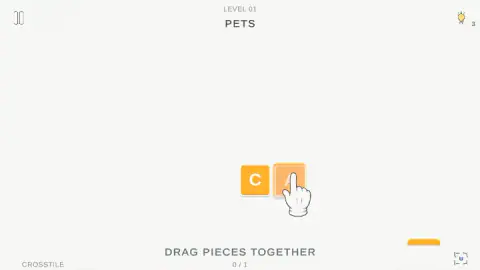
| 1 | PETS | DRAG PIECES TOGETHER | CAT, across | Solved both times |
| 2 | COLORS | BUILD A VERTICAL WORD | BLUE, down | Solved once, then ten minutes of failing |
| 3 | SKY | GREY TILES ARE SHARED BY TWO WORDS | Two, crossing at a grey S | Never solved |
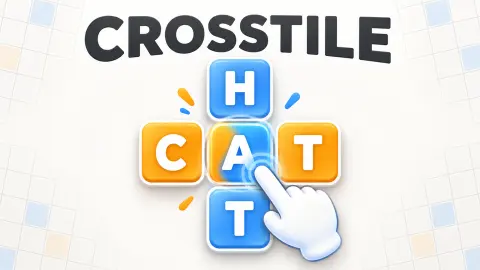
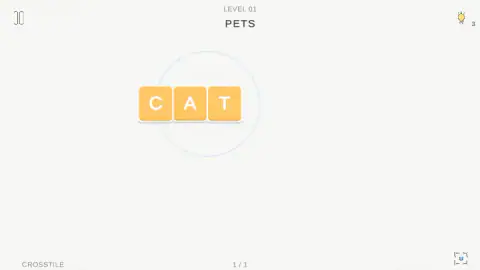
Finishing the first level is quiet. The three tiles settle into a row reading CAT, two faint rings open behind them, the line of instructions disappears and the counter flips to 1 / 1. No fanfare, no score screen, no button to press: the next level simply arrives.
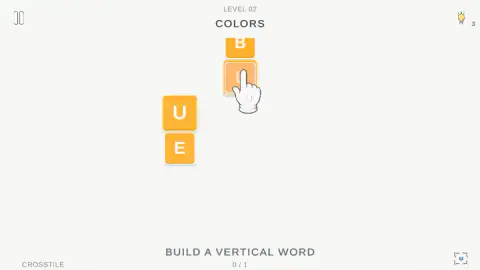
The second level is worth a warning, and not because the word is hard. Under a theme of COLORS the board gives you two joined pairs, B above L and U above E. Anyone reads BLUE off that at a glance. We still sat at 0 / 1 for ten minutes on our second visit, because the puzzle is geometry rather than vocabulary: the pairs have to end up in the same column, B-L directly above U-E, so the letters form one unbroken line. We kept setting them down in neighbouring columns, a tile's width apart, where the eye reads BLUE and the game reads nothing. Knowing the word is not enough, which is worth knowing before you blame yourself.
The third level is where the crossword arrives. The board holds a grey S, a piece with U and N side by side, and a piece with K above Y. The counter reads 0 / 2, so there are two words to make and the grey tile belongs to both. Our reading is SUN across and SKY down, meeting at the S; we say reading because we never got the pieces to lock.
Notice what the game never gives you: a definition. The theme narrows the answer, the shape of the pieces narrows it further, and the rest is trial.
Drag the background and the whole board moves
This is the one thing the game does not explain, and it cost us the third level. A drag that starts on a tile moves that piece. A drag that starts on empty space moves everything: every piece slides the same distance, as if the board were a sheet of paper under your hand. That is useful once you know: pieces can start far apart, and sliding brings a far corner into reach.
It is also easy to do by accident. On the SKY level we missed a tile a few times in a row, and each miss pushed the board further up, until the screen was blank except for the bottom edge of one orange tile under the header. The level was still running; the pieces were out of view. We stopped before pulling the board back, so take the fix as advice rather than something we tested: if your board looks empty, drag the background the other way before reaching for Restart.
A crossword cut up like a jigsaw: both ideas are old
The mix is new; the halves are not. According to Wikipedia, the puzzle usually cited as the first crossword ran in the New York World on 21 December 1913. Its author, Arthur Wynne, a journalist born in Liverpool, called it a "Word-Cross". The name was flipped to "Cross-Word" weeks later, which Wikipedia's article on Wynne puts down to a typesetting error, and it stuck.
The jigsaw is older still. Wikipedia credits John Spilsbury, a London mapmaker and engraver, with selling the first ones around 1760: maps glued to wood and cut along the borders, known as dissected maps. They taught geography, and you learned where a country was by finding the hole it fitted.
CrossTile borrows one rule from each. From the crossword, the crossing: a letter that has to be right for two words at once, which is what the grey tile is. From the dissected map, the idea that the answer is already in your hands, in bits, and only the arrangement is missing. You are never asked to know a word, only to put one back together.
What the screen tells you, and what it never says
The layout is spare: an off-white board with a faint grid, orange tiles with white letters, the level and theme at the top, the counter at the bottom, and a small frame icon in the corner whose job we never confirmed. We saw no clock, no lives, no move count and no score.
One piece of feedback is harder to read. A pale circle blooms behind a group of tiles now and then, and it is not a prize: it turned up around an unfinished pair as often as around a finished word, and was missing from screens that looked the same. Trust the counter instead.
The pause menu is titled "Take your time", which says a good deal about the intent. Resume is the blue button at the top; under it sit Restart, Levels and switches for Sound and Haptics, with the board washed out behind the panel. We opened none of the last four. The Haptics switch points to a game made with phones in mind, and it is listed for Android and iOS; we played only on a desktop, so we cannot say how it handles under a finger.
Who it is for
It suits players who like word games but not being quizzed: there was no vocabulary test in the levels we saw, so a child who can read short words could manage the opening. It is less for anyone who wants clues to crack, or who is short of patience with a mouse: the placing is fussier than the thinking.
More games to try next
For the clue-based original, there is Crosswords: Big Collection. Word Finder is a word search, and Word Associations Solitaire sorts words by theme with a deck of cards. If it was the fitting of pieces you liked, Cozy Jigsaw Puzzles is the picture kind. The rest are under puzzle games.
Screenshots
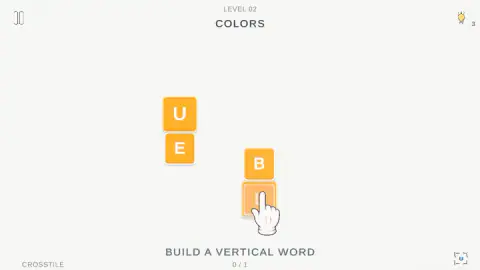
Taken by opening the game ourselves and letting it run — not supplied by the publisher, and not the same picture every other site shows.
How to play CrossTile
- Read the theme. It sits under the level number at the top: PETS on the first level, COLORS on the second, SKY on the third. Every word you make belongs to it.
- Drag a piece by one of its letters. Some pieces are a single tile, some are two tiles already joined. Joined tiles travel together, and we never managed to pull a pair apart.
- Line the pieces up in one row or one column. Words read left to right or top to bottom, and tiles have to meet edge to edge along the same line.
- Watch the counter. It sits at the bottom centre and reads words done out of words needed, going from 0 / 1 to 1 / 1 the moment our tiles spelled CAT.
- Use the light bulb if you are stuck. It is in the top right corner with a 3 beside it. We never pressed it.
What two sittings taught us:
- The pale tile is the one to grab. The white-gloved hand settles on a tile and that tile turns lighter, with a thin outline. It is a real piece, not a picture of one: pick it up and it moves, and a joined pair comes with it.
- Close is nothing, and on top is nothing. There is no snapping and no partial credit: pieces in neighbouring columns score the same as pieces at opposite ends of the board, and a tile dropped on top of another, as we tried with the grey S, counts for nothing.
- Look at the edges before you start. On the first level the C and the A sit in the middle while the third tile waits in the bottom right corner, half cut off by the screen. Push a tile too high and it hides under the header.
Controls
| Drag a letter tile | Moves that tile and every tile already joined to it |
|---|---|
| Drag the empty background | Slides the whole board, pieces and all |
| Pause icon (top left) or Escape | Opens the "Take your time" menu with Resume, Restart, Levels, Sound and Haptics |
| Light bulb (top right) | The hint button, with a 3 beside it; we did not press it |
Features
- Letter tiles that come in chunks of one or two and have to be pushed together into whole words
- A one-word theme per level in place of crossword clues: PETS, COLORS and SKY in the first three
- A counter at the bottom that shows words finished out of words needed, such as 0 / 2
- Grey tiles that mark the letter where two words cross
- A board you can slide around by dragging its empty background
- No clock, lives or score on screen in the levels we played
- Made by Lucas Entertainment Studio
Game details
- Developer
- Lucas Entertainment Studio
- Release date
- September 2026
- Last updated
- September 14, 2026
- Added here
- August 2026
- Technology
- HTML5
- Platforms
- Browser (desktop, mouse), Browser (mobile & tablet, touch)
- Classification
- Casual , Puzzle , Word & Trivia
- Saved progress
- Saving, when available, is managed by this game. Mava cannot confirm your level.
FAQ
How do you play CrossTile?
You drag pieces made of letter tiles across a blank board and set them side by side until they spell a word that fits the theme shown at the top. A counter at the bottom shows how many words are done and how many the level needs. When the two numbers match, the level is finished and the next one starts.
Why is my word not counting in CrossTile?
Almost always because the pieces are close but not in the same line. The second level hands you two joined pairs, B over L and U over E, and the answer is BLUE. We spent ten minutes dropping one pair in the column next to the other, a tile's width off, and the counter stayed at 0 / 1 the whole time. Tiles have to meet edge to edge in one unbroken row or column, and they cannot overlap.
What are the grey tiles in CrossTile?
They are the letters where two words cross. The third level introduces them with the line "GREY TILES ARE SHARED BY TWO WORDS": a grey S sits on the board, and one word has to run across from it while another runs down. A grey tile can be dragged like any orange one.
What is the pale tile with the hand on it in CrossTile?
That is the tutorial pointing at the piece it wants you to move. A white-gloved hand rests on a tile, the tile turns lighter and gets a thin outline, and it is an ordinary piece underneath: you can pick it up and drag it like any other. On the second level the pale tile is the bottom half of a joined pair, so the whole pair comes with it.
Why did the tiles move or disappear in CrossTile?
Because dragging the empty background slides the whole board. If the drag starts on a tile, only that piece moves; if it starts on blank space, everything moves together. A few of those drags pushed all our pieces off the top of the screen on the third level. The pause menu also has a Restart button, which we did not use.
Does CrossTile have a timer or lives?
We saw neither in the levels we played. The screen shows the level number, the theme, a hint button and a word counter, and nothing counts time, moves or mistakes. The pause menu is even titled "Take your time". The game's own description also says there are no timers or lives.
How do hints work in CrossTile?
There is a light bulb in the top right corner with a number beside it, which read 3 on every screen we saw. We did not press it, so we cannot say what a hint reveals or how you get more. The game's instructions only say to use a hint if you get stuck.
Who made CrossTile?
It is credited to Lucas Entertainment Studio. It was published on 13 September 2026. We found no other source for the studio.