


About Rowly: Word Association
Most word association puzzles show you sixteen words and ask you to pick four. Rowly does not let you pick anything. You can only swap. Every tile stays on the board the whole time, and a group exists only when four related words end up side by side in the same row.
That one change makes it feel closer to a sliding-tile puzzle than a quiz. You are not hunting for an answer and submitting it. You are tidying a messy shelf, two items at a time, until each shelf holds one kind of thing.
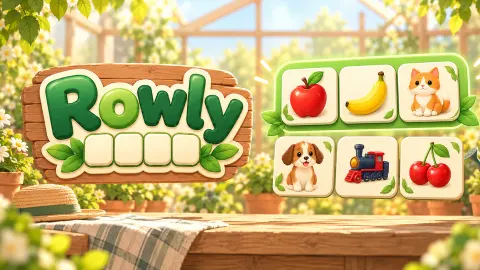
Each tile carries a word and a small colour drawing: a teddy bear, a dress, a calendar, a sunrise. The background is a soft greenhouse full of flowers, there is no clock, and the only score is a counter at the top left that tells you how many groups you have found out of the total.
The game is by Booblyc, a small developer, and was published on 26 October 2026. We played it two days later.
One swap per move: why Rowly plays differently
In a pick-four word game, a wrong guess costs you a life. In Rowly, a wrong guess costs nothing, because there is no guess. You can swap two tiles, look at the row, and swap them back.
What makes it hard is that every swap affects two rows at once. On our first board, Foot sat in the top row next to Teddy, Blocks and Train, while Bathroom sat in the fifth row next to Hand, Knee and Shoulder. One swap fixed both problems at once: the fifth row became Body and locked, and Bathroom moved up to wait with the toys for its own group. Good moves in Rowly usually look like that. They fix one row and leave the other one closer to done, not further away.
When a group turns into a picture
The second group in level 1 is where Rowly shows its own idea. After we swapped Heat into the row with Sunglasses, Light and Sunrise, the four tiles did not lock into a strip. They left the board, and a single tile with a drawing of the Sun appeared in their place. A card explained it: "Some groups turn into a picture. That picture belongs to another group - use it as a word."
At the same moment three new tiles arrived: Rainbow, Frost and Snow. With the Sun, that makes four kinds of weather. So the answer to one group became a word in the next one, and the board kept the same number of loose tiles.
It is a small rule, but it changes how you read the board. Some words on it are not there to be grouped yet. They are the reward for a group you have not finished.
Word association: an old idea in a new shape
Word association games borrow from a very old experiment. In 1879 the scientist Francis Galton read words to himself and timed how long it took for another word to come to mind. Carl Jung later used the same idea as a psychology test, listening for the words that came slowly.
Rowly turns the question around. Instead of asking what one word makes you think of, it asks which four words belong under one name. But the old effect is still there: the first link your mind makes is not always the one the puzzle wants. Shorts goes with sunglasses in your head before it goes with dresses and coats, and Rowly builds its traps on exactly that.
How far we got: two groups out of seven
We spent about ten minutes with a mouse on level 1 and did not clear it. We locked 2 of 7 groups: Body (Hand, Foot, Knee, Shoulder) and the sun group that turned into a Sun tile.
The 20 tiles left at that point read like five families of four: weather (Rainbow, Frost, Snow, Sun), toys (Teddy, Blocks, Train, Robot), clothes (T-Shirt, Dress, Coat, Shorts), rooms (Bathroom, Office, Balcony, Bedroom) and time (Minute, Day, Month, Year). That matches the five groups still missing on the counter, but it is our reading of the board, not something we locked in.
Rowly's own description promises colour levels, bonus levels, daily goals and a hint that suggests a useful swap. We did not reach any of them, and on level 1 we saw no hint button, only the counter, the level name and a gear for settings. The instructions also say you can swap by clicking one tile and then another, and that it works with touch on phones and tablets. We played with a mouse and dragged every time.
Who it is for
Rowly suits anyone who likes sorting things and does not want a clock running while they think. The first level is gentle enough for a child who reads simple words, and the pictures help younger players more than they might in a text-only word game. The harder moments come from words that fit two themes, and those are a fair test for adults too.
The same studio also makes Wordaire: Word Solitaire, which sorts words by theme with cards instead of rows. If you like the idea of themed groups, Word Associations Solitaire and Wordeck: Associations both build it on a solitaire table, and 4 Clues 1 Word asks for the link between four clues in a single answer. There are more in our puzzle games.
Screenshots
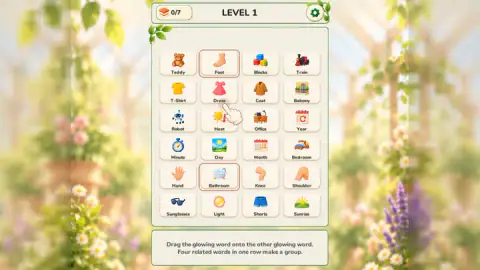
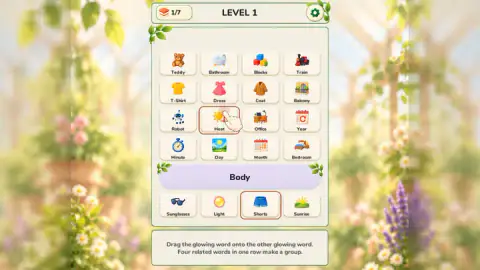
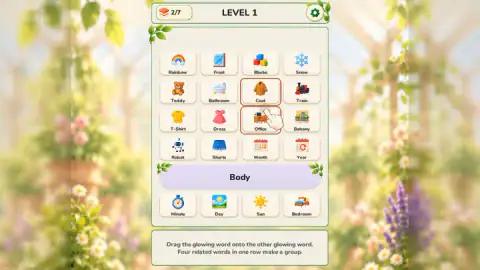
Taken by opening the game ourselves and letting it run — not supplied by the publisher, and not the same picture every other site shows.
How to play Rowly: Word Association
- Read the Welcome card: "Every level hides groups of words that belong together. Sort the words into groups." Press OK.
- Drag the glowing tile onto the other glowing tile. They swap places.
- When a row holds four words with one theme, it locks into a coloured strip with the theme's name, and the counter goes up by one.
- If a finished group turns into a single picture, treat that picture as a new word and find its group.
- Keep swapping until the counter shows every group found.
Tips from our session
- A drag is a swap, never a drop. We lost several minutes treating the bottom row as a tray to drop words into. Nothing happens that way. Whatever you drag trades places with the tile you release it on.
- Look at the drawings first. The pictures are faster to scan than the words. A row with a hand, a knee and a shoulder drawn in it is telling you something before you read a label.
- Watch for bridge words. Shorts sat in the same row as Sunglasses, Light and Sunrise at the start, and it looks like it belongs: they are all summer things. It did not. The fourth word was Heat, and the group was about the sun itself.
- Do the guided swaps. The first moves only work on the glowing tiles. Try anything else and the panel below the board simply says "Use the glowing words".
- Do not reload mid-level. Each time we reloaded the page, level 1 started again at 0/7 with the Welcome card.
Controls
| Drag a tile onto another tile | Swaps the two tiles; this is the only move in the game |
|---|---|
| Click one tile, then another | Also swaps them, according to the game's instructions (we used dragging) |
| Tap and drag | The same swap on phones and tablets |
| Gear icon | Opens the settings |
Features
- Level 1 is a board of 24 picture tiles in six rows of four, hiding seven groups
- The only move is a swap: drag one tile onto another and they trade places
- A row of four words that share a theme locks into a coloured strip with the theme's name
- Some finished groups collapse into a single picture tile that belongs to a different group
- Every tile pairs a word with a small drawing, so you can read the board by pictures alone
- No timer and no move limit on the first level; a counter at the top shows groups found
- The game lists 13 languages on its listing
Game details
- Developer
- Booblyc
- Release date
- October 2026
- Last updated
- October 27, 2026
- Added here
- October 2026
- Technology
- HTML5 (2D)
- Platforms
- Browser (desktop, mouse), Browser (mobile & tablet, touch)
- Classification
- Puzzle
- Saved progress
- Saving, when available, is managed by this game. Mava cannot confirm your level.
FAQ
How do you play Rowly: Word Association?
The board is a grid of tiles, each with a word and a small picture. You drag one tile onto another to swap them, and when a row holds four words that share a theme it locks into a coloured strip with the theme's name. Lock every group to finish the level.
How many groups are there in level 1 of Rowly?
Level 1 hides seven groups, and a counter at the top left shows how many you have found. The board starts with 24 tiles in rows of four. The first group in our game was Body: Hand, Foot, Knee and Shoulder.
Why did my group in Rowly turn into one picture?
Some groups do not become a strip. When we completed Sunglasses, Light, Heat and Sunrise, the four tiles left the board and a single Sun tile appeared. The game explains that this picture belongs to another group and you should use it as a word.
Do you place words in the bottom row in Rowly?
No. There is no tray to fill. Every move swaps two tiles that are already on the board, and any of the rows can become a group. The bottom row is simply where the tutorial builds its first examples.
Is there a timer in Rowly: Word Association?
We saw no timer and no move limit on level 1. The only numbers on screen are the level and the groups-found counter, so you can take as long as you like over a swap.
Who made Rowly: Word Association?
Rowly is by Booblyc, a developer that also made Wordaire: Word Solitaire. It was published on 26 October 2026 and was updated on 27 October.
Can kids play Rowly?
The first level uses everyday words such as Teddy, Train, Dress and Bedroom, each with a drawing next to it, so a child who reads simple words can follow it. The trickier part is spotting words that could fit two themes, which is where an adult may need to help.