
About Word Solitaire
Solitaire is a game about order: ace before two, red on black, king at the bottom. Word Solitaire keeps the table and throws most of that order away. Its cards carry no suits and no numbers, only words, and the one rule that survives is the rule about who goes first.
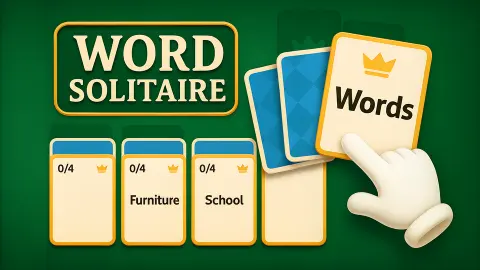
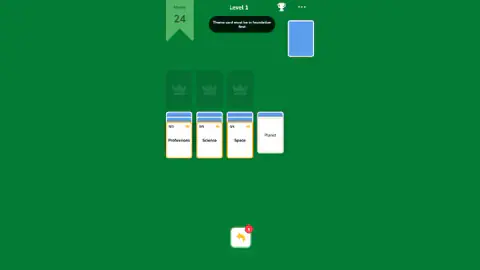
That rule is the theme card. Three of the four columns on the opening table are topped by a card with a gold frame, a small crown and a fraction. They are headings. Everything else is a plain white card with a single word on it, and no word can go anywhere until its heading has been moved up into one of the crown slots above the columns.
Over all of it hangs a green ribbon reading Moves 24. It counts down, not up. That turns a quiet sorting game into a budget problem, because everything you do on the table is paid for — including looking at a card you have not seen yet.
The game is by Mewton Games. It was published in October 2025.
We have played Level 1 twice now. The second sitting ran ten minutes and fifty-eight attempts, ended with the ribbon on 2 and the level still unfinished, and it is where the game finally gave up its rules.
The theme card is this game's ace
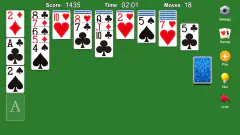
In Klondike, the solitaire most people picture, the four piles at the top of the table are called foundations. Each one has to start with an ace. After the ace comes the two of the same suit, then the three, and so on up to the king. The game is won when all four foundations are complete. Until an ace turns up, a foundation stays empty, no matter how many twos you are holding.
Word Solitaire uses the same word on screen, foundation, and the same idea. The crown slots are the foundations and the theme card is the ace: the card that opens the pile. What changes is what comes after. A Klondike pile grows in a fixed order, and any player can tell you the next card. Here the pile grows by meaning. Nothing printed on the card called Rocket tells you it follows Space. You have to know it.
That is also why the fraction matters. A suit always has thirteen cards, so Klondike never needs to tell you how long a pile is. A theme can be any length, so each theme card carries its own count.
Two deals, one Level 1
The first time we sat down, Level 1 dealt Mathematics, Family and Nature, with a loose word called Island. The second time it dealt Professions, Space and Science, with a loose Planet. Same level number, same green 24, same three crown slots.
So Level 1 is a shape rather than a hand. And the shape is strict: on both tables the three themes asked for three, four and five words, twelve in all, with two cards hidden behind each heading and one behind the loose word.
What that means for the player is that there is nothing to memorise. The subjects we met the second time were Professions, Space and Science, and the words that went under them were Designer and Writer, Rocket and Planet, Physics and Geology and Zoology. Sorting those is general knowledge rather than vocabulary, which is the kindest thing about the game: a reader who knows what a geologist does has everything the level asks for.
The piles also tell you where they are as they fill. A foundation that has taken one word shows the theme on the top line and that word underneath, with the fraction stepping up from 0/5 to 1/5 to 2/5. You never have to count the pile; the card counts it for you.
Where the 24 moves actually go
Here is the part the first level is really teaching, and it took us two sittings to see it.
We spent twenty-two of our twenty-four moves and placed eleven cards: three theme cards and eight words. The other half of the budget went on the deck. Drawing is a move. We watched the ribbon read 3, clicked the face-down card, and a card named Writer turned over beside it while the ribbon dropped to 2.
That reframes the whole level. The twelve words are not all on the table at the start — four columns of two or three cards do not hold them — so some of them have to be fetched, and every fetch is charged at the same rate as a placement. A player who spends freely on the deck early runs out of ribbon with piles standing at 1/3 and 4/5, which is exactly where we finished.
The counterweight is the undo button at the bottom of the screen, which opens Level 1 with a red 5 and counts down as you use it. It is more generous than it looks. With the ribbon on 2 and that drawn Writer sitting face up, one undo put the card back on the deck and the ribbon back to 3. The move came back with the card.
Two notices, and one pause
Every refused move came with a short black notice at the top of the screen, and between them the two notices are the whole rulebook.
Drop a word on a theme that is still down in its column and the game says: "Theme card must be in foundation first". Drop a word on an empty crown slot and it says: "Place a theme card in foundation first". Both are fair, both say the same thing from opposite sides, and both are free — across every refusal in both sessions the ribbon held steady.
One other message is worth knowing about. Twice the table froze behind a notice reading "Click to keep playing". A single click anywhere brought it straight back, with the ribbon and the piles exactly as we had left them.
How far we got, and who it suits
Ten minutes, fifty-eight attempts, Level 1, not finished. We ended with the ribbon on 2, all four columns emptied, and three piles standing at Professions Designer 1/3, Space Planet 3/4 and Science Zoology 4/5: eight of the twelve words home. We never saw the counter reach zero, a win screen, a lose screen or a second level, never opened the trophy or the three-dot button at the top, and did not play it by touch.
What we can say is who the first level speaks to. The feed files the game under kids, and nothing on screen is hurried: no clock, no sound of failure, no penalty for a wrong try, and five undos to lean on. But the cards say Zoology and Designer in plain text, with no pictures, so it needs a confident reader. For a child who reads well it is a sorting exercise with a gentle limit. For an adult it is a ten-minute solitaire where the thinking is about meaning, and about not spending your moves on the deck.
More word and card puzzles on Mava Games
Word Associations Solitaire is the closest match, with picture cards and a ribbon that shows no limit at all on its first level. For words without the card table, Word Finder and Crosswords: Big Collection are the obvious next stops. If it was the solitaire half you liked, Solitaire Emperor - Secrets of Fate is a one-higher-one-lower solitaire played with ordinary playing cards. More are filed under puzzle games.
Screenshots
Taken by opening the game ourselves and letting it run — not supplied by the publisher, and not the same picture every other site shows.
How to play Word Solitaire
- Read the table. Four columns, each topped by one face-up card with more tucked behind it. Above them sit three dark slots marked with a crown, and a blue deck waits in the top right corner.
- Move a theme card up. Drag a gold-framed card from its column into a crown slot. The ribbon drops by one, and the card that was hiding behind it turns over.
- Send its words after it. Drag a word onto a theme that is already in a slot. The fraction counts up as the pile grows, and the card in the slot renames itself: Space becomes Space Rocket, Science becomes Science Physics.
- Draw when the table runs dry. Click the deck and the next card turns face up beside it. This costs a move, exactly like placing one.
- Finish inside the budget. The goal, in the game's own words, is to sort every card into its group within a limited number of moves.
Tips from our sessions
- Drag, do not click. Single clicks on cards and on empty slots changed nothing for us, in either sitting.
- Headings first, always. A word has nowhere to go until its heading is in a slot.
- Wrong guesses are free. Across dozens of refused drags the ribbon never moved.
- Count before you draw. A card off the deck costs the same as a card you place, and that is where our budget quietly went.
- Hold on to the undos. They give back the move as well as the card, which makes them worth more than they look.
- Move a theme card early and you get two things for one move: the heading is in place, and the card behind it turns over.
Controls
| Drag with the mouse | Move a card from a column into a crown slot, or a word onto the theme card already sitting in one |
|---|---|
| Click the face-down deck | Turns the next card face up beside the deck, and costs a move like any other |
| Undo button | Takes back the last move and hands the move back on the ribbon; it starts Level 1 with five uses |
| Click anywhere | Starts the table again after the notice that reads "Click to keep playing" |
| Tap | Phones and tablets play by touch, according to the game's listing |
Features
- A move counter on a green ribbon that starts Level 1 at 24 and drops every time you place a card or draw one
- Gold-framed theme cards with a crown and a fraction, three of them per deal, asking for three, four and five words
- Three crown slots above the columns, which take a theme card before they will take any word
- A foundation that renames itself as it fills, showing the theme and the last word you placed on it
- Five undos on Level 1, each one giving back the card and the move
- Two plain-language notices that explain a refused move, and a refused move costs nothing
- A different set of subjects on each deal of Level 1, from Nature and Family to Science, Space and Professions, in English or Russian
Game details
- Developer
- Mewton Games
- Release date
- October 2025
- Last updated
- September 28, 2026
- Added here
- August 2025
- Technology
- HTML5 (2D)
- Platforms
- Browser (desktop, mouse), Browser (mobile & tablet, touch)
- Classification
- Puzzle
- Saved progress
- Saving, when available, is managed by this game. Mava cannot confirm your level.
FAQ
How do you play Word Solitaire?
Drag a gold-framed theme card, such as Science or Professions, from its column up into one of the three crown slots. Once a theme is up there, the plain word cards that belong to it can follow, and the fraction on the theme card counts them as they land. When the table runs out of useful cards, click the deck to turn the next one face up.
What does Theme card must be in foundation first mean in Word Solitaire?
It means you tried to put a word on a theme card that is still sitting in a column. The theme card has to be moved up into a crown slot before it accepts any words. A second notice, Place a theme card in foundation first, appears when you drop a word on an empty crown slot. Neither refusal costs you a move.
How many moves do you get in Word Solitaire?
Level 1 starts with 24 on the moves ribbon. Placing a card costs one, and so does drawing a card from the deck, which is where most of our budget went. Refused moves cost nothing. We have not seen what happens when the counter reaches zero.
Is there an undo in Word Solitaire?
Yes. The undo button sits at the bottom of the screen with a red 5 on it at the start of Level 1, and the number counts down as you use it. It gives back the move as well as the card: in our session the ribbon read 2, we undid a draw, and the ribbon went back to 3 with the drawn card returned to the deck.
Are the levels in Word Solitaire always the same?
Level 1 is not. We played it twice and were dealt different subjects each time, Mathematics, Family and Nature on one occasion and Professions, Space and Science on the other. What stayed the same was the shape: 24 moves, three crown slots, and three themes asking for three, four and five words.
Who made Word Solitaire?
This Word Solitaire is by Mewton Games. It was published in October 2025. Other games with the same name exist on other stores; this page is only about this one.
Is Word Solitaire the same as Klondike?
No. It borrows the table: columns with face-down cards, a deck to draw from and slots above called foundations. But the cards carry words, not suits and numbers, and you sort them by meaning under a theme card. Nothing is stacked in red and black order.
Can you play Word Solitaire on a phone?
It is listed for PC, Android and iOS, in landscape and portrait, with tapping as the control. We played on a computer with the mouse, so we cannot tell you how it handles by touch.