




About Emerland Solitaire
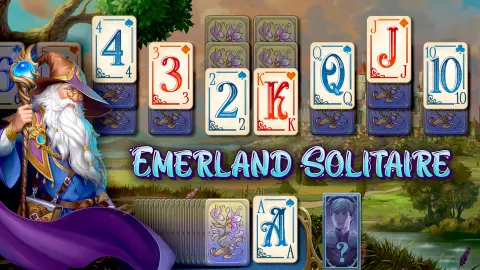
Most solitaires keep secrets. Cards lie face down, and half the game is turning them over to find out what you were up against. The first level of Emerland Solitaire hides nothing. Every card at the back of a column shows its rank and suit on a thin grey strip, so the whole board is on the table before you touch it.
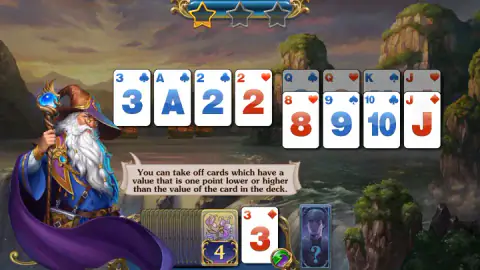
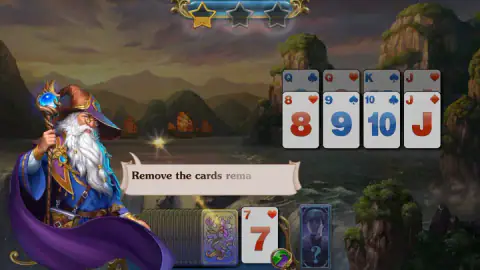
The rule is printed on a sign in the middle of that board: You can take off cards which have a value that is one point lower or higher than the value of the card in the deck. One card lies face up at the bottom. Take a card one rank above or below it, suit ignored, and the card you took becomes the new face-up card. A level is a chain of those choices, and a long chain is worth more than a short one.
A wizard in a blue hat watches from the left, in front of a lake with red-sailed junks. The game is credited to Studio7108 and shows it at.
We played it for ten minutes. We cleared level 1 with three stars, lost three of those minutes to one king, and took the first four cards of level 2 before the session ended.
Our level 1, card by card
The deal is fifteen cards: eight in front, seven behind, because the fourth column holds a single two of hearts. The opening face-up card was a six of clubs.
The first run took the whole left half. Five, four and three came off the front row, which exposed a three, an ace and a two to join the lone two of hearts. From the three we went down to a two, up to the three, down to the other two and finally to the ace: seven cards without touching the stock. Then the wizard spoke: There are no more available moves! Let's finish the combination and turn over the top card in the deck. An ace sat face up, and on the table there were only an eight, a nine, a ten and a jack.
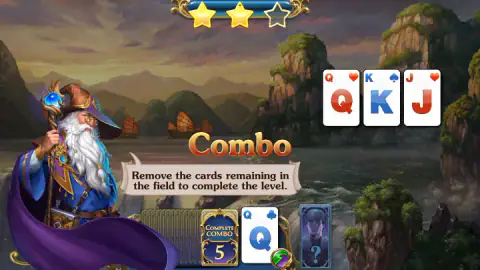
One turn of the stock gave us a seven, and the second run went up the right half: eight, nine, ten, jack, then the queen of clubs uncovered behind them. On that fifth card the word Combo flashed across the table. Jack, queen, and the table was down to one king of spades with a queen face up below it.
That is where we stalled. A king is one rank above a queen, so the move was there, but we spent about three minutes trying to drag the queen up onto the king. When we took the king instead, the table emptied and the screen said Tap to continue.
What the plaque, the stars and the heart are telling you
Between the stock and the face-up card is a card painted with lilac flowers and a gold plaque with a number. It goes up by one for each card in a run and goes blank when you turn the stock. On long runs it changes to read COMPLETE COMBO; ours reached eight on the first run of level 1 and seven before the last king.
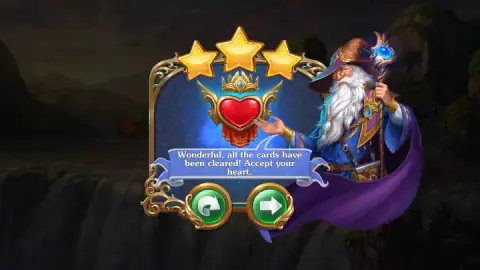
The three stars at the top fill as the table empties. Two were lit by the start of our second run. The third lit only after the table was clear, while the cards we never needed were swept off the stock. The results panel then showed all three, a winged red heart and the line Wonderful, all the cards have been cleared! Accept your heart.
The right-hand arrow on that panel leads to a map called Kingdom. It showed 50 coins, a heart counter at 5 MAX, a Star Chest at 3 of 20, and level 1 with its three stars. When we picked level 2, its badge showed a heart marked -1. Our reading is that a level costs a heart and a win gives one back; we did not lose a level to check.
Two things we never touched: the green disc with a curved arrow beside the face-up card, and the dark portrait card with a question mark to its right. The listing speaks of new assistants; that slot looks like where one would sit, and ours stayed a question mark.
The sign describes Golf, a patience scored like a round
The one-up, one-down rule is far older than this game. It is the patience called Golf, also known as One Foundation. In the classic deal, seven columns of five cards go down face up, one card starts a single pile, and the rest wait in a face-down stock. A card goes on the pile if it is one rank higher or lower, regardless of suit. In the strict game, nothing may be played on a king, and an ace does not follow a king.
The name comes from the scoring, as Wikipedia's entry on the game sets out. Each card left on the table when the stock runs out costs a point, a full game is nine deals called holes, and 45 or lower is par. If you clear the table, every card still in the stock counts as a point in your favour.
That last rule is the best explanation we have for our third star. It arrived exactly when the unused stock was being cleared away, after the table was empty, and the fewer stock cards you burn, the more there are left to count. Emerland Solitaire shrinks the deal, adds a wizard, and grades in stars, but it rewards what Golf players have always chased: clear the table, and do it without spending the stock.
Level 2 takes the grey strips away
Level 2 moves from the lake to a forest and the wizard leaves the screen. The table now has ten columns, and the cards behind the front ones lie face down with flowered backs, some of them stacked several deep. You can no longer see a run before you start it.
The opening face-up card was an ace, with a two of spades on the table. We went two, three, four, and the four uncovered a seven of diamonds. That is as far as we got: the session ended there, so we cannot tell you how level 2 finishes, or how many levels the Kingdom holds.
Who it is for
Emerland Solitaire is slow and readable. There is no clock on the table, and a click on a card that does not fit cost us nothing. Level 1 works as a lesson in reading a chain before you start; level 2 is where luck and the stock begin to matter.
For the same rule on other tables, Tri Peaks Emerland Solitaire shares the country of Emerland, and Magic Tri Peaks Solitaire and Magic Story of Solitaire keep the fantasy setting. Solitaire Tripeaks deals the cards with nothing around them. The rest are in puzzle games.
Screenshots

How to play Emerland Solitaire
- Read the face-up card. It sits at the bottom of the screen, to the right of the stock. Every move is measured against it.
- Take a card one rank up or down. Click it on the table. Red or blue, any suit counts.
- Keep the run going. The card you took is now the face-up card, so look for the next one before reaching for the stock.
- Turn the stock only when the table is dead. The wizard tells you when that happens. A new face-up card starts a new run.
- Empty the table. The level ends when the last card is gone.
Tips from our game:
- On level 1, plan from the grey strips. Behind our opening three, four and five were a three, an ace and a two, and taking the front cards in the right order turned them into one run of seven.
- You move cards from the table to the face-up card, never the reverse. Dragging the face-up queen onto a king did nothing for us; taking the king did everything.
- A pair of equal ranks is a fork, not a gift. With two twos on the table, take one, climb back up to a three, then come down to the other.
- Treat a king as the end of a road. We never tested whether an ace may follow one, and in the classic rules it may not, so plan to reach each king from a queen.
- The stock costs you the run. The plaque that counts it goes blank on every turn.
Controls
| Left click or tap a table card | Takes it if it is one rank above or below the face-up card, whatever the suit. It becomes the new face-up card |
|---|---|
| Click the stock (the fan of cards at the bottom) | Turns a new face-up card when nothing on the table is one rank away, and ends the current run |
| Green arrows on the results panel | The curved arrow and the right arrow under the stars; we pressed the right one and reached the Kingdom map |
| Keyboard | Nothing we could find. Enter, Escape and letter keys got no response |
Features
- One rule, printed on a sign in the middle of the first board: take a card one rank above or below the face-up card, and the suit never matters
- On level 1 the hidden card behind each column shows its index on a grey strip, so the whole board can be planned before the first click
- Our level 1 board of 15 cards went in two runs, seven cards and then eight, with a single turn of the stock in between
- A plaque beside the stock counts the run, goes blank when you turn the stock, and switches to COMPLETE COMBO on long runs
- Three stars fill as the table empties; our third lit only after the last card was gone and the unused stock was swept away
- Wins pay a heart and stars toward a Star Chest of 20 on a Kingdom map, and starting level 2 showed a heart marked -1
- Level 2 moves to a forest with ten columns and its hidden cards face down, so the planning from level 1 stops working
Game details
- Developer
- Studio7108
- Release date
- September 2026
- Last updated
- October 26, 2026
- Added here
- March 2025
- Technology
- HTML5 (Unity WebGL)
- Platforms
- Browser (desktop), Browser (mobile & tablet, touch)
- Classification
- Adventure , Cards & Board
- Download size
- 48.9 MB
- Ad requests
- 2 (few)
- Has a save
- Yes
- Saved progress
- Saving, when available, is managed by this game. Mava cannot confirm your level.
Measured by opening the game ourselves on 2026-09-11, not taken from the feed. Twelve seconds on a phone-sized screen, with ad requests counted and blocked rather than loaded.
FAQ
How do you play Emerland Solitaire?
One card lies face up at the bottom of the screen. Click any card on the table that is one rank higher or one rank lower, whatever its suit, and it becomes the new face-up card, so each move sets up the next. When nothing on the table fits, click the stock to turn a new face-up card. A level is won when the table is empty.
How do you get three stars in Emerland Solitaire?
The stars fill as cards leave the table, so long runs and few stock turns are what earn them. We cleared the first level with only one stock turn in the middle, and two stars were lit while we played. The third lit after the table was empty, as the cards left unused in the stock were swept away, and the results panel showed all three.
What does COMPLETE COMBO mean in Emerland Solitaire?
It is the plaque between the stock and the face-up card. Its number goes up by one with each card you take in a run and the count starts over when you turn the stock. On long runs the plaque reads COMPLETE COMBO, and in our game the word Combo flashed across the table on the fifth card of a run.
Why can't I take a card in Emerland Solitaire?
Either it is not exactly one rank from the face-up card, or it is still covered by the card in front of it. Also check what you are moving: you take cards from the table onto the face-up card, not the other way round. We lost about three minutes at the end of level 1 dragging a queen onto a lone king before taking the king itself, which finished the level.
What does "There are no more available moves" mean in Emerland Solitaire?
The wizard says it when no card on the table is one rank from the face-up card, and he adds that you should finish the combination and turn over the top card in the deck. Click the stock to get a new face-up card and a new run. It is not a game over: in our level 1 the next turn of the stock opened a run of eight cards.
What are the hearts in Emerland Solitaire for?
The Kingdom map shows a heart counter reading 5 MAX next to the coins. Clearing a level ends with the line Accept your heart, and when we picked level 2 its badge showed a heart marked -1. Our reading is that starting a level costs a heart and winning returns one, but we did not run out of hearts to check.
Is Emerland Solitaire the same game as Tri Peaks Emerland Solitaire?
No. They share the invented country of Emerland and the one-rank-up-or-down rule, but the boards differ. This game opens with a wizard by a lake and eight short columns, and its second level moves to a forest with ten columns of face-down cards. Tri Peaks Emerland Solitaire is a separate game on its own page.
Who made Emerland Solitaire?
The game is credited to Studio7108. The Emerland name is credited elsewhere to Rainbow Games, who are named on Tri Peaks Emerland Solitaire. The two records do not match, and we would rather say so than pick one. The game is free in a browser, and its listing also names Android and iOS, landscape only.