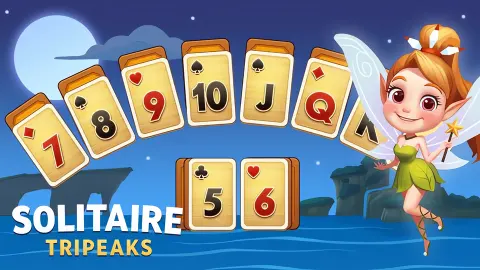






About Solitaire Tripeaks
Most solitaire games ask you to remember a stack of rules: red on black, kings into empty columns, aces up to the top. Solitaire Tripeaks asks you to remember one. There is a card at the bottom of the screen, and you may tap any face-up card that is one step above it or one step below it. That is the whole game.
The suit does not matter and neither does the colour. A four of spades goes onto a three of diamonds. The card you tap slides down and becomes the new bottom card, so each move changes what you are allowed to do next. A level is over when the table is empty; the panel that opens it says so in three words, CLEAR ALL CARDS.
The game is credited to a developer listed as yzy. It was published in October 2025.
A word on how much of it we saw, because it is not much. We played for about four minutes on a desktop computer, with the mouse. All of that went on level 1, which is a guided lesson, and we left it with four cards still on the table. So this page can tell you exactly how the first level works and what it teaches. It cannot tell you what level 2 looks like.
Level 1 is one long run in disguise
The first level deals 13 cards onto a beach. Seven lie face up in a front row, and six lie face down behind them, each one tucked under two cards of the front row. At the bottom of the screen sits a two of diamonds.
A two can take an ace or a three. There was one three on the table, at the far left, so that went first. Then the four next to it, then the five, then the six. At every step exactly one card on the table fitted, which is how you can tell the level is a lesson and not a puzzle: it cannot go wrong.
What it teaches is the flip. When the three and the four had both gone, the face-down card they had been lying on turned over and showed a two of clubs. That two was no use yet, since the bottom card was by then a four. It stayed on the table and waited. The same happened along the row: an ace, a queen, a king and a jack came up one by one, none of them playable when they appeared.
We carried on up the ranks, through seven, eight, nine, ten and the jack. That left a queen, a king, an ace and the two of clubs. Count the cards and the design shows. Thirteen cards, one of each rank, set over a two: the level is a single run that climbs from three to king and, it seems, goes round the corner to the ace and ends on the two that turned up first. We stopped before that corner, so the king-to-ace step is something the layout points to, not something we watched.
The bar in the corner and the numbers on the map
In the top left corner of the table there is a bar with two round markers along it and a star at the end. It starts empty and fills as cards leave. The first marker turned green once six cards were gone. With nine gone the second marker was still grey.
The panel that opens the level shows three empty stars, and the bar has three stops. It is reasonable to read the bar as the star rating for the level, though we did not finish and so did not see any star awarded.
The map behind the panel is an island with a path of level markers. Along its top edge run three counters: coins, which read 1,000 before we had played a card; a heart marked MAX; and stars, at zero. We never lost a heart or spent a coin, so what costs one and what the other buys are both outside this page.
One thing we looked for and did not find on level 1 is a pile to draw from. In most games of this family you turn a new card from a spare pile when nothing on the table fits. The game's own instructions speak of "the card from the deck", so a deck probably plays a part later. The first level never needs one.
Where the rule comes from: Robert Hogue's game of 1989
The rule is older than the browser. According to Wikipedia, TriPeaks was created by Robert Hogue in 1989. It reached most people through Microsoft, which shipped it in one of its Windows Entertainment Packs and later made it a standard part of Microsoft Solitaire Collection. This game has no connection with any of those; it borrows the rule, as many card games do.
The name describes the original table of TriPeaks solitaire. Hogue's layout has three pyramids of face-down cards, the three peaks, standing on a row of ten face-up cards. You play on a single pile, one rank up or down regardless of suit, and a face-down card turns over when nothing overlaps it any longer. Level 1 here is that same mechanism cut down to two rows.
It also explains why the first level has no peaks. Wikipedia notes that the three-peak layout was only the first one, and that its inventor meant others to adopt new layouts. A level map is that idea taken literally: the same rule, a different arrangement each time.
One more figure is worth carrying into the game. Hogue ran a statistical analysis of the original and found that over 90% of the deals can be cleared completely. Most are solvable; few are solved, because part of the table is face down when you choose. That is the real difficulty of the genre, and it is the reason to uncover hidden cards before making a tidy move somewhere else.
Who it is for
It suits anyone who wants a card game without a rulebook, including people playing TriPeaks for the first time. A child who can count to thirteen can play level 1, and the order of the picture cards, jack, queen, king, is the only thing to learn.
It is not Klondike, and there is nothing to build or sort. It is also a game of levels on a map, with hearts and coins around it, not a single table you can redeal for ever. How that economy behaves after the first level we cannot say.
More card games to try next
Solitaire puts four classic tables in one place, among them Pyramid, another game where you clear the table instead of building on it. Solitaire Klondike - Treasure Island is the red-on-black game with a story around it. Solitaire Emperor - Secrets of Fate is another level-by-level card game, played with tarot cards. The rest are under puzzle games.
Screenshots
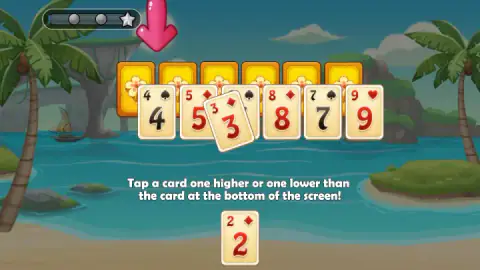
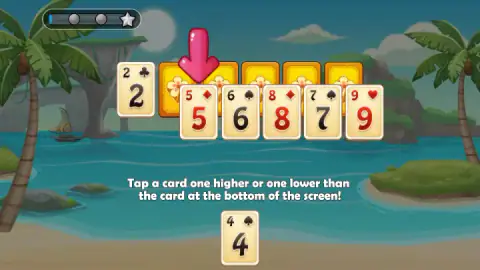
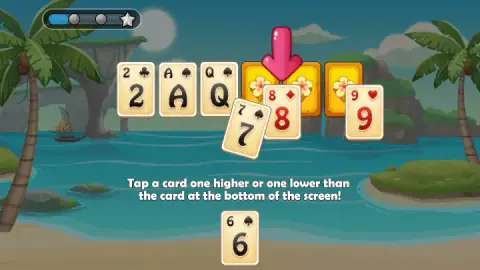
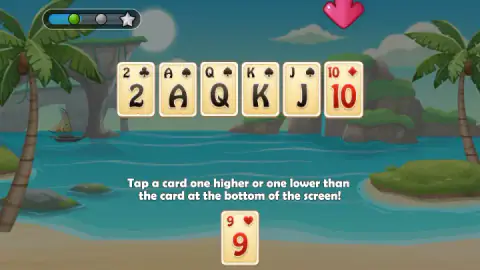
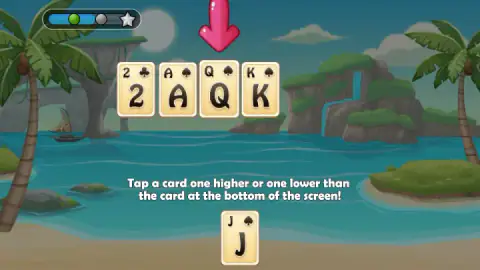
Taken by opening the game ourselves and letting it run — not supplied by the publisher, and not the same picture every other site shows.
How to play Solitaire Tripeaks
- Press PLAY! on the level panel. The map shows a panel with the level number, three empty stars and the goal.
- Look at the card at the bottom of the screen. That is the only card that matters right now.
- Find a face-up card one rank higher or one rank lower. On a five, that means a four or a six.
- Tap it. It moves to the bottom and becomes the card you play on next.
- Keep going until the table is empty.
What the first level taught us:
- Think in runs, not in single cards. Every card you play decides the next one. Before tapping a six, check there is a five or a seven waiting for it.
- Neighbours on the table are not neighbours in rank. In the front row of level 1 the eight sat to the left of the seven. Read the numbers, not the positions.
- A hidden card needs both cards on top of it gone. Clearing one of the two leaves it face down.
- Follow the pink arrow while it lasts. On level 1 an arrow hangs over the card to tap and a line of text repeats the rule. We do not know how long that help continues.
- The arrow keys do nothing. We pressed one and the table stayed exactly as it was. This is a pointer game.
Controls
| Click or tap a face-up card | Plays it onto the card at the bottom of the screen, if it is one rank higher or one rank lower |
|---|---|
| PLAY! button on the level panel | Starts the level shown on the panel |
| Gear (bottom right of the map) | Settings; we did not open it |
Features
- One rule for every move: the card you tap must be one rank above or below the card at the bottom
- Suits and colours do not matter; a spade goes on a diamond
- Face-down cards turn over once the two cards lying on them have gone
- A guided first level of 13 cards, with a pink arrow over the card to tap
- A progress bar with two markers and a star, which fills as cards leave
- A level map with coins, hearts and stars counted along the top
- Made by yzy
Game details
- Developer
- yzy
- Release date
- October 2025
- Last updated
- August 10, 2026
- Added here
- September 2025
- Technology
- HTML5
- Platforms
- Browser (desktop, mouse), Browser (mobile & tablet, touch)
- Classification
- Cards & Board , Casual , Puzzle
- Saved progress
- Saving, when available, is managed by this game. Mava cannot confirm your level.
FAQ
How do you play Solitaire Tripeaks?
One card lies face up at the bottom of the screen. You tap any face-up card on the table that is one rank higher or one rank lower, and it moves down to become the new bottom card. Suit and colour are ignored. The level panel states the goal in three words: clear all cards.
Do suits matter in Solitaire Tripeaks?
No. Only the rank counts. In our first level a four of spades went onto a three of diamonds and a five of diamonds went onto that four. If you come from Klondike, where red goes on black, this is the habit to drop.
When do the face-down cards turn over?
A face-down card turns over when nothing is lying on it any more. On the first level each hidden card sat under two face-up ones, and it flipped only after both had been played. Taking one of the two is not enough.
What is the bar with a star in the top left corner?
It fills as you remove cards. It has two round markers and a star at the end, and the level panel shows three empty stars, so it appears to track the level's star rating. On level 1 the first marker turned green once six of the 13 cards were gone. We did not see the bar reach the star.
Can you put an ace on a king in Solitaire Tripeaks?
We did not see it happen, so we cannot confirm it. What we can say is that the first level left us with a queen, a king, an ace and a two, on top of a jack. The only way to clear those four is queen, king, ace, two, which points to the king and the ace counting as neighbours.
Is this the same game as the TriPeaks in Microsoft Solitaire or the TriPeaks mobile apps?
No. It is a separate browser game, credited to a developer listed as yzy, and it has no link to those products. It uses the rule of the TriPeaks card game invented by Robert Hogue in 1989, which many games share.
Who made Solitaire Tripeaks and how is it rated?
It is credited to a developer listed as yzy. It was published on 28 October 2025. It is listed for PC, Android and iOS; we played it on a desktop computer with the mouse.