



About Merge Royal 2048
Almost every merging game hands you a grid. Rows and columns of identical squares, a number stamped in the middle of each one, and a rule that sweeps the whole board at once. This one hands you a deck. It also ends in a way no grid game can.
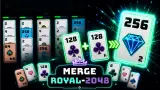
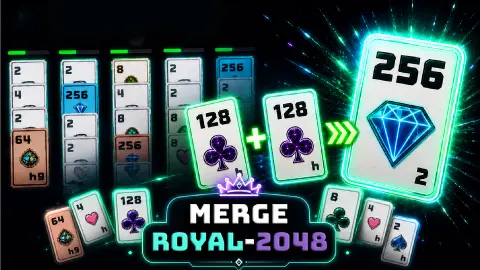
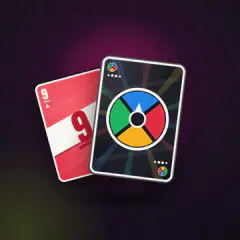
The numbers here are printed on playing cards: a value in the top-left corner, the same value upside down in the bottom-right, and in the middle a clover, a heart or a cut gem where a card would carry its suit. The cards pile into four columns that overlap the way cards lie in a real tableau, so each one covers most of the card beneath it. You pick a card up, carry it across the table, and drop it on another showing the same number. The two become one card worth double.
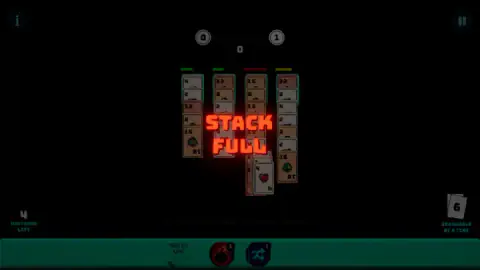
Here is the part the first few minutes hide. A card you drop that does not merge is not undone. It stays where it landed, on top of that column, and the column gets one card longer. Ours ran to nine cards before the game put a stop to it: STACK FULL in big red letters across the board, the table dimmed behind them, and no sound we could pick up to mark the moment. There is no clock in this game and no losing score. You lose by running out of room.
It is credited to Balram Thakur and was published in August 2026.
The bar above each column is the whole game
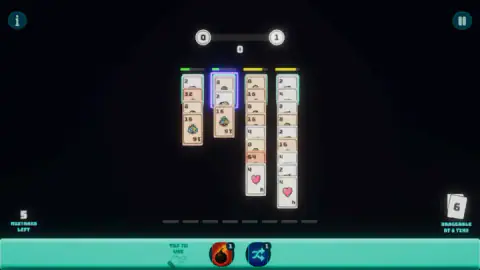
Four thin tracks sit above the four columns, one each, and for the first minute they look like decoration. They are not. They are how much room that column has left.
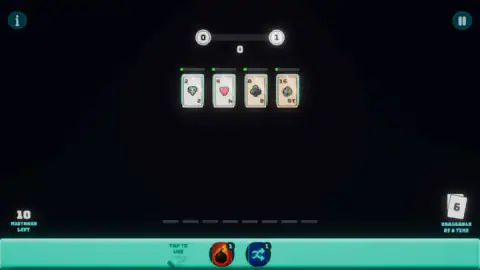
At the deal, with a single card in each column, every bar is green and barely started. Let the board grow and they fill from the left. By the time our tallest columns were nine cards deep, their bars had turned yellow and were nearly at the end of the track, while the short columns beside them stayed green and half empty. The frame where our run ended tells the rest: the bar over the column that had no room left was red and full, the others were not, and STACK FULL was written across the board.
That turns this from a game about making big numbers into a game about floor space, and it changes what a good move looks like. A merge is not just points. A merge is one card removed from a column, which is the only way space ever comes back. Every other drop you make is a deposit.
It also explains the shape of a run. Early on, with four short columns and nothing but small cards, you can drop almost anywhere. Later the only move worth making is the one that shortens your worst column, and the cards you parked in it are the reason you cannot. A gauge going yellow is the game saying so out loud, several moves before the ending arrives.
The number in the corner is a nineteenth-century invention, and this game leans on it
Pick up a modern deck and look at what tells you a card is a seven. Not the seven pips scattered across the face, although they are there. The small number in the corner, printed again upside down at the other end so the card reads the same whichever way round you hold it. That corner index is not as old as playing cards themselves. For centuries a card showed only its suit symbols spread across the whole face, and you had to count them, which meant spreading your hand wide or lifting cards one at a time to see what you had.
The index did one specific thing: it made a card readable when almost all of it is hidden. Fan a hand and you are looking at a row of slivers. The corner is what you read. The rest is decoration.
Now look at this game again. The cards overlap down four columns, each covering the body of the one below it, which is a fanned hand turned on its end. Nine cards fit in the height of about three, because only the top strip of each needs to be visible, and that is where the index lives. A merging game that prints its number in the middle of a tile cannot stack those tiles, because a covered tile is unreadable. Borrowing the playing card gets round that for free.
The arithmetic underneath is the doubling everyone knows, and the cost of it is worth saying plainly: a card worth two hundred and fifty-six is a hundred and twenty-eight twos, merged step by step with nothing skipped. Every one of those steps is a card that has to be somewhere while it waits for its partner. That is why space runs out before numbers do.
Ten mistakes, and then ten more
The counter on the left edge is the second thing the game is counting. It starts at ten, the words MISTAKES LEFT sit under it in small cyan capitals, and it drops when you let a card go somewhere it does not merge. Ours was down to four by the time a column filled.
What we learned this time is that it resets. The moment the table was dealt again, the counter read ten. It is a per-run allowance, not a life bar you carry between attempts, and it is deliberately not the thing that kills you: we still had four mistakes in hand when the red letters came up. The columns got there first.
What we still have not seen
Two circles sit at the top with an empty track between them and the score underneath. They read zero and one this time and one and two on our earlier visit, so they are counting something that carries across runs, but we have never watched the track between them move.
We do not know what the bomb does, or the shuffle. We do not know exactly how many cards a column holds, only that nine was not quite enough to finish one off. A row of eight short dashes is ruled across the table below the columns, empty in every capture from both sessions, and we still have no idea what they are for. A note in the bottom-right corner reads six draggable at a time over a drawing of two cards; it read five the last time we played, so it is counting something rather than labelling a rule.
What we can say is that the first few minutes are more legible than most merging games manage. The board, the gauges, the mistakes and the two helpers are all on one screen, nothing hides behind a menu, and the only thing between you and a bigger number is whether you can read a column from its corners before you commit to a drop.
More merging, and more cards
NumMerge Clash is the closest relative we have: numbered cards again, merged by value, with falling pressure instead of a filling column. Drop & Merge 2048 keeps the doubling and drops the deck, sending numbered cubes down five lanes so you place by timing rather than by reading. 2048 Legend is the sliding grid that the number in this title comes from, and it is a different game in every other way: playing the two back to back is the quickest way to feel the difference between tipping a whole board and carrying one card. And Solitaire Klondike - Treasure Island takes the other half of the idea, the overlapping columns, and plays them straight. The rest are in puzzle games.
Screenshots
How to play Merge Royal 2048
- Click and hold a card. A bright purple ring closes around what you are carrying and the column you lifted it from lights up.
- Drag it over a card showing the same number. Columns light as you pass across them, which is the game telling you where a drop would land.
- Let go on a match. The two cards become one worth double, and that column gets shorter by one.
- Check the thin bar above each column before you commit. That bar is how full the column is, and filling one ends the run.
- Read the corners, not the faces. Most cards in a column are almost entirely covered. The corner index is the only part you can see, and reading a column from the top down is the whole skill.
What the sessions taught us:
- A drop that merges nothing is paid for twice. It takes one of your ten mistakes, and it leaves a card on a column that was probably long already. The second cost is the one that gets you.
- The colour of a card tells you its size before you read it. Twos and fours come out white, sixteens cream, the big ones a warm peach. Scanning a tall column for the warm cards is much faster than reading every corner.
- Saving the two helpers is the same as not having them. Each carries a single charge. We finished a run with both of them still unused, which is one way of saying we never found out what they do.
- The score is not what you are racing. Ours sat at zero while the columns filled, and the run still ended. The columns are the clock.
Controls
| Click and hold | Picks up the card under the pointer. What you are carrying is ringed in bright purple, and the column you took it from lights up |
|---|---|
| Drag | Carries the held card across the board. Columns light as you pass over them |
| Release | Drops the card. Let go over a card showing the same number and the two become one card of twice the value. Let go anywhere else and the card stays there, on top of that column |
| Touch, hold and drag | The same three moves on a phone or tablet. The game is listed as playing on desktop, mobile and tablet; our own sessions were on a desktop with a mouse |
| Bomb, on the teal bar | The first of two helpers, labelled TAP TO USE and marked with a single charge. We have now lost a run with that charge still unspent, so we cannot tell you what it does |
| Shuffle, on the teal bar | The second helper, drawn as two crossing arrows, also showing one charge |
| Pause, top right | Stops the game. An information button sits opposite it, in the top left corner |
Features
- A run ends with STACK FULL in red letters when a column fills: there is no clock and no losing score
- A gauge above each column that fills as the column grows and turns from green to yellow to red
- Ten mistakes to spend, counted down on the left edge under the words MISTAKES LEFT, and dealt out again from ten when the next run starts
- Numbers printed as real playing cards: the value in the corner, repeated upside down in the opposite corner, and a clover, a heart or a cut gem in the middle
- Card colour that warms as the number grows, so a heavy column can be read at a glance
- Two helpers on a teal strip along the bottom, a bomb and a shuffle, with a single charge each
- Made by Balram Thakur
Game details
- Developer
- Balram Thakur
- Release date
- August 2026
- Last updated
- August 28, 2026
- Added here
- June 2026
- Technology
- HTML5 (2D)
- Platforms
- Browser (desktop), Browser (mobile & tablet, touch)
- Classification
- Cards & Board , Puzzle
- Download size
- 16.3 MB
- Ad requests
- 5 (some)
- Has a save
- Yes
- Saved progress
- Saving, when available, is managed by this game. Mava cannot confirm your level.
Measured by opening the game ourselves on 2026-09-11, not taken from the feed. Twelve seconds on a phone-sized screen, with ad requests counted and blocked rather than loaded.
FAQ
What is Merge Royal 2048?
It is a browser puzzle in which numbers arrive as playing cards instead of tiles. The cards pile into four overlapping columns on a dark table, and you drag one onto another showing the same number so that the two become a single card worth double. It is a single-player game, free to play, and it needs no download.
How do you lose in Merge Royal 2048?
You run out of room. Every card you drop without merging it stays on the column where it landed, and each column has a gauge above it that fills as the column grows. When one of them fills completely, the words STACK FULL come up in red across the board and the run is over. There is no timer and no minimum score.
What is the bar above each column for?
It is how full that column is. At the deal all four are barely started and green. As cards pile up the bar fills and changes colour, yellow when the column is getting long and red when it is out of room. On the frame where our run ended, the full column's bar was red and the other three were not. Treat a yellow bar as the game asking you to merge something out of that column.
How do you play Merge Royal 2048?
With the pointer, or with a finger on a phone. Click and hold a card, drag it over a card showing the same value, and release. A bright purple ring shows what you are carrying. Tipping the keyboard at it did nothing we could detect, so treat it as a game you play entirely by dragging.
What does MISTAKES LEFT mean?
It is a budget the game gives you on top of the space in your columns. The counter starts at ten on the left edge and goes down when a card is let go somewhere it does not merge. Ours was down to four by the time a column filled. When the next run is dealt it reads ten again, so it does not carry over.
What do the bomb and the shuffle buttons do?
We still cannot tell you honestly, so we will not guess. They sit on the teal strip along the bottom under the words TAP TO USE, each showing a single charge: a red bomb with a lit fuse, and a blue icon of two crossing arrows. On the frame where our run ended, both were still showing that one charge.
Why is the number printed twice on every card?
Because they are playing cards, and playing cards have carried their value in the corner, repeated rotated in the opposite corner, since the nineteenth century. It matters more here than it does in a card game. The columns overlap, so most cards show only a thin strip of their top edge, and that corner is the only part of them you can read.
Is this the same as 2048?
No, and the difference is the point. The 2014 sliding puzzle everyone means by that number is a grid: you tip the whole board in one direction and every tile slides until it hits something. Here nothing slides and nothing moves on its own. You pick up one card, you carry it where you want it, and you let it go. The doubling arithmetic is shared, the game around it is not.
Who made Merge Royal 2048 and when?
It is credited to Balram Thakur. It was published in August 2026. Those are the platform's dates for the game's page, which is the most reliable record we found.