




About Merge Balls Shooter 2048 Connect Fruits
A small white card sits at the top of the screen with a green ball in it marked 8, and a number printed underneath. On the first screen of our session that number was 5. By the last one it was 3, and the only thing that had changed in the box below was that two green balls marked 8 were now floating in it.
That card is the clearest thing in the game and the thing nobody explains. It is not your ammunition and it is not your score. It is an order slip: build five eights. Every eight that appears knocks one off the count, and on the eight screens we have it never moved for any other reason.
The building happens one shot at a time. A ball sits on a magenta line across the bottom of a beige box with navy walls, you drag upward, and it goes. Where it stops, it stays. Touch two balls carrying the same number and they become one ball carrying double, with a splash of juice-coloured particles to mark the moment. We watched ones become a two, twos become a four, and fours become the eight the card was asking for.
The game is credited to VeturGames and has been available since December 2024.
Our own session ran about four minutes on a desktop and never left level two. We did not finish it. The order slip went from five eights down to three, which is exactly where this page stops being able to tell you what happens next.
The 2048 in the name is one rule, and not the one you expect
2048 was put online on 9 March 2014 by Gabriele Cirulli, an Italian web developer who was nineteen at the time and built it over a single weekend. It was itself a reworking: Cirulli called it conceptually similar to Threes, an iOS game from a month earlier, and it came by way of 1024, a clone of Threes by Veewo Studio.
What that game does is specific. Four tiles by four, every tile worth a power of two starting at 2, and one swipe moves the entire board at once, which is the part that makes it a puzzle rather than a chore. You are chasing a single tile worth 2048.
This game keeps the doubling and throws out all of it. There is no grid, so a ball can come to rest anywhere. Nothing moves except the ball you just fired. The numbers start at 1, which 2048 never does, and level two asked us for eights, which is three doublings from the bottom rather than ten.
The practical difference is where the thinking goes. In 2048 the hard question is which direction to swipe, because every tile pays the price. Here the hard question is where to park a ball you cannot use yet, because every ball you fire is a permanent decision about the shape of the board.
What a bubble shooter does that this one will not do
The other half of the title is the shooter, and that form has a birthday. Taito put Puzzle Bobble in Japanese arcades in June 1994, and released it in North America that December as Bust-A-Move.
Its rules are worth laying next to this one, because four of them are missing here. In Puzzle Bobble you need three matching bubbles to clear anything; here you need two. There the match makes bubbles pop and takes down everything hanging below them; here the match makes a single bigger ball and takes nothing away. There every bubble clings to a ceiling, which is what lets a clever shot bring down a curtain of them; here there is no ceiling to hang from and no chain reaction to set off. And there the pressure is that ceiling creeping downward a notch every few shots.
Take away the descending ceiling and a shooter needs a new clock. This one uses your stock of balls: fire and it drops, merge and it climbs back. The game is not asking you to survive, it is asking you to stay solvent.
The third family worth naming is the fruit-dropping one, where you tip a cherry into a box and gravity does half the matchmaking for you. In this box nothing falls at all. A ball stops in mid-air and hangs there, so a shot that nearly worked leaves an obstacle floating exactly where you did not want one. Grid, ceiling, floor: every relative of this game organises itself around something, and this one declines all three.
Two counters at the top, and only one of them is a clock
In the top-left corner there are two small white boxes, and they are not measuring the same thing.
The one with the yellow star only ever goes up. It read 6 at the start of our session and 18 at the end, climbing a point or two at a time, and nothing we did ever brought it down. It is the score, and the score is not asking anything of you.
The one with the little green ball in it goes both ways, which is what makes it the interesting number. It fell as we fired and it rose after a merge. That is the pressure gauge, the thing that decides whether a level ends well, and it is tucked into a corner at about a fifth of the size of the board.
The card between them, the one showing an 8 with a number underneath, is the finish line. Five on our first screen, four once an eight existed, three once a second one did. It is the reading that fits every screen we have, though we should say plainly that we never reached zero on it and never saw the level end.
That is three separate numbers doing three separate jobs on a screen where the game itself never says a word about any of them. The fruit is the friendly part. The accounting is the game.
More from VeturGames, and more things to merge
The same studio has a couple of other puzzles on the site, and neither resembles this one much: Wiggle Escape: Snake Puzzle is about threading a body through a space too small for it, and Word Associations Solitaire swaps numbers for meanings. If the doubling chain is what brought you here, Merge 2048 runs it the orthodox way, on a grid where the board moves as one. Pool Blast: Merge Balls is the closest cousin, aiming and merging on a table where the physics does more of the work. And Bubble Shooter: Tap & Pop is the other half of this game's title played straight, with a ceiling, a grid and three of a colour. The rest is in puzzle games.
Screenshots
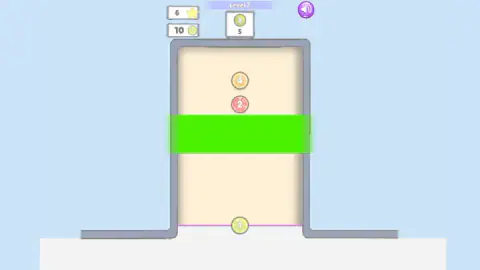
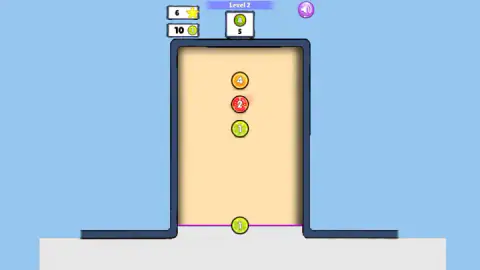
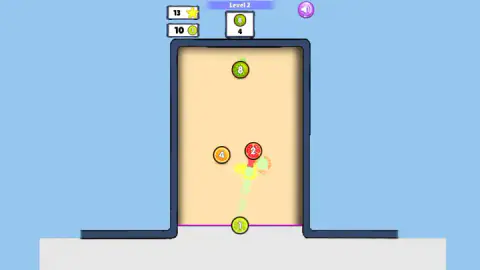
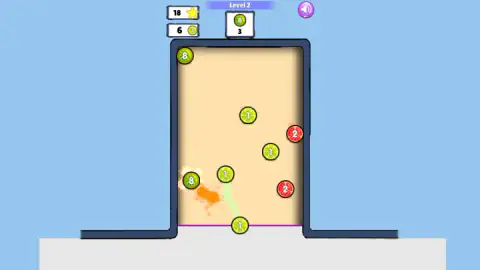
Taken by opening the game ourselves and letting it run — not supplied by the publisher, and not the same picture every other site shows.
How to play Merge Balls Shooter 2048 Connect Fruits
- Drag upward from the ball resting on the magenta line. That ball is the one you are about to fire, and the line is the bottom edge of the playfield. Clicking it sends it up as well. The arrow keys and the space bar did nothing we could see.
- Aim before you let go. The direction of the drag is the direction of the shot. Balls ended up against both side walls during our session, not only straight above the line.
- Hunt for a twin, not a trio. Two matching numbers is the entire requirement. A third ball of the same value is not a bonus, it is a leftover.
- Read the card at the top first. It names the ball you are being asked to build and counts how many of them are still owed. That is the win condition, not the star counter beside it.
- Keep an eye on the small counter with the green ball in it. That is your stock of shots, and it is the only thing in the game that can actually run out.
What the session taught us:
- Merging pays you back. Our stock went from ten to eleven immediately after a merge, then drained to six as shots went in without connecting. The listing's instructions say merging gives you extra balls, and that is their claim, but the counter we watched did climb.
- A miss is not neutral, it is litter. Nothing clears itself. A ball that fails to find its twin stays in the box permanently, parked in the space you wanted for the next one.
- Work the bottom of the chain, not the top. An eight costs two fours, which cost four twos, which cost eight ones. Every eight on that order slip is eight successful shots deep, so the ones are where a level is actually won or lost.
- The playfield is a tall, narrow column. It is drawn for a phone held upright, so on a wide monitor you get a strip of game in the middle and a lot of pale blue on either side.
- The speaker button is top right, outside the box, and it is the only setting we found.
Controls
| Drag upward from the ball on the magenta line | Fires it into the box. This is what moved the game for us, and the direction of the drag is the direction of the shot |
|---|---|
| Click the ball on the magenta line | Sends it up as well, the shorter version of the same move |
| Arrow keys and the space bar | Nothing we could see or hear. This is a game for a mouse or a thumb |
| Speaker button, top right | Turns the sound off and on |
Features
- Equal numbers merge into one ball worth double, with a burst of juice-coloured particles to mark it
- The chain we played ran green one, red two, orange four, green eight: three doublings, and we saw nothing above eight
- Nothing falls. A ball stays exactly where it stops, so the box fills with whatever you failed to connect
- A goal card at the top that counts down as you build: level two wanted five balls of value eight
- A supply of balls that merging tops back up, and that firing drains
- A star counter that only ever climbs, separate from the goal and from the supply
- Available since December 2024
Game details
- Developer
- Partner studio
- Release date
- December 2024
- Last updated
- August 10, 2026
- Added here
- April 2025
- Technology
- HTML5 (2D)
- Platforms
- Browser (desktop), Browser (mobile & tablet, touch)
- Saved progress
- Saving, when available, is managed by this game. Mava cannot confirm your level.
FAQ
How do you play Merge Balls Shooter 2048 Connect Fruits?
A fruit ball sits on a magenta line at the bottom of a tall box. You drag upward from it to fire it, and it stops wherever it first finds room. When a ball touches another ball carrying the same number, the two become one ball carrying double. You keep doing that until you have built whatever the card at the top of the screen is asking for.
How do the fruit balls merge?
Two of the same number, touching, become one of double the value. We watched ones turn into a two, twos turn into a four, and fours turn into an eight. It takes two, not three, which is what separates it from a bubble shooter, and the merge announces itself with a splash of juice-coloured particles.
What is the goal of a level?
On the level we played it was a count rather than a score. A card at the top showed a green ball marked eight with a number under it, and that number dropped by one each time an eight appeared in the box. It started at five and we got it down to three. We cannot tell you whether every level sets its goal the same way.
Is this the same game as 2048?
No, and the only thing they share is the doubling chain. The 2048 that Gabriele Cirulli released in 2014 is a four-by-four grid where tiles start at 2, every tile slides at once when you swipe, and you are chasing a single tile worth 2048. Here you start at 1, you aim and fire one ball at a time, there is no grid, and level two asked for eights.
Do the balls fall to the bottom?
No, and that is the strangest thing about it. There is no gravity in the box. A ball stops where it stops and hangs there, so you end up with balls floating at every height with empty space underneath them. Fruit-merging games usually let the fruit pile up on a floor, and this one does not.
Can you run out of balls in Merge Balls Shooter 2048 Connect Fruits?
There is a small counter at the top left with a green ball in it, and it goes down every time you fire. It also goes back up when you merge, so it behaves like a budget rather than a countdown. Ours dropped to six and we never reached zero, so we cannot tell you what happens when it does.
Who made Merge Balls Shooter 2048 Connect Fruits?
The game is credited to VeturGames, which also made Wiggle Escape and Word Associations Solitaire. No studio name appears on screen while you play. The game has been available since December 2024.
How many levels does Merge Balls Shooter 2048 Connect Fruits have?
We cannot tell you. Our session ran about four minutes and spent all of it on level two without finishing it, so we never saw how far the game goes or whether the numbers climb past eight. Anything else you read about its length did not come from playing it.