







About Watermelon Merge: Fruit Drop
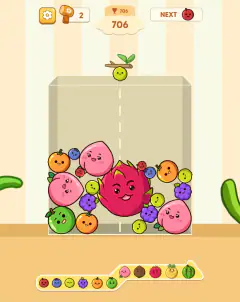
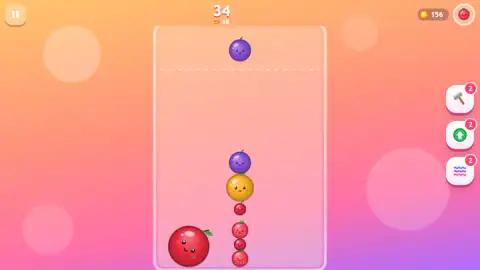
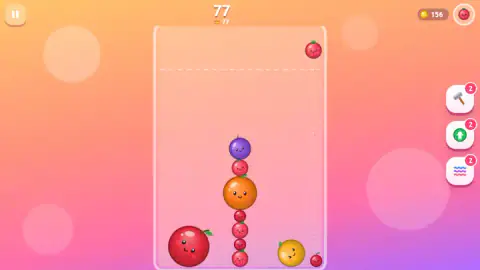
Four pictures of the same jar, and in three of them the biggest fruit on the board sits in the bottom-left corner doing nothing at all. A deep red apple, pressed into the rounded corner, with no twin in sight and nothing you can drop that will shift it. Beside it the small fruit has piled into one narrow tower up the middle, and the entire right-hand half of the jar is bare. The jar was never full. It was badly packed, and in this game those two things end the same way.
What you actually do takes a sentence. Fruit with little faces drops into a tall container with rounded corners; two identical fruits that come to rest touching merge into the next one up, and the number above the jar climbs. The chain we climbed went small dark cherry, then a slightly larger speckled red berry, then a purple plum, then a yellow one the size of a lemon, then an orange, then that apple. Six rungs, each visibly fatter than the last.
Above the jar sits the score, and directly beneath it, in small gold type with a crown beside it, your record. That second number is not a trophy you collect at the end: it moves while you play. Three of our captures read 68, set in an earlier run. The fourth reads a score of 77 with a crown of 77 next to it, because the instant you pass your own best the crown follows you up.
Seventy-seven is where we stopped, and that number sets the edge of what this page can tell you. We never spent one of the three helper buttons down the right edge, whose red badges still read 2 in every capture, and we never met the watermelon the game is named after.
Round fruit never fills a box, and that is why the jar runs out of room early
Put a layer of oranges in a crate and the problem shows itself immediately: however carefully you arrange them, there is air in between. Round things cannot touch everywhere at once. Stack equal balls in the tightest pattern anyone has ever found — the greengrocer's pyramid, every ball nestled in the dip between three below — and they still only occupy about 74 per cent of the crate. The remaining quarter is air, and no amount of care squeezes it out.
That figure has a long history. In 1611 Johannes Kepler, better known for working out how the planets move, published a short New Year's gift of a book about why snowflakes have six corners, and in it he remarked on stacked cannonballs: the greengrocer's pyramid, he said, was the best anyone could do. He could not prove it, and nor could anyone else for the best part of four centuries. Kepler's conjecture was finally settled by Thomas Hales in 1998, with an argument that leaned on a computer to grind through thousands of cases.
Now look back at your jar, because you are not stacking anything carefully. You are dropping. Balls poured in at random settle looser than the pyramid — nearer two thirds of the space filled than three quarters — and the gaps they leave are scattered rather than regular. So a jar that still looks half empty is closer to full than it appears, and every drop that lands badly turns a temporary crevice into a permanent one.
Here is the part that makes it a game rather than a geometry lesson. Mixed sizes pack better than equal ones, because the small balls drop into the gaps the big ones leave. In a crate that is a bonus. In this jar it is the trap: a cherry that rolls into the crevice between the apple and the wall is in a place its twin cannot reach, and it will still be sitting there when the pile touches the dashed line.
You do not lose by failing to merge. You lose by where you let go
Our best run makes the point cleanly. By the time the score read 77 the middle of the jar held a tower four small fruits deep with an orange above them, a berry above that and a plum on top, while the apple squatted in the bottom-left corner and a lemon and a stray cherry sat in the bottom-right. Nothing there was a failed merge. Every one of those fruits had worked. They had simply worked in the wrong places.
Watch the shape of the pile rather than the score and the warning arrives early. Fruit against a wall can only ever be met from one direction; fruit in a corner, under something bigger, cannot be met at all. The jar's rounded corners make that worse than square ones would, because the curve leaves a wedge too small to use and too awkward to clear.
The game is honest about the consequence. When the pile crosses the line you get a card reading "Game over", with your score, your best underneath, and the coins the run earned. Beneath it sit two purple buttons marked with a video icon. The first, "Second chance", says in plain words what it is for: We will remove the top fruits so you can keep playing. That sentence is the clearest statement in the game of what actually kills you. Not a missed merge. A pile that got tall in the wrong place.
Coins, the seven-day ladder, and everything we cannot vouch for
Coins gather in a counter in the top-right corner, and ours sat at 156 across all four captures: runs pay a handful at a time, and a merge chain pays a bonus on top — a banner reading "Combo x2!" dropped across our screen once. The card at the end of a run offers to double that haul for a video, beside a green "Play again" that asks nothing of you, and an advert panel appeared across that same card during our session.
The other source of coins is simply turning up. A panel headed "Daily rewards", with the line "Come back every day — rewards grow!" above it, lays out a week in a grid. Day one pays fifty and day seven pays five hundred, climbing steadily in between. Three of the seven also hand over a helper item: the hammer on day three, the green arrow on day five, all three on day seven. Once claimed, the button underneath reads "Come back tomorrow" and goes grey.
Everything past that is the game talking rather than us. Its own description promises a rare Golden Seed that merges with any fruit and lifts it a rung, a Fruit Album that pays out for each new fruit recorded in it, achievements, quests, skins and a leaderboard — and the menu does carry buttons labelled Shop, Rewards, Quests, Collection and Leaders, two of them wearing a red dot. We opened none of them. That description also names the three helper buttons as a hammer, an upgrade and a shake of the jar; since we never spent one, take that as its account and not ours.
More jars, drops and merges
If this is the shape of puzzle you want more of, Fruit Drop 3D sets the same falling-and-combining idea in three dimensions, where depth gives you a whole extra way to park a fruit badly, and Fruit Merge: Juicy Drop Game keeps the flat jar and the growing chain. NumMerge Clash swaps the fruit for numbered cards and merges one with every matching neighbour at once, which turns the same instinct into something far more deliberate, while Sand Fall lets its falling blocks crumble into flowing sand when they land. The rest are in puzzle games.
Screenshots


How to play Watermelon Merge: Fruit Drop
- Close the "Daily rewards" panel if it is up — there is a pink X in its top corner — and start a run from the menu behind it.
- Move the fruit along the top of the jar and click to let it go. A dotted line falls from it to the floor while you aim.
- Land a fruit touching another of the same kind. The pair vanishes, one fruit a size up appears in its place, and the score climbs.
- Keep the pile below the dashed line near the rim. Fruit that settles above that line ends the run.
- Glance at the circle in the top-right corner between drops: it shows what arrives after the fruit in your hand.
What only sitting in front of it teaches:
- The dotted vertical line is a plumb line, not decoration. It runs from the fruit you are holding straight down to the floor, so the column you are about to add to is never a guess.
- The preview is one fruit ahead, not the one in your hand. In two of our captures the circle matched the fruit already hanging over the jar and in two it did not, which is what a one-step preview looks like when the same fruit comes twice running.
- Keep the big fruit off the walls. A large fruit in the open middle can still be reached from either side by its twin. The same fruit in a corner can only be reached from one, and the corner it blocks is the room you will want later.
- A tall thin tower is a bad sign even when the score is good. Height is what the dashed line measures; width is what you are wasting.
Controls
| Move the mouse left and right | Slides the fruit along the top of the jar. A dotted vertical line drops from it to the floor so you can see which column you are aiming at |
|---|---|
| Click | Lets the fruit go. This is how we dropped every fruit in our session |
| Left or right arrow, or A and D | Listed by the game as the keyboard version of the same slide. In our run, pressing them changed nothing we could see on screen |
| Space or Enter | Listed by the game as the keyboard drop. Same story as the arrows: we could not see it work, which is not the same as it doing nothing |
| Drag a finger and lift it | The touchscreen equivalent, per the game's own listing. We played with a mouse, so this is the listing's claim rather than ours |
| The pause button, top left | Opens a panel headed Pause with Resume, Restart and Menu. Nothing is lost while it is open |
Features
- Six fruits deep is as far as we climbed: a small cherry, a larger speckled red berry, a purple plum, a yellow one the size of a lemon, an orange, and a big deep red apple
- A dotted vertical line falls from the fruit in your hand to the floor of the jar, so the column you are about to add to is never a guess
- A circle in the top right previews one fruit ahead — the one that arrives after the one you are holding
- Your record rides under the score with a small crown beside it, and it climbs live: the moment you pass your own best, that number follows you up
- Three helper buttons sit down the right edge — a hammer, a green upward arrow and blue waves — and each carries a red badge reading 2
- The seven-day reward ladder runs from fifty coins on day one to five hundred on day seven, with helper items attached to days three, five and seven
- The game-over card offers a tidy-up rather than a revival: its Second chance button promises in plain words to remove the top fruits so you can carry on
Game details
- Developer
- Partner studio
- Release date
- October 2026
- Last updated
- October 25, 2026
- Added here
- October 2026
- Technology
- HTML5 (2D physics)
- Platforms
- Browser (desktop), Browser (mobile & tablet, touch)
- Saved progress
- Saving, when available, is managed by this game. Mava cannot confirm your level.
FAQ
How do you play Watermelon Merge: Fruit Drop?
You slide a piece of fruit along the top of a tall jar and let it go. Two fruits of the same kind that come to rest touching each other merge into the next fruit up the chain, and the score above the jar climbs. A dashed horizontal line sits near the rim, and if the pile settles above it the run is over.
What is the order of the fruits in Watermelon Merge: Fruit Drop?
The run we played climbed six rungs, each one visibly bigger than the last: a small dark cherry, a slightly larger speckled red berry, a purple plum, a yellow fruit about the size of a lemon, an orange, and finally a big deep red apple. The game is named after a watermelon, so the chain clearly continues past the apple, but we never got there and this sheet will not guess at what comes next.
How do you lose in Watermelon Merge: Fruit Drop?
By letting the pile grow above the dashed line that crosses the jar near the top. You do not lose for failing to merge; you lose because fruit you dropped in an awkward place is still sitting there taking up room. A large fruit wedged into a bottom corner with no twin in sight is the usual culprit, because nothing you drop later can move it.
What do the hammer, the arrow and the waves do in Watermelon Merge: Fruit Drop?
They are the three helper buttons down the right edge of the jar, and each one carries a small red badge reading 2. The game's own instructions say the hammer smashes a fruit, the arrow turns one into the next fruit up and the waves shake the jar. We never pressed any of them, so those three descriptions are the game's word rather than ours, and we cannot tell you whether the 2 counts uses left, a price or something else.
Are there ads in Watermelon Merge: Fruit Drop?
Yes. An advert slot sits on the game-over card, and during our session an advert panel appeared across it. The two purple buttons on that card are optional video offers rather than interruptions: Second chance says it will remove the top fruits so you can keep playing, and x2 coins doubles what the run paid. A green Play again button starts a fresh run without watching anything.
What is the crown number in Watermelon Merge: Fruit Drop?
It is your best score, printed in small gold type directly under the live score with a little crown beside it. It is not just a record you read afterwards — it tracks you during a run. Three of our captures show a crown of 68, set earlier; the fourth shows a score of 77 with a crown of 77 beside it, taken the moment the run caught up with the old best.
What rewards does Watermelon Merge: Fruit Drop give for coming back?
A panel headed Daily rewards shows a seven-day ladder with the line Come back every day, rewards grow printed above it. Day one pays fifty coins and day seven pays five hundred, with the steps in between at eighty, one hundred and twenty, one hundred and sixty, two hundred and twenty and three hundred. Days three, five and seven also hand over helper items, and once the day is claimed the button underneath reads Come back tomorrow.
Is Watermelon Merge: Fruit Drop free, and who made it?
It is free and it runs in a browser with nothing to install. The studio behind it is not recorded anywhere we can check, so this sheet names no author rather than guessing one. It reached our catalogue on 24 October 2026, which makes it days old at the time of writing rather than a back-catalogue title.