




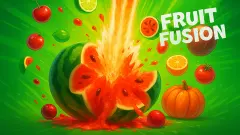


About Connecting Flowers: Garden Merge
Most drop-and-merge games tell you one thing about the next piece: what it is. Connecting Flowers: Garden Merge hides exactly that. The box beside the board is labelled Next Flower, and where the flower should be there is a little film strip marked AD. Unless you pay with your time, every drop is blind. You cannot save a gap for a flower you know is coming, so you learn to leave room for any of them.
The rest is the familiar loop, dressed as a meadow at sunset. A flower waits at the top of a tall frame. You drag inside the frame and let go, and it falls. If it comes to rest touching its twin, the two turn into one larger bloom and the score in the top bar goes up. There is no clock and no levels.
The game is credited to NazzalexGames. It was published in January 2026.
We first played it for four minutes and wrote this page from that. This time we sat with it for ten, and ten minutes changes the story. The score went from 486 to 2,589 and we still never lost. The one thing our short sitting could not explain has a simple answer, and the one thing it treated as a danger is not one yet.
What the flowers turn into
We can vouch for the first steps because we watched them happen. Two pink petunias make a small yellow flower. Two yellow ones make a purple pansy. The collection panel shows a blue flower after the purple one, with 72 points listed as its merge score.
After that the game stops being a chain and starts being a discovery. Make a kind you never have before and everything halts for a card: New flower unlocked!, the new bloom glowing in the middle, the line Get a reward for every new flower you open, and a purple Continue button. We got two cards in ten minutes. The first was a fat yellow dandelion, and the proof is in the pictures either side of it: no dandelion on the floor before the card, one sitting there from the next look onwards. The second, at the very end of the run, was a broad deep-pink bloom with five wide petals, a kind the collection panel had not even shown us.
That panel still has a white flower in its first slot that has never once fallen on our board. Five slots were open and the rest carried padlocks, at least seven of them. Ten minutes showed us two new kinds; there are clearly more.
Where the honeycomb comes from
Our first write-up reported a windfall we could not explain: the honeycomb counter jumped by a couple of hundred in the middle of a run and we never saw what paid it. We can close that now. The unlock card pays it.
Each card lists three rewards: two blue gems, a few hundred honeycomb, and one spare flower. Ours paid 221 honeycomb the first time and 253 the second, and the counter at the top went up by exactly that, to the unit. The gems climbed by two each time.
The unexplained jump from our earlier visit was the same 221, paid by the same kind of card we had simply not been looking at.
The spare flower is worth a second look, because it is not the one you just unlocked. Unlock the dandelion and the card hands you a blue flower; unlock the pink bloom and it hands you a dandelion. Both times, one step back down the chain.
And here is the part that changes how you should play. Between those two cards, the honeycomb counter did not move once. It read the same figure in twelve separate looks at the top bar, through a stretch where the score more than doubled. Merging pays score. Discovering pays honeycomb. If you want the upgrades, you want new kinds, not more of the ones you already have.
The upgrades sit behind the New Flower! button. Pick a flower from the collection and you get two of them, one labelled nectar per touch and one for the score a merge pays. On the blue flower those cost 184 and 44 honeycomb. They are bought flower by flower, so a cheap rise on something you make constantly beats a dear one on a flower you reach twice a game.
One counter still beats us. A hive sits in the top right with 50/400 written on it. It read 50/400 in every capture we have, across two sessions a fortnight apart, through hundreds of merges and two unlocks. Whatever fills it, we have not found it.
The line you are told to fear
A yellow dashed line crosses the frame near the top, and the genre trains you to read it as the overflow mark. The developer's instructions treat losing as a matter of time, with an "if, or rather when" about it, and promise a place in a global ranking of nectar collectors when it happens.
Ten minutes of play got nowhere near it. The flowers lay in a single row along the floor, five to seven of them wide, and the space above stayed empty the whole time. Once a pink petunia perched on top of two flowers below it. That was the entire extent of our second layer.
So the early game is not a survival game, whatever the frame implies, and there is little point playing it cautiously.
The buttons you can leave alone
Under the board, on the right, there are two round buttons, one with a bee and one with a gust of wind, priced at 5 and 10 blue gems. We have never pressed either. They were grey for most of this run; the bee lit up green partway through and was grey again by the end, with our gem count unchanged, so the colour looks like a recharge rather than a question of affordability. Beside the counters there are green plus signs and a gear, which we also left alone.
The adverts are harder to leave alone. Roughly every ninety seconds our run stopped dead: the whole page dimmed and a purple Continue playing button waited in the middle of it. Three of those breaks landed inside ten minutes. None of them actually played a video for us, which may not hold on your machine, but the interruption itself is real and it arrives on its own clock rather than yours.
The flowers stand where a watermelon used to
This kind of puzzle has a short, well-documented history. In January 2021 a Chinese browser game called Merge Big Watermelon had players drop fruit into a container and join equal pairs into bigger fruit. A few months later the Japanese company Aladdin X made its own version, Suika Game, for its digital projectors, and put it on the Nintendo eShop in Japan that December. It reached the rest of the world in October 2023 and had passed 11 million downloads a year later, according to its Wikipedia entry.
The rules of that family are the ones you play here: one piece at a time, equal pairs make the next piece, and the pile must not overflow the container. Connecting Flowers keeps the frame and swaps the fruit for a meadow. What it adds is the layer around it, and after ten minutes that layer is clearly the point. The watermelon game is about how long you last. This one is about how many kinds of flower you have seen.
More merge games to try next
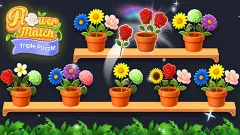
Watermelon Game is the fruit version of the same idea, and the one to try if you actually want the overflow to threaten you. Fruit Merge: Juicy Drop Game and Fruit Drop 3D are two more takes on the same drop. Flower Merge - Triple Puzzle keeps the flowers and asks for groups of three. The rest are under puzzle games.
Screenshots
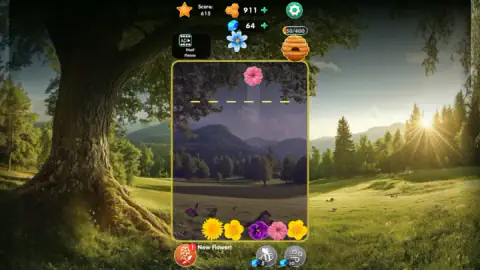
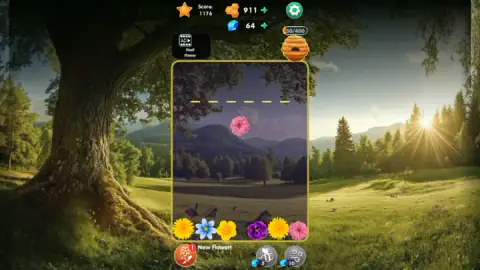
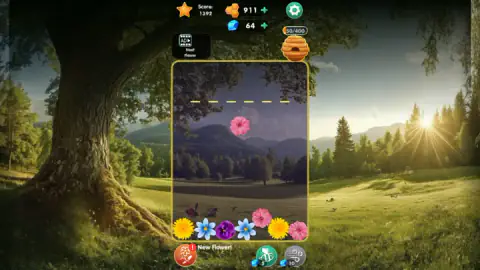
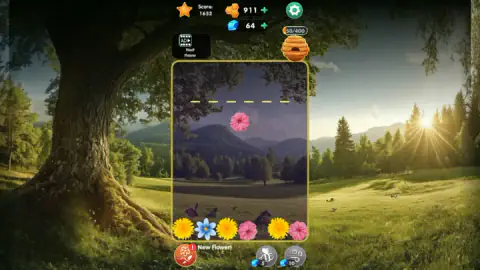
Taken by opening the game ourselves and letting it run — not supplied by the publisher, and not the same picture every other site shows.
How to play Connecting Flowers: Garden Merge
- Look at the flower hanging above the board. It waits there until you act.
- Drag inside the frame and let go. The flower falls from where you let go.
- Bring it to rest against its twin. Two of the same kind become one of the next kind.
- Keep the same kinds together. Flowers that find no partner stay where they fell.
- Watch the red dot on the New Flower! button. That is the collection, and the upgrades.
What our two sessions taught us:
- Touching is the whole rule, not nearness. In our very first capture two identical blue flowers sat on the floor with a clear gap between them, and there they stayed. A gap you cannot close is a flower wasted.
- Where you let go is where the pile grows. Nearly all our releases were near the middle, and that is where the only flower we saw on a second layer landed.
- A merge leaves the bigger flower in the same place. Plan for what the spot will hold next, not only for the pair you are making.
- Small merges are worth very little. Two pinks paid 22 points and two yellows paid 63. The score only moves properly when a chain reaches the later flowers.
- Start the drag inside the frame. Our first ever drag began on the button under the board and opened the collection over the game instead. The arrow in its top left corner takes you back.
Controls
| Drag inside the frame and let go | Drops the waiting flower; it falls where you release it |
|---|---|
| New Flower! button (bottom left) | Opens the flower collection and the two upgrades of the flower you select |
| Back arrow (top left of the panel) | Returns to the board |
| Bee and wind buttons (bottom right) | Two helpers priced at 5 and 10 gems; we did not press them |
| Next Flower box (ad icon) | Offers a look at the next flower for an advert; we did not press it |
| Continue / Continue playing | Closes the unlock card and the advert break; nothing moves until you press it |
Features
- A tall frame where flowers pile up on the floor and only merge when they touch
- A chain confirmed in play, pink to yellow to purple, with blue, a yellow dandelion and a broad pink bloom after it
- An unlock card for every new kind, paying gems, honeycomb and one spare flower
- Honeycomb that comes from discovery, not from merging: ours sat still for most of a ten-minute run
- Two upgrades per flower, paid in honeycomb, one for nectar and one for merge score
- A hive counter that read 50/400 in every capture of both our sessions
- No timer and no level list; one board and one score that climbs
- Made by NazzalexGames
Game details
- Developer
- NazzalexGames
- Release date
- January 2026
- Last updated
- August 10, 2026
- Added here
- November 2025
- Technology
- HTML5 (2D)
- Platforms
- Browser (desktop, mouse), Browser (mobile & tablet)
- Classification
- Arcade , Casual , Multiplayer , Puzzle
- Saved progress
- Saving, when available, is managed by this game. Mava cannot confirm your level.
FAQ
How do you play Connecting Flowers: Garden Merge?
A flower waits at the top of a tall frame. You drag inside the frame and let go, and the flower falls where you released it. When it comes to rest touching a flower of the same kind, the two become one larger flower of the next kind and your score goes up. Flowers of the same kind that land apart do not merge, however close they look.
How do you lose in Connecting Flowers: Garden Merge?
We have not managed to lose it. A yellow dashed line crosses the frame near the top and in this kind of game that line is the limit for the pile, but across ten minutes and roughly sixty drops our flowers never rose above a single row on the floor. The developer's instructions say that when you lose you are shown your place in a global ranking.
What do the flowers merge into?
Two pink petunias make a small yellow flower, and two of those make a purple pansy. The collection panel lists a blue flower after the purple one, worth 72 points. A large yellow dandelion and a broad deep-pink bloom both turned up later as new discoveries, so the chain runs on past the five kinds the panel had open for us.
Where does the honeycomb in Connecting Flowers: Garden Merge come from?
From discovering a flower you have never made before. Each discovery puts up a card reading "New flower unlocked!" that pays two blue gems, a few hundred honeycomb and one spare flower. Between the two cards we saw, merging alone never moved the honeycomb counter, even though the score more than doubled.
What is the honeycomb for?
Upgrades. The New Flower! button opens a collection, and each flower in it has two upgrades of its own, one for nectar and one for the score a merge pays. On the blue flower those cost 184 and 44 honeycomb. Upgrades are bought flower by flower, not for the whole board.
What do the bee and wind buttons do?
We did not press them, so we cannot say. They sit under the board with a price in blue gems, 5 for the bee and 10 for the wind. They were grey for most of our run; the bee lit up green partway through and had gone grey again later, with our gem count unchanged, which looks more like a recharge than anything we did.
Are there adverts in Connecting Flowers: Garden Merge?
Yes, on two counts. The Next Flower box beside the board shows an advert icon where the preview of the next flower should be, so you play blind unless you pay for the look. And roughly every ninety seconds our run stopped for an advert break that dimmed the whole page and waited for a Continue playing button. Dropping and merging itself never asked for one.
Who made Connecting Flowers: Garden Merge?
It is credited to NazzalexGames. It was published on 19 January 2026. It is listed for PC, Android and iOS; we played it on a desktop computer with a mouse.