








About Smash & Merge Balls
Merge games usually keep you at arm's length. You drop a thing, it lands on another thing, the two become one bigger thing, and the board fills up while you watch from above. Smash & Merge Balls puts you down on the board with a mallet bigger than you are, and the balls are already rolling before you touch anything.
The whole interface is three things. A stopwatch at the top left counting down, a score at the top centre counting up, and a pause button. No lives, no health, no second currency on screen — and nothing in the game that can take a point back off you once you have it.
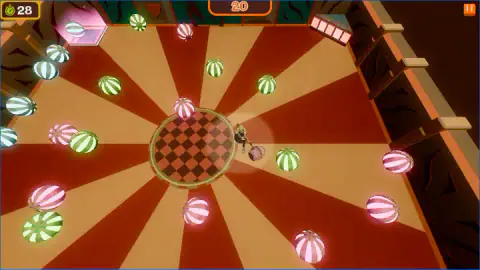
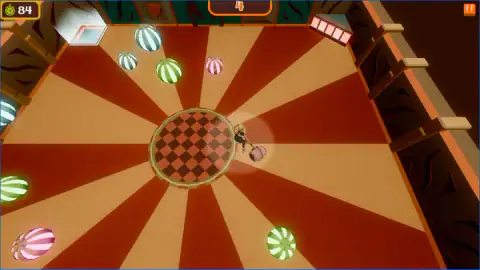
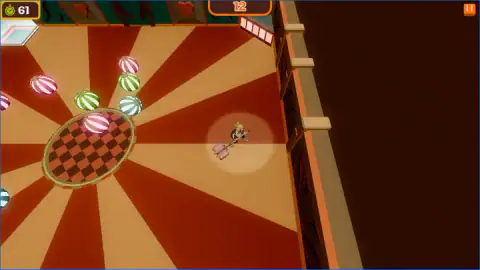
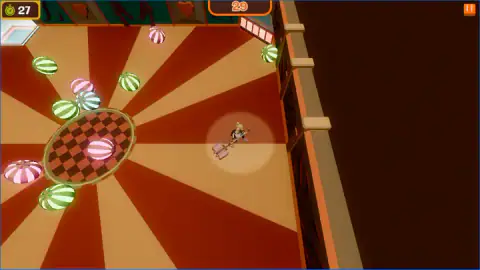
Here is the part that tells you what kind of game this is. For most of our second run our player was jammed against the arena wall and did not move an inch: four captures, the same spot in every one, the same angle of the mallet. The score climbed anyway, from twelve when we got stuck to twenty-nine by the time the clock ran out. The balls do the scoring. You start them.
MaidTronic put the game up in October 2025 and gave it its last update in August 2026. Our own session was two runs on the free table, about four minutes in all, and the rest of this page is honest about which parts of it we actually saw.
The clock is the whole game
There is no failure state in Smash & Merge Balls that we could find. Nothing chased us, nothing hit back, nothing deducted. The stopwatch at the top left starts somewhere above 84 — that is the highest reading any of our captures holds — and from there it only goes one way.
That makes this a very short game played many times, which is a design with real consequences. Every round is the same question with a different answer: how much can you get moving before the time is gone. A bad round costs you a minute and a half and nothing else, which is exactly why the exclamation mark matters. Those last few seconds are the only moment the game raises its voice, and the only moment where a last swing is worth more than a careful one.
It also means the number under the table's thumbnail is the real scoreboard. Ours read 0 before we started and 29 when we stopped, and the only thing that number asks of you is one better round than your last one.
The room is a circus ring, and that is the point
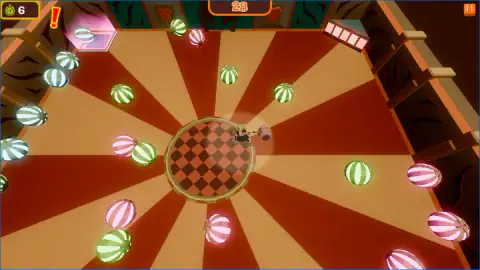
Look at what you are standing in. Tiered pale ledges run around the edge of the floor like seating, and beyond them the hall is unlit. A spotlight travels with your player across the boards, so the bright patch is always under your feet. The floor itself is painted as a sunburst of red and sand wedges spreading out from a round chequered platform, which is a fairground floor and nothing else. And your weapon is a strongman's mallet with a head the size of your torso.
That room has a real and surprisingly exact history. Modern circus starts with Philip Astley, a former cavalryman who in 1768 marked out a circle in a field south of the Thames in London and performed trick riding inside it. He chose a circle for a practical reason: a horse at a canter leans into the turn, and riding a continuous circle lets the rider use that lean and the centrifugal force to stand steady on the horse's back. The diameter he settled on — roughly thirteen metres, forty-two feet — turned out to be about the tightest circle a horse can hold at that speed in comfort. It became the international standard, which is why a touring act built in one town would still work in the next.
The idea that outlived the horses is the one this game is built on: a bounded performance floor where everything that leaves the centre comes back. In Astley's ring the rider never rode away from the audience. Here the balls never leave either. They roll, they hit the boundary, they come back in, and they keep colliding while you set up the next one. The boundary is not scenery; it is the thing that keeps the show going, which is also why driving into it and staying there is such a bad idea.
And it explains the shop. The three tables you can buy are not new levels, new rules or new balls. They are new floor shapes — a doubled square, a narrow corridor, a heart — and in a game where everything bounces off the edges, the edge is the game. That is the promise the thumbnails make, anyway. We never bought one, so we cannot tell you whether a corridor really does send the traffic back at you harder than a box does.
What two runs are worth
The coin counter sits in the top right of the menu. Ours read zero before we started and four when we stopped, which is the entire economy of the game stated in two numbers.
Against that, the prices under the locked tables: two hundred coins for Double Box, three times that for Corridor, five times for Heart. At the rate we were earning, the cheapest of the three is something like a hundred rounds away — and we were, to be fair, bad at this, having spent half of one round driving into a wall. A player who keeps moving will fill the counter faster than we did. Nobody is filling it quickly.
Whether that reads as a grind or as a reason to keep going depends on what you came for. If you want the heart-shaped floor, this is a long project. If you want a game you can replay in a minute and a half without a second thought and a personal best to nudge upward, the free table gives you that on the first click, and the other three are a bonus you may never need.
More things to set rolling
If the part you liked was starting a chain and watching it pay out without you, Domino Battle is built on nothing else. Block Crush and Sand Blocks both scratch the same itch from the other side, where clearing the board is the whole job rather than filling it. And if you want the opposite of a round that is over in a minute and a half, Kingdom Tower Defense and Mini Dice Chess ask you to think before anything moves. None of those four got a session like the one behind this page, so treat the comparisons as directions rather than reviews. The rest of the shelf is in strategy games.
Screenshots
How to play Smash & Merge Balls
- Press the top button on the menu and the table picker opens. Box is free and the only one you can start; the other three have price tags on them.
- Move with the letter keys, W, A, S and D, or with the on-screen stick on a touchscreen. The arrow keys did nothing for us at all.
- Get in among the balls and set them moving. The listing puts the mallet swing on the left mouse button and a dash on the space bar.
- Watch the clock at the top left. When it drops into single figures a red exclamation mark appears beside it, and that is your warning that the run is nearly over.
- When the clock empties, the round ends and you are returned to the menu with coins added to the counter in the corner. Your best score stays pinned under that table's thumbnail.
What we only learned by being in there:
- Do not park. Driving into the barrier is the worst thing you can do, and it is easy to do by accident, because the camera follows you out to the edge and the floor behind you goes off screen. Half our second run went that way.
- Try the letters before the arrows. This is the single most useful thing on this page. Our player crossed the floor exactly once in that second run, in the one stretch where we reached for a letter key.
- The score does not need you every second. A ball you set going is still in play long after you have walked away from it. The sensible move after a good hit is to go and start something else, not to chase what you just knocked.
- The floor does not empty out. By the last seconds of our first run there were close to twenty balls loose on the wedges, more than at any earlier point we captured. Expect a busier table as the clock runs down, not a cleaner one.
- Each table keeps its own record. The number under the Box thumbnail is your best on Box, not your best overall, so the free table is where a score you can actually chase lives.
Controls
| W, A, S, D | Move. The listing gives these as the movement keys, and the one stretch of our second run where our player actually crossed the floor is the one stretch where we touched a letter key |
|---|---|
| Arrow keys | Nothing we could see. We leaned on them for most of a run and four captures spanning the whole stretch show the player in exactly the same spot |
| Space bar | A dash, according to the listing. We could not tie it to anything visible in our own captures, so take it as the game's claim |
| Left mouse button | Swings the mallet, according to the listing. Our player is holding the mallet in every frame and we never caught a swing landing, so this one is unconfirmed too |
| On-screen stick and button | The touchscreen equivalents of the above. We played with a keyboard and a mouse, so how they feel is not something we can tell you |
| Mouse click | Everything on the menus. Start, the Buy buttons, the X that closes the table picker |
| The two bars, top right | Pause, during a run |
Features
- One free table, Box, and three locked ones: Double Box at 200 coins, Corridor at 600 and Heart at 1000, each with a thumbnail of the floor shape you are buying
- Every table keeps its own best score under its picture. Ours read 0 before we played and 29 when we stopped
- A clock, a score and a pause button. That is the entire interface during a run, and there are no lives to lose
- The clock is the only thing that ends a round. A red exclamation mark appears beside it for the last seconds
- The score climbs without you: pinned against the barrier and not moving, ours went from 12 to 29 as the clock ran down
- Nothing we did made the floor emptier. By the last seconds of our first run there were close to twenty balls loose on the wedges
- Two runs paid four coins, which makes the cheapest locked table a long way off at that rate
Game details
- Developer
- MaidTronic
- Release date
- October 2025
- Last updated
- October 23, 2026
- Added here
- August 2025
- Technology
- HTML5 (3D)
- Platforms
- Browser (desktop), Browser (mobile & tablet, touch)
- Saved progress
- Saving, when available, is managed by this game. Mava cannot confirm your level.
FAQ
What is Smash & Merge Balls?
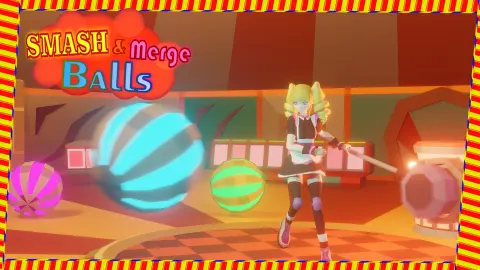
It is a free browser arcade game in which you stand on a brightly painted table holding an oversized wooden mallet, surrounded by striped balls that roll and bounce off the walls. A clock counts down at the top left and a score climbs at the top centre as the balls collide. There is one free table to play on and three more you can buy with the coins a run pays out.
How do you move in Smash & Merge Balls?
The listing gives movement as W, A, S and D on a keyboard, or an on-screen stick on a touchscreen. We can half confirm it: the arrow keys did nothing for us across four captures of a single unmoving player, and the one time our player crossed the floor was the one time we used a letter key. Try the letters first and you will save yourself the half-run we wasted.
How long does a round of Smash & Merge Balls last?
A round lasts exactly as long as the clock at the top left, and nothing else ends it: no lives, no hazard we ever met. The highest reading we caught was 84 and the lowest was 5, so a round is a matter of a minute and a half rather than an evening. When it empties you are handed back to the menu with your coins topped up.
How do you unlock Double Box, Corridor and Heart?
You buy them with coins, from the same panel that starts a game. The prices are printed under the thumbnails: 200 for Double Box, 600 for Corridor and 1000 for Heart, against the free Box table that is open from the start. Our two runs earned four coins between them, which tells you most of what you need to know about the pace of it.
What happens when two balls merge?
The listing says balls of the same colour merge when they collide, score you points and leave a new ball of a random colour behind. We never caught a merge in a single capture, so we cannot describe it first hand, but what we can confirm fits: the score keeps climbing while balls are rolling, and the floor never got emptier as a run went on.
Can you lose in Smash & Merge Balls?
Not in any way we found. There are no lives on screen, nothing chases you and nothing took points off us. The clock is the only pressure in the game, and the only question each round asks is how high the number at the top centre is when it reaches zero.
Who made Smash & Merge Balls and when did it come out?
The listing credits MaidTronic and dates the release to October 2025, with a last update in August 2026. No studio announcement with a firmer date turned up, so this page takes the listing at its word and says so.
Can you play Smash & Merge Balls on a phone?
It is free, it runs in the browser on this page with nothing to install, and it is listed for desktop, Android and iOS alike, in landscape. The touchscreen controls are a stick to move and buttons to swing and dash. We played with a keyboard and a mouse, so the phone version is the game's claim rather than our verdict.