



About Merge 2048
The 2048 most people know is a grid you slide. Every tile moves at once, and two equal numbers that bump into each other become one. Merge 2048 keeps the doubling numbers and throws the sliding away. You hold one tile above a jar, choose where it falls, and let gravity do the rest.
That small change moves the whole difficulty. In a sliding game you can always try another direction. Here every drop is final: the tile lands where you let go, and if it lands on the wrong number it stays there. The jar has a red line across its top edge, and when the pile reaches it the game is over.
There are two ways to play. The classic mode uses square numbered tiles that stack in neat columns. Shapes mode swaps the numbers for geometric pieces that pile up and roll, closer to the fruit-dropping jar games than to a grid. Merge 2048 is credited to Tejas Anil Shrimali, was published in August 2025. We played a game of each mode.
Two games behind one name
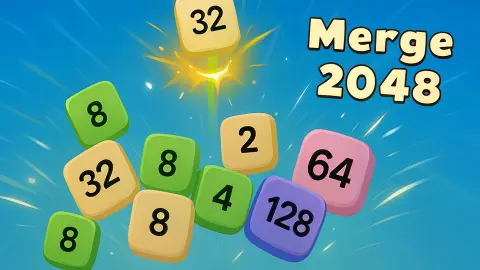
The classic mode is the one that earns the title. Tiles are small squares, mostly green and cream with a pink 64, with the number printed on each. They fall in straight columns and stack exactly on top of each other, so you always know where a tile will end up.
Shapes behaves differently. The pieces are triangles, a diamond, pentagons, hexagons, octagons and large purple circles, and they grow in size roughly in that order. They do not stack in columns. They land, tip over and settle into whatever gap the pile leaves, which means a piece dropped on the left can roll to the middle. In our Shapes game the score went from 22,400 to 26,000 over a couple of drops, and a second purple circle appeared in the jar along the way.
The two modes reward different habits. In the numbered mode you plan columns. In Shapes you plan slopes, because the pile moves under you.
What the queue throws at you
The detail that changes the numbered mode most is the order of the tiles. You do not start with a long run of 2s and 4s. Our second tile was a 32, and by the seventh we were holding a 64.
That is a problem the original 2048 never gives you. A large tile that arrives early has nothing to merge with, so it sits in the jar taking space until another tile of the same value appears. If it lands in the middle, it blocks everything around it.
What we would do differently is keep one side of the jar for big numbers and the other for small ones, so a 64 never falls on top of the 4 you were about to match. We did not get a long enough game to prove it, but the end of ours shows what happens without a plan: one tall column in the middle, no two neighbours alike, and a 64 on its way to the top.
Where the 2048 comes from
The name points to 2048, the puzzle Gabriele Cirulli released in March 2014. In it you slide tiles across a small square grid, equal tiles add up, and the goal is a single tile worth 2048, eleven doublings from the smallest tile.
Merge 2048 is not connected to that game. It borrows the numbers and the idea that two equals make one, and replaces the grid with a jar and gravity. It is also one of many browser games with the same name, so if you are looking for a particular version, the jar and the Shapes mode are how to recognise this one. We saw no target tile and no win screen in our run. Both of our games ended when the pile crossed the red line.
Titles, TNT and what we did not try
A title sits above the score. In our numbered game it read Noob from the first tile to the last. In the Shapes game, which passed 22,400 points, it read Chad. The game's description talks about unlocking titles as you play, and that fits what we saw, but we did not see the moment one changes.
In the bottom right corner there are two buttons. The red TNT button has a small video icon above it, the usual sign of a power-up that costs an ad. The game's description says TNT clears unwanted tiles. Next to it is a second button with "10/10" above it. We used neither, so we cannot tell you how much TNT clears or what the second button does.
Two more things from our session. When a game ends you get a card with your high score and current score and two buttons, Home and Replay. In our session an ad break came up both on the way back to the menu and when we started a new game from it.
More merge games
If the numbered mode is the part you liked, Block Blast 2048 keeps the doubling numbers in a different puzzle, and Drop & Merge 2048 is another take on dropping numbered tiles. If Shapes was more your speed, Watermelon Game is built on the same jar of pieces that grow when they merge. Tejas Anil Shrimali also made Astro Shooter, a shooting game rather than a puzzle. For more, see the puzzle games.
Screenshots
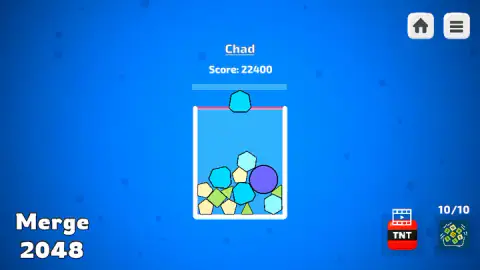
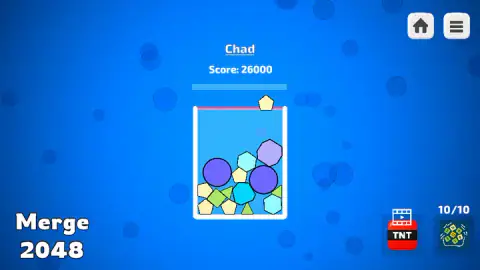
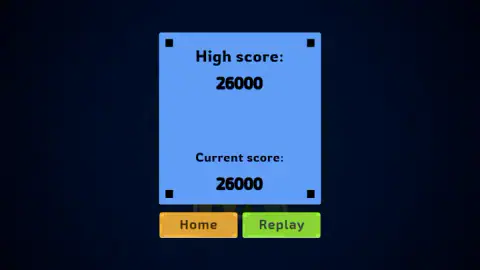
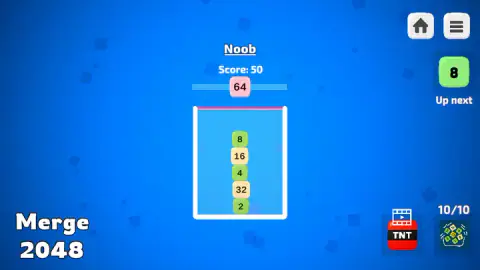
Taken by opening the game ourselves and letting it run — not supplied by the publisher, and not the same picture every other site shows.
How to play Merge 2048
- Press and hold on the piece above the jar, or touch it on a phone.
- Drag it left or right until it sits over the spot where you want it.
- Let go. The piece drops straight down and stops on whatever is below it.
- When it lands on a tile with the same number, the two join into one tile of double value. A 4 on a 4 makes an 8.
- Keep the pile below the red line at the top of the jar. Crossing it ends the game.
Tips from our run:
- Use the whole width. In our numbered game we dropped every tile in the middle. They made a single tower, only one pair ever met, and the game ended at 50 points. The jar is about five tiles across, so there is room for several stacks.
- Watch "Up next". The box on the right shows the tile after the one you are holding. Knowing that a 4 follows your 16 tells you to leave a 4 uncovered.
- Do not bury small numbers under big ones. A 2 under a 32 has no way out. Every tile you cover is a tile that cannot merge until the one above it goes.
- Leave the keyboard alone. The arrow keys and the space bar gave us no response. On a computer this is a mouse game.
Controls
| Click and drag (mouse) | Move the next piece left or right above the jar |
|---|---|
| Release the mouse button | Drop the piece into the jar |
| Drag and lift your finger (touch) | Same as the mouse, the piece falls when the drag ends |
| TNT button (bottom right) | A special block the game offers to clear space; it carries a video icon and we did not use it |
Features
- Two modes behind one name, a classic numbered mode and a Shapes mode with geometric pieces
- You choose where each piece falls by dragging it across the top of the jar, then letting go
- Equal numbers join into one tile of double value when they meet, as a 4 landing on a 4 turns into an 8
- An "Up next" box shows the following tile, and the queue mixes large values like 32 and 64 in early
- In Shapes the pieces pile and roll against each other, and the biggest ones we saw were purple circles
- The game ends when the pile crosses the red line at the top of the jar
- A title sits above your score and changes with it, from Noob at the start to Chad in our longer game
Game details
- Developer
- Tejas Anil Shrimali
- Release date
- August 2025
- Last updated
- August 10, 2026
- Added here
- June 2025
- Technology
- HTML5 (2D)
- Platforms
- Browser (desktop, mouse), Browser (mobile & tablet, touch)
- Saved progress
- Saving, when available, is managed by this game. Mava cannot confirm your level.
FAQ
How do you play Merge 2048?
Drag the next piece left or right above the jar and let go to drop it. When two equal tiles meet they join into one tile worth double, which frees space. The game ends when the pile crosses the red line at the top of the jar, so the whole skill is choosing where each piece lands.
What is the difference between the two modes in Merge 2048?
The classic mode uses square tiles with numbers on them that stack neatly in columns, with an "Up next" box showing the following tile. Shapes mode drops geometric pieces, from small triangles to large purple circles, which pile up and roll against each other, so you have less control over where they settle.
How do you lose in Merge 2048?
Each jar has a red line along its top edge. When the pile reaches it, the game stops and shows your high score and current score with Home and Replay buttons. In our numbered game that happened after a single column of tiles grew tall enough to touch the line.
What does the TNT block do in Merge 2048?
According to the game's description, the TNT block clears unwanted tiles to make room. Its button sits in the bottom right corner and carries a small video icon, which usually means it is unlocked by watching an ad. We did not use it, so we cannot say how much it clears.
Is Merge 2048 the original 2048 game?
No. The original 2048 was released by Gabriele Cirulli in March 2014 and is played by sliding tiles on a four-by-four grid. Merge 2048 borrows the doubling numbers but drops tiles into a jar instead, and it is one of many games that use the same name.
Who made Merge 2048?
Merge 2048 is credited to Tejas Anil Shrimali. It was published in August 2025.
Can you play Merge 2048 on a phone?
Yes. The game's instructions say you drag with your finger and the piece drops when the drag ends, the same movement as the mouse on a computer. It needs no download or sign-in.
What do Noob and Chad mean in Merge 2048?
They are titles shown above your score. In our run the title read Noob while we had 0 to 50 points and Chad in a game that passed 22,400 points, which matches the game's description of titles you unlock as you score more.