



About Connect: Monsters
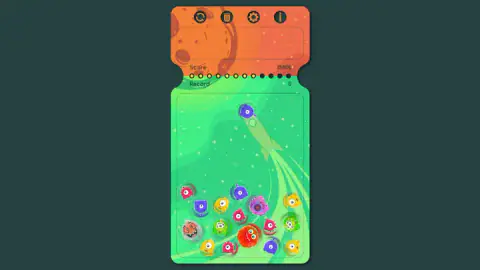
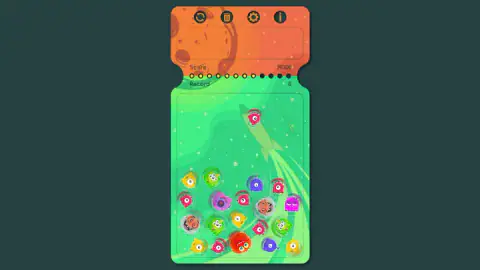
Most puzzle games of this shape hand you a grid. Columns, rows, a tidy place for everything to land. Connect: Monsters hands you a jar instead — a tall tank of bright green liquid with pale specks drifting through it and the faint outline of a rocket hanging behind the glass — and every monster in the game arrives sealed inside its own clear bubble. They do not snap into place. They settle where they land, at whatever angle the pile happens to leave them, and the heap at the bottom grows crooked.
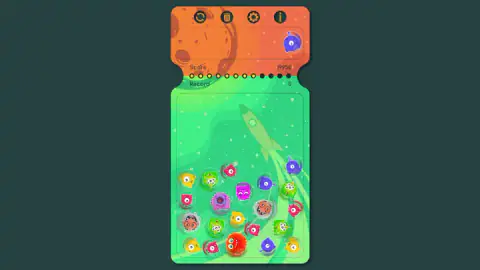
Only one monster waits at a time. It sits in a slot in the orange card above the jar, you point somewhere in the green, and down it goes. That is the entire input. While a bubble is falling the slot is empty, which means the moment you most want to plan ahead is exactly the moment the game shows you nothing.
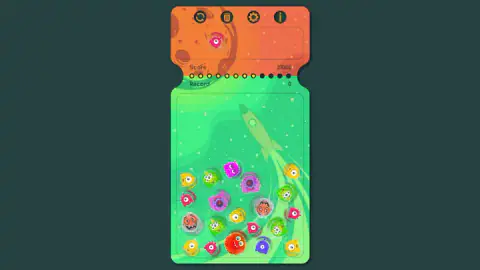
What accumulates down there is a cast that repeats: small yellow one-eyed things, crimson spiky ones, a purple one with a thin antenna, green blobs covered in half a dozen little eyes, a grey and orange face grinning with square teeth, a large pink blob with a single dark pupil, a magenta ghost with its eyes shut. The sizes are the tell. Some are coin-sized and some are roughly double that, which is the shape of a game where matching things become bigger things.
The listing credits a developer called Redactor.
It has been sitting on that page since October 2024, and was last touched in the summer of 2026.
Our own session ran about four minutes with a mouse and never reached the end of a run. The rest of this page is careful about which half of that is a result and which half is a gap.
Bubbles that eat bubbles
The jar is not just decoration, and the thing it is drawing is real. Put soap bubbles together and they do not stay separate for long. Over hours, a foam coarsens: the big bubbles get bigger and the small ones vanish into them. It happens without anything popping and without anybody touching it.
The reason is pressure, and a nine-year-old can hold it. The air inside a small bubble is squeezed harder than the air inside a big one, because the skin of a small bubble is curved more tightly and pulls inwards more. Air always drifts from where it is squeezed hard to where it is squeezed less, and the soap film between two touching bubbles is thin enough to let it through. So the small one quietly empties into the large one next door. Big bubbles do not win because they are strong. They win because they are relaxed.
The man who worked out how foams arrange themselves was a Belgian physicist, Joseph Plateau. Where soap films meet, he found, they always meet three at a time along an edge, and always at the same angle, a third of a full turn apart — which is why a packed foam looks like a honeycomb that has been nudged. He finished much of that work after going blind, with assistants describing the films to him while he reasoned out what they had to be doing.
Now look at the heap in this jar. The bubbles crowd each other at uneven angles, three-at-a-time, exactly the way a real foam packs. The monsters inside them come in sizes that step upward. And the one rule the game runs on is the same rule the foam runs on: get the right ones touching, and several become one bigger thing.
The honest difference is who does the work. In a real foam nobody aims; the coarsening happens on its own and the whole thing eventually collapses. Here the merging waits for you to put matching monsters in contact, and the jar is topped up from above every time you drop, so the pile is always being refilled faster than you are clearing it. A foam left alone simplifies. This one does the opposite.
What the two numbers did, and what they would not do
The score behaved. It started our first look at 15800 and finished the session at 21050, and in every frame in between it was higher than the frame before. We never once saw it fall. Whatever the game thought of our play, it was prepared to say so immediately.
Record would not. It sat directly under the score reading 0, and it read 0 in every picture we took, including the last one. The most likely explanation is the simple one: a record only gets written when a run ends, and we never ended a run. But that is reasoning, not something we watched, and it is worth knowing before you expect the number to tick up while you play.
Then there is the row of small circles along the bottom of the orange card, most of them lit yellow and the last few dark. It looks like a progress bar for something — a level, a stage, a stock of moves. It is not. That row read exactly the same in every single frame of our session, down to which dots were lit, while the score climbed by more than five thousand points. Steady play did not shift one of them. We cannot tell you what they count; we can tell you that ordinary play is not it.
Where four minutes ran out
A short, honest list of what we did not reach. We never filled the jar, so we never saw a game over or whatever screen follows one. We never caught a merge in the act, which is why this page attributes the merging to the listing and to the evidence of the different sizes rather than to our own eyes. We never opened the cog or the letter i at the top of the card, and we never pressed the bin beside them, so we cannot tell you what any of the three do. We pressed the circular arrow once, at the end, and that is the only one of the four buttons we can vouch for.
What we can tell you is the texture. This is a quiet, unhurried game with one input, one screen and no music cue telling you how to feel about your last drop. It asks a small question every few seconds — where does this one go — and it never raises its voice about the answer.
More things to connect
If the drop-and-match idea suits you but you would rather it sat on a proper board, Block Crush and Sand Blocks both give you one. Hero Rescue Puzzle swaps the aiming for a single right answer you have to find before you commit, which is the opposite bargain. Word Blossom keeps the one-screen shape and changes the pieces to letters. Those three have not been sat with the way this jar was sat with, so what you get above is a direction, not a judgement. The rest of the shelf is in puzzle games.
Screenshots
How to play Connect: Monsters
- Click or tap inside the jar. There is no title screen and no Play button to get past: the board is live the instant the game loads, and the monster in the slot above goes where you were pointing.
- Aim before you commit, because that is the only decision you get. Once the bubble is in the air, nothing you do steers it.
- Land matching monsters against each other. The listing says that connecting them produces a higher-ranked monster, and the different sizes already sitting in the heap back that up.
- Keep an eye on how high the pile is reaching. The listing says a crowded jar ends the run. We never filled ours, so take that as a warning from the game rather than from us.
- Read the score along the bottom of the orange card. It is the only number that reacted to anything we did.
What we only found out by being there:
- The keyboard does nothing. Arrow keys and the space bar got no reaction we could detect in four minutes. Point and click is the whole instrument.
- The preview slot empties while a bubble falls. You can see what is coming next only between drops, never during one, so the habit of lining up two moves at a time does not transfer here.
- Nothing sits on a grid. A bubble that lands half a width off leaves a wedge-shaped gap in the pile, and that gap is permanent in a way a misplaced grid piece never is.
- The scoring moves in small steps. Three separate times during our run the counter advanced by exactly 150 points. The biggest single jump we recorded was 950.
- The game is quiet about how you are doing. In four minutes we never heard a failure sound or a reward sound. Nothing cheered, nothing buzzed, nothing warned.
Controls
| Click or tap inside the jar | Sends the waiting monster down. There is no separate drop button and no title screen to get past; the board is already live when the game loads |
|---|---|
| Where you point | Where it goes. Aiming is the whole input, and once the bubble is falling you have no further say in it |
| Click and drag across the pile | Something registers. We spent most of our session dragging between monsters and the board kept changing and the score kept climbing, but we could not isolate what a drag does that a click does not |
| Arrow keys, space bar | Nothing we could detect. This is a pointer game and the keyboard sat idle for four minutes |
| Circular arrow, top left of the orange card | Restart. We pressed it once, at the very end of the session |
| Bin, cog and i, along the top of the orange card | Unknown. We never pressed any of the three, so we will not tell you what is behind them |
Features
- One jar, one screen, no levels to travel through: the same tank of green liquid with the same rocket behind it from the first drop to the last
- Every monster arrives sealed in its own clear bubble and settles wherever it lands, so the pile is never a tidy grid
- Only one monster waits at a time, in a slot above the jar, and that slot is your entire preview
- Monsters come in visibly different sizes, from coin-sized to roughly double that, and the big ones stay put at the bottom of the heap
- Two numbers and nothing else: Score along the bottom of the orange card and Record directly underneath it
- Our score climbed from 15800 to 21050 across four minutes and never once fell
- A row of twelve dots sits under the score, eight lit and four dark, and it did not move in our whole session
Game details
- Developer
- Redactor
- Release date
- October 2024
- Last updated
- October 23, 2026
- Added here
- March 2025
- Technology
- HTML5
- Platforms
- Browser (desktop), Browser (mobile & tablet, touch)
- Saved progress
- Saving, when available, is managed by this game. Mava cannot confirm your level.
FAQ
What kind of game is Connect: Monsters?
It is a free single-screen puzzle game played in the browser. A tall jar of green liquid fills most of the screen, monsters arrive one at a time sealed in clear bubbles, and you aim each one into the heap below so that matching monsters end up touching. There are no levels and no second location: the same jar is there from the first drop to the last.
How do you play Connect: Monsters?
You point and you drop. One monster waits in a slot in the orange card above the jar, a click or a tap sends it down, and where you were pointing is where it goes. Once the bubble is falling you have no further control over it, and the next monster only appears in the slot after the current one has landed.
Do the monsters in Connect: Monsters merge?
The monsters in the jar are plainly different sizes, from coin-sized up to about double that, and the listing says that connecting matching ones turns them into a higher-ranked monster. That matches what the heap looks like, but we never caught a merge happening in front of us during our session, so we are passing that on as the game's claim rather than ours.
How do you lose in Connect: Monsters?
The listing says the run ends when the jar gets too crowded. We played for about four minutes without filling it, so we never saw a game over, heard a failure sound or reached whatever screen follows one. If you want to know what losing looks like, you will find out before we did.
What does Record mean in Connect: Monsters?
Record sits directly under Score and is meant to hold your best result. Ours read 0 in every single picture we took, including the one where the score had reached 21050, so it did not update while a run was still going. The likeliest explanation is that it only writes when a run ends, and we never ended one.
What are the twelve dots under the score?
A row of twelve small circles runs along the bottom edge of the orange card, the left ones lit yellow and the right ones dark. They look like a progress bar, but they read exactly the same in every frame of our session while the score climbed by thousands of points. Whatever they count, ordinary play did not move them, and we would rather say that than guess.
Can you play Connect: Monsters on a phone?
It is free, it runs on this page with nothing to install, and the listing covers desktop, mobile and tablet. The playfield is drawn as a tall column with wide empty margins either side, which is a phone shape sitting in a desktop window, and a game whose only input is a tap is a game built for a thumb. We played it with a mouse, so how it feels under a thumb is the listing's claim and not ours.
Who made Connect: Monsters and when did it come out?
The game's listing credits a developer called Redactor. That page has been up since October 2024 and was last updated in August 2026. Those are portal dates rather than a studio announcement, which is why this page does not claim a precise release day.