




About Traffic Puzzle Game Linky
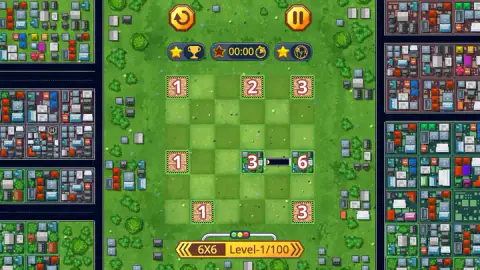
A game with Traffic in its name usually means something is stuck. Nothing is stuck here, because there is nothing yet to be stuck on. The first level is a meadow with eight numbered blocks dropped on a six-by-six grid and not one metre of road between them. You are not clearing the jam. You are the reason there will ever be traffic at all.
The numbers are the entire game, and they are demands rather than labels. A block marked 3 wants three lanes of road arriving at it. A 6 wants six. A 1 wants to be left nearly alone. You lay a road by dragging from one block to another along a row or a column, straight, never diagonally, never across a road already there. When a block has exactly what its number asked for, that number turns green.
We watched it happen once, and it is the clearest lesson the game gives. The 3 in the middle of our board had a single-lane road running two squares up to the 2 above it, and another single lane running right to the 6. Three squares of tarmac, and the number stayed red. Then the road above it widened into two lanes. Three lanes arriving, and the 3 went green. The number counts lanes, not distance.
SecGame made it, and it has been available since March 2026.
The banner across the bottom of the board carries two things: the size of the grid and the level, which read 1 of 100. That first level is as far as we got. We spent the session on it and did not solve it, which is worth saying about a board that looks like a minute's work.
The numbers are a puzzle with a name, and it is older than the browser
Strip the meadow, the traffic and the hazard tape, and what is left is a Japanese pencil puzzle called Hashiwokakero, which means "build bridges". It appeared in the magazine Puzzle Communication Nikoli in September 1990, from the same publisher that gave sudoku its name, and English-language puzzle pages have run it since as Bridges, or as Hashi in The Times.
The rules will sound familiar by now. You get islands with numbers from 1 to 8. You join them with straight bridges, horizontal or vertical, which may not cross each other or pass through an island. At most two bridges join any one pair. Each island must end up with exactly as many bridge ends as its number says, and every island has to be reachable from every other, one single network with nobody left out.
Swap islands for city blocks and bridges for lanes of road and you have this game, down to the detail that makes it work. The ceiling of 8 is not arbitrary: an island has four sides and each side takes two bridges, so eight is all the room there is. That is also why the 6 on our board was the hard one, and why we never cracked it.
Here is the trick worth taking into any level. The eight numbers on our board add up to twenty. Every lane is counted twice, once by the block at each end, so a solved board is ten lanes of road and not one more. Count before you start and you know when you are close.
One more thing, for anyone who wonders whether there is a clever way to do this. There is not. Deciding whether a board of this kind can be solved at all belongs to a family of problems nobody has found a quick general method for, which is a mathematician's way of saying the only route is the one you are on: work out what each number forces, and follow it.
What the screen is telling you
The board floats on grass, with the city crowded against both edges of the screen like a promise about what all this road is for. Three badges sit along the top, each carrying a star: one with a trophy, one with the stopwatch, one with a round emblem too small to read. The first star is gold and the other two are dark, which reads like three things to earn per level rather than one.
Under the board sits a small traffic light, and below that the banner with the grid size and the level number. The arrows on either end of it suggest the boards grow: ours was six by six, and the banner has room to say otherwise.
What we did not get to
One level of a hundred is a short look, so here is what we cannot tell you. We do not know whether the clock runs on later boards, what earns the second and third star, or what the trophy is for. We never isolated the gesture that widens a road to two lanes; it happened while we were working on that pair of blocks, and we are not going to pretend we know which drag did it. We played with a mouse, so the portrait layout and the touch controls are untested.
And one warning worth having. The controls published with this game in several places describe aiming and shooting, with a trajectory line and barrels full of power-ups. That is a different game. Nothing here aims at anything.
More puzzles cut from the same cloth
Car Escape is the other side of this coin: the roads are already there and the traffic is wedged solid. Arrow Parking is the closest relative we have, since it also asks you to lay down a route rather than drive one, and Bus n Ball Jam turns a queue of buses into a colour problem. If what you like is the joining rather than the traffic, Onet Puzzle pairs tiles with a path that bends at most twice. The rest are under puzzle games.
Screenshots
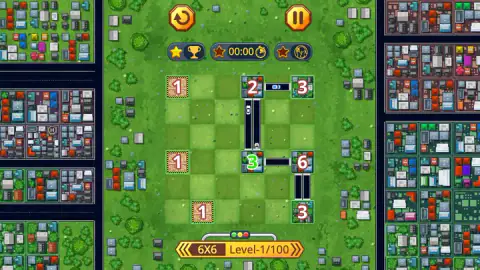
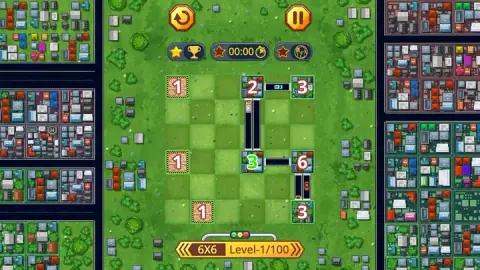
Taken by opening the game ourselves and letting it run — not supplied by the publisher, and not the same picture every other site shows.
How to play Traffic Puzzle Game Linky
- Drag from a numbered block to another block in the same row or column. A road appears between them, and a car is driving on it almost at once.
- Read each number as a demand: that is how many lanes of road must arrive at that block.
- Remember the ceiling. A pair of blocks takes one lane or two and never more, so a 6 has to be fed from at least three of its four sides.
- Watch the colour. A number in green has exactly what it asked for; a number in red is still wrong.
- The circular arrow at the top left starts the level again. The button opposite it pauses.
Things we only found out by sitting in front of it:
- A block with no road is a crate behind hazard tape. The moment a road reaches it, buildings and trees grow on the square. You can count the work left from across the room: our three 1s were still crates when we gave up.
- The cars are scenery. They turn up the instant a road exists, even on a stretch one square long, and they wander on it going nowhere. Nothing we did ever depended on where a car was.
- The clock never started. The stopwatch badge read 00:00 in every screen we have of level 1.
- There is no undo. The header has two buttons, restart and pause. A road you regret is a level you start over.
- The 1s are the quiet ones. A 1 takes a single lane from a single neighbour, which also settles one of that neighbour's four sides. On a board with three of them, they are the cheapest places to be certain.
Controls
| Drag from one numbered block to another | Lay a road between them, straight along a row or a column |
|---|---|
| Click the circular arrow (top left) | Start the level again |
| Click the pause button (top right) | Hold the level |
| Drag | On phones and tablets the same roads are drawn by dragging a finger, according to the game's platform list |
Features
- Level 1 is a 6x6 board with eight numbered blocks: three 1s, a 2, three 3s and a 6
- The banner along the bottom counts the levels, and it reads 1 of 100
- A number counts lanes, not distance: the 3 on our board stayed red until the road above it widened to two lanes
- A block with no road is a crate behind hazard tape; buildings appear on it as soon as a road arrives
- Cars start driving the moment a road exists, even on a stretch one square long
- The only two buttons on screen are restart and pause, with no undo among them
- The stopwatch badge read 00:00 for the whole of level 1, so nothing was counting against us there
- Three badges sit across the top, each with a star; the first is lit gold and the other two are dark
Game details
- Developer
- SecGame
- Release date
- March 2026
- Last updated
- August 10, 2026
- Added here
- December 2025
- Technology
- HTML5 (2D)
- Platforms
- Browser (desktop, mouse), Browser (mobile & tablet, touch)
- Saved progress
- Saving, when available, is managed by this game. Mava cannot confirm your level.
FAQ
How do you play Traffic Puzzle Game Linky?
You drag from one numbered block to another in the same row or column, and a road appears between them. The number on a block is how many lanes of road have to arrive at it: when it has exactly that many, the number turns green. Roads run straight, never diagonally, and never across each other.
What do the numbers mean in Traffic Puzzle Game Linky?
They are demands, not names. A block marked 3 wants three lanes of road meeting it, from any direction, and a block marked 6 wants six. Since a pair of blocks can be joined by one lane or two and no more, a 6 has to be served from at least three of its four sides.
How many levels does Traffic Puzzle Game Linky have?
The banner across the bottom of the board reads 6X6 and Level-1/100, so the game offers a hundred levels and tells you the size of the grid you are on. We spent our session on the first of them, which is a six-by-six board with eight numbered blocks.
Is there a time limit in Traffic Puzzle Game Linky?
One of the three badges at the top is a stopwatch, and on level 1 it read 00:00 in every screen we have, so nothing was running against us there. The game is described elsewhere as timed, but we did not reach a level where the clock started. We also never found an undo button: the header carries a restart and a pause, and nothing else.
Do you aim and shoot in Traffic Puzzle Game Linky?
No. Some listings publish aim-and-shoot controls with this game, and they belong to a different one. There is no cannon and nothing to fire here; the whole game is dragging roads between numbered blocks on a grid.
Is Traffic Puzzle Game Linky the same puzzle as Bridges or Hashi?
It behaves like it. Hashiwokakero, published in English as Bridges or Hashi, gives you numbered islands that have to be joined by straight bridges, at most two between any pair, until every island has exactly as many bridges as its number. This game swaps islands for city blocks and bridges for roads, and the arithmetic we watched on the board matched that rule.
Can you play Traffic Puzzle Game Linky on a phone?
It is listed for desktop, Android and iOS, in both landscape and portrait, so the roads should be drawn with a finger instead of a mouse. We played it on a desktop with a mouse and have not tested the touch controls ourselves.
Who made Traffic Puzzle Game Linky?
The game is credited to SecGame. The puzzle was published in March 2026 and updated in August.