






About Rings and Dot!
Noughts and crosses stops being a game at about the age of nine, when both players work out that careful play always ends level. Rings and Dot keeps the board, three squares by three, and removes the rule that runs it dry: a square that has been used is not closed. A ring can go into a cell that already holds a ring, as long as the two are different sizes, and the smaller one sits inside the larger.
There is no opponent either. Pieces arrive one at a time on a pedestal under the board, in red, yellow, green or blue, and you drag each one to a cell. Three of one colour in a line clear away and score. What you play against is the board filling up.
The game's listing credits Yermix Studios and dates the game to September 2026.
This page rests on about four minutes at a desktop with a mouse. A guided opening took us to 270 points in two pieces. After that we placed four more, cleared nothing and never reached the end of a run. Read it as a close look at how the cells work, not as a high-score guide.
A cell is not taken until each size in it is taken
Here is the move that showed it. The top-left cell held one blue ring of the smaller size, with clear space around it. We were holding a big green ring, and the cell we had been aiming at would not accept it. So we dropped it on the blue one. It went in, and the corner became a green ring with a blue ring inside.
A cell, then, works like a set of sockets, one for each size. We saw two sizes of ring, big and middle. The title promises a dot, and the listing describes it as a third and smallest size for the very centre of a cell. No piece we were dealt was a dot, so that part is the listing's word.
This is what separates the game from the paper one. In noughts and crosses a cell belongs to one player for good. Here a cell can carry several colours at once, which means a single cell can be working towards several lines of different colours.
The listing also says size is ignored when a line is checked: only colour counts. The one line we watched form was three red rings of the same size, so we cannot back that from our own play.
The opening hands you 270 points
The first two pieces are a lesson, and the game sets the board for each. A faint ring and a yellow circle show where the first one goes. Ours finished the red row, and as it landed four more rings appeared in the corners: yellow at top left and bottom right, green at the other two. That is one diagonal waiting for yellow and one waiting for green, and the only cell they share is the centre.
Our notes have the score at 30 after the red row, and the next piece as a two-colour one, green around yellow. It went into the centre. The next time we looked, the board was empty, the score read 270 and a small ×2 sat under it.
So one piece closed both diagonals in the same move, and that move was worth far more than the row before it. The ×2 was gone one piece later. From that point the bin and the eraser were on screen and the board was ours.
Eight lines, and the centre sits on four of them
A board of nine cells has eight lines: three rows, three columns and two diagonals. The cells are not equal. The centre lies on four of those lines, a corner on three and the middle of an edge on two. Anyone who has played the paper game knows the centre is worth having, and that is the arithmetic behind it.
In Rings and Dot the centre is worth more still, because it can hold more than one colour. Our centre cell held blue and green together, which made it a live part of four possible blue lines and four possible green ones.
We then wasted it. At the end of the run the top-left corner held green around blue, the centre held blue around green, and the bottom-right corner was empty. The piece in our hand was blue around green. If size is ignored, as the listing says, that piece in the empty corner would have put three greens and three blues on the same diagonal in one move. We dropped it on the top-left corner, where both sizes were taken, and it came back. We ended one drag away from finding out.
The bin and the eraser
Both buttons are small, round and numbered. The bin read 3 from the moment it appeared to the moment we stopped, because we never pressed it. The listing calls it a discard, which would make it the way out when the piece on the pedestal fits nowhere you want it.
The eraser read 1. The eraser is greyed out while the board is empty and lights up once the first ring is down. We pressed it three times. After two of those presses our notes have a prompt reading "Choose a cell to clear", and each time we backed out without choosing. The counter still read 1 afterwards, so pressing the button does not spend it.
We saw no way to earn more of either. With a single eraser, the sensible reading is to keep it for the cell that is blocking two lines at once.
What four minutes did not show us
The end of a run. The listing says the game is endless and stops when the board fills, and we never came close: once the opening was over, three cells in use was our fullest. We did not see a line made of mixed sizes, a dot, or any clear after the opening, so we cannot say what a single line pays in free play or whether the multiplier climbs past ×2.
We did not press the bin or the pause button. We logged one sound as the game opened and none we could tie to a move. The arrow keys and the space bar did nothing we could make out. Every move here was a mouse drag.
Who should play it
Players who like a small board and a long look before each move. We saw no timer and nothing that hurried us, and a piece released in the wrong place cost nothing.
If you want levels, a story or a rival across the board, this is not that. It is one board, one piece at a time and a best score to beat.
More boards to fill
Block Crush is the same habit on a bigger grid: drag pieces from a tray and clear full rows and columns. Wood Block Journey does it on a nine-by-nine board that also clears by square, like a sudoku. Sand Blocks clears lines by colour, with blocks that crumble into sand, and Flower Merge - Triple Puzzle is another game of threes. The rest are under puzzle games.
Screenshots
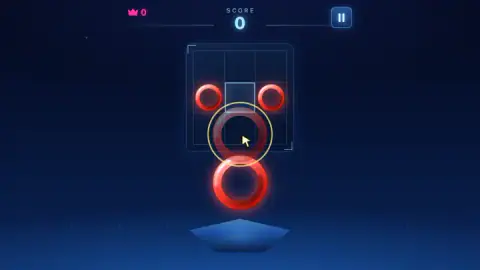
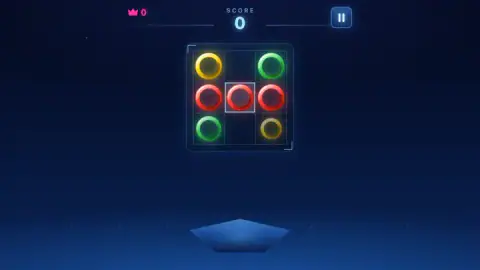

Taken by opening the game ourselves and letting it run — not supplied by the publisher, and not the same picture every other site shows.
How to play Rings and Dot!
- Start a game. Ours opened on a board that was already set: two red rings in the middle row with a gap between them, and a third red ring waiting on the pedestal.
- Press on the piece, drag it up to a cell and let go. It shrinks to fit the cell.
- Get the same colour into all three cells of a row, a column or a diagonal. Those rings clear, and the SCORE figure at the top goes up.
- After the opening the board is empty and two round buttons appear beside the pedestal: a bin marked 3 and an eraser marked 1.
- Keep placing pieces. The figure beside the pink crown, top left, is your best, and it rose with our score as we played.
Four things the board made clear:
- Let go inside the grid. Twice we released a ring wide of the board. It went back to the pedestal and nothing was lost, but nothing was placed either.
- Read a piece for its size before its colour. A big green ring would not go into a cell that already held a big green ring. We tried it twice to be sure.
- A two-colour piece needs two free sizes. Ours was a big blue ring around a smaller green one. A cell with both of those sizes filled sent it back.
- Use a half-full cell. A big ring dropped onto a cell holding only a smaller one went in around it, and that cell then counted for two colours.
Controls
| Drag (mouse) | Carries the piece from the pedestal to a cell of the board; released outside the grid, it goes back to the pedestal |
|---|---|
| Bin button (left of the pedestal) | Carries a 3; the listing calls it a discard, and we did not press it |
| Eraser button (right of the pedestal) | Carries a 1 and is greyed out on an empty board; pressing it did not spend it, and we never picked a cell to clear |
| Pause button (top right) | On screen throughout; we did not press it |
Features
- A board of nine cells where one cell can hold rings of different sizes, one inside another
- Pieces in four colours, dealt one at a time, some of them two rings of different colours in a single piece
- A guided opening on a board set up for you, which took our score from 0 to 270 in two pieces
- A multiplier, shown as a small x2 under the score, after the move that cleared two diagonals together
- Two limited tools beside the pedestal, a bin marked 3 and an eraser marked 1
- A best score beside a pink crown that rose with our score during the run
Game details
- Developer
- Yermix Studios
- Release date
- September 2026
- Last updated
- October 10, 2026
- Added here
- August 2026
- Technology
- HTML5 (2D)
- Platforms
- Browser (desktop, mouse), Browser (mobile & tablet)
- Saved progress
- Saving, when available, is managed by this game. Mava cannot confirm your level.
FAQ
How do you play Rings and Dot?
Drag the piece waiting under the board onto one of the nine cells and let go. When the same colour sits in all three cells of a row, a column or a diagonal, those rings clear and the score goes up. Pieces come one at a time in red, yellow, green or blue, and some carry two colours at once.
Can you put a ring in a cell that already has one?
Yes, if the sizes differ. We dropped a big green ring onto a cell holding a smaller blue one and it went in around it. A big ring onto a cell that already had a big ring was refused, and the piece went back under the board.
Does the size of a ring matter for making a line?
The game's listing says it does not, and that only colour counts. The one line we watched form was three red rings of the same size, so we could not confirm it from our own play. Size clearly matters for placing, since each size fits a cell only once.
What do the bin and the eraser do in Rings and Dot?
They sit either side of the piece, marked 3 and 1. The listing describes them as a discard for a piece you do not want and an eraser for making space. We never pressed the bin. We pressed the eraser without choosing a cell, and its counter stayed at 1.
How does the score work in Rings and Dot?
Clearing a line adds to the SCORE figure at the top. In our run the opening moves took it from 0 to 270, and a small x2 showed under the score after one piece cleared two diagonals together. Placing a piece without completing a line added nothing.
How does a game of Rings and Dot end?
We did not reach the end of one. The listing says the run is endless and stops when the board fills up, with no final level to beat. After the guided opening we never had more than three of the nine cells in use.
Can you play Rings and Dot on a phone?
It is listed for PC, Android and iOS, in portrait. Everything we did was dragging one piece to a cell. Our own time with it was on a desktop with a mouse, so the phone side is the listing's word and not ours.
Who made Rings and Dot?
The game's listing names Yermix Studios as the developer. The game was published in September 2026 and its last update is dated October 2026.