


About Tick-Tack-What?
Noughts and crosses is the one board game nobody loses once they have learned it. Take the centre or a corner, block every line of two, and the worst you can get is a draw. Children work that out by the age of nine, and from then on the game is a way of passing time rather than a contest. Tick-Tack-What? is built on the idea that this is a problem, and its answer is a computer opponent that does not accept the board you both started on.
We played it for ten minutes and lost three rounds in a row. That is not a complaint about the difficulty. Each time the computer won, the white grid in the middle of the screen was redrawn in a new shape, with black squares around it that are not cells and a different number of cells inside, and the score line at the top ticked up on the right. The game calls your opponent "BOT" on that line, PLAYER on the left and the computer on the right, and the rest of this page calls it the computer.
Nobody is credited on the launch card or inside the game; the game's listing gives the maker as Kshtult and dates the game to June 2026. The portal files it under Board. Nothing else about its origin is on screen.
Lose a round and the board grows a new shape
The first board is the one you know: a black three by three grid on a white page, nothing else but the score and a speaker icon in the corner. Our first marks went down the way they do in any game of noughts and crosses, an O in the top-left corner, our X beside it, our second X in the centre, the computer's O below that.
The second board, the one you get after the computer's first win, has ten cells. The square is still there, with one extra cell hanging under the middle column, and above it sit three solid black squares, two at the top like ears and one between them. Squint and it is a head. Our X and the computer's O went into the top row of it, just as they had on the square, and the extra cell at the bottom stayed empty the whole time we were there.
The third board is taller than it is wide: three columns and four rows, twelve cells, with a black slab down each side of the lower rows, a white strip underneath and a black stand below that. It looks like a trophy, or a robot's head on a plinth. Our X went in the top row and the computer's O two rows down.
The fourth, which we reached at 0 : 3 and did not get to play, is the strangest. Three cells on top, five across the second row, then a row where only the two end squares have outlines and the middle is blank white, two more cells under that, and a black base with a stem. A tree, perhaps, or a mushroom. What three in a row means on a shape like that, whether a line can cross the blank patch, whether four rows let you win on a column of three, we cannot tell you. We never won a round, so we never found out what the boards look like when the score goes the other way.
The computer scored three times and we never saw how
This is the part we have to be honest about. In each of our three lost rounds, the last clear picture of the board shows no line of three anywhere. In the first, there were two of ours and two of the computer's on the square, an O in the top-left corner, our X beside it, an O in the centre, our X in the bottom-left corner. The next thing on screen was the break pill and a score of 0 : 1. We think one of our X's had gone and a third O was on the board when the pill lifted, but we have no clean picture of that moment and will not swear to it.
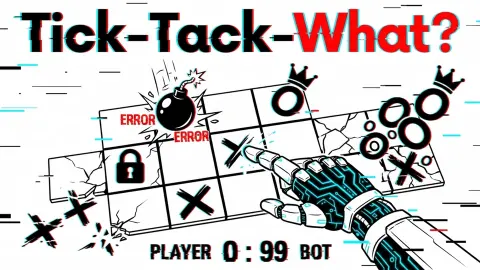
The game's own blurb promises exactly this kind of thing. It says the computer erases your X's, locks cells, drops bombs on the board, fakes its own victories and shifts gravity, and the cover art backs it up with a bomb, a padlock, two red ERROR labels and a robot arm reaching across the grid. We are not doubting any of it. We are saying that in ten minutes of play we did not catch a single one of those tricks in a picture, and that what we did see, over and over, was a board that ignored our clicks.
Most of our moves did nothing. Some of that was our own impatience, clicking before the computer had placed its O. Some of it may have been locked cells, which would fit the blurb. Some of it was a board that had simply stopped: twice, with two X's and two O's down, no empty cell would take a mark, and we reloaded the page. The game gives no message in any of these cases, which is the one thing we would change. A cheat you can see is a joke; a cheat you cannot see is indistinguishable from a bug.
Click to keep playing is the portal's break, not the game's
Between rounds, a dark pill with the words Click to keep playing drops over the score line, the screen dims, and the distributor's mascot appears in the middle, a red heart one time and a golden pigeon the next two. Under it a message read, every time, that the ad had been skipped and we should enjoy the game, with a purple Continue playing button beneath. We never saw an actual advert. Another day, or another browser, probably will.
Two details worth knowing. The next board is already drawn under the message while it is up, so you get your first look at the new shape through the dimmed screen. And your progress is kept: when we reloaded the page at 0 : 1 and pressed Let's Play! again, the game put us back at 0 : 1 on the ten-cell board, not at the starting square.
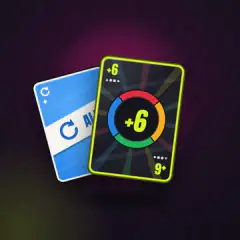
The launch card itself is a small joke. Its artwork is a cracked grid with crowned O's, a padlock in one cell, a bomb mid-explosion, two ERROR labels and a chrome robot arm reaching in, and the score printed under it already reads 0 : 99 in the computer's favour. By the time we had lost three rounds that number felt less like a joke.
Who it is for, and more board games
This is a game for people who find ordinary noughts and crosses too safe and want to be wrong-footed, and for anyone who likes a puzzle whose rules you discover by losing. It is not a game for a quiet, fair contest: the whole point is that the other side does not play fair, and the game trusts you to find that funny rather than infuriating. Our run leaned towards infuriating, mostly because so many of our clicks were swallowed in silence; your patience may be longer than ours.
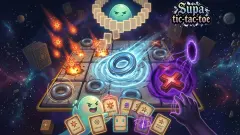
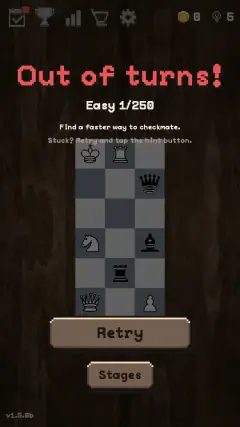
If you want the grid with a twist you can actually see, Supa Tic Tac Toe hands you a deck of cards to bend the board with. For a small board where the computer plays straight, Mini Chess packs chess variants onto boards as small as four by four. Angry Checkers is another old board game with the rules bent on purpose, and Ludo World is for when you would rather blame the dice than the computer.
More in our strategy games.
Screenshots
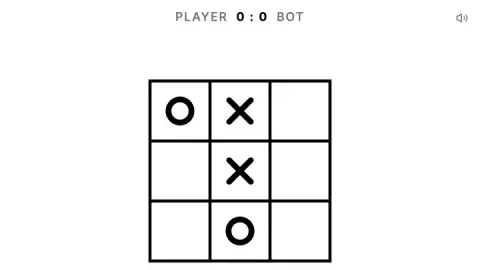
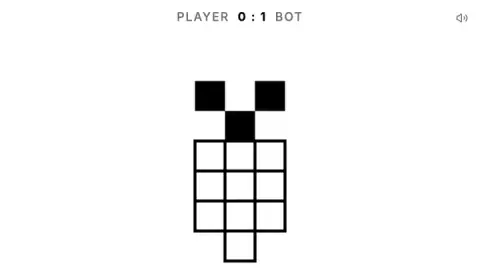
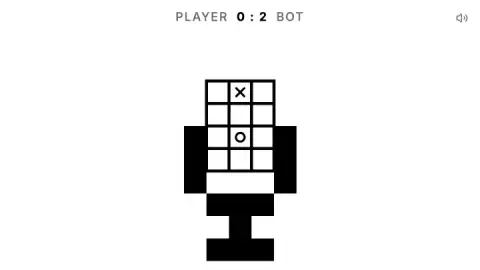
Taken by opening the game ourselves and letting it run — not supplied by the publisher, and not the same picture every other site shows.
How to play Tick-Tack-What?
- Press the purple Let's Play! button under the cover art. A Warming Up bar runs for a moment first.
- Click any empty cell. Your X appears there. On a computer, the cell under your pointer turns pale grey before you click, so you can see which square you are about to take.
- Wait. The computer puts its O down a moment later, and clicking during that pause did nothing for us.
- Line up three to win the round. The score line above the board counts rounds, not pieces.
- When a round ends, a dark pill reading Click to keep playing covers the score. Click it, press Continue playing, and the next board appears in a new shape.
Things we learned the hard way. If a click does nothing, do not click the same cell again; the game never tells you why a move was refused, and repeating it only costs time. Only the white outlined squares are cells: the black blocks that frame the later boards have no outline and are part of the picture. Twice our board froze with four marks on it and no move would register; a page reload fixed it, and the score came back as it was. There is no undo, no timer and no turn indicator, so the only clue that it is your move is that the computer has stopped placing pieces.
Controls
| Click or tap an empty cell | Places your X; the computer answers with an O a moment later |
|---|---|
| Mouse hover | The cell under the pointer turns pale grey, so you can see which square a click will take |
| Let's Play! button | The purple button under the cover art on the launch card; the only way into a game |
| Speaker icon, top right | Sound toggle; we left it alone and heard nothing we could attribute to the game |
| Keyboard | Nothing we found; Enter and Escape changed nothing |
| Drag | Nothing; every move that worked for us was a single click |
Features
- Plain noughts and crosses to begin with: a black three by three grid on white, an X for you, an O for the computer, and a score line above it
- Every round the computer wins, the board changes shape: ten cells under three black blocks like ears, then three columns by four rows on a black stand, then a wide tree-like outline
- The score stayed at 0 : 1 when we reloaded the page, and the same shaped board came back
- Between rounds a dark pill reading Click to keep playing covers the score; in our run it said the ad was skipped and offered a Continue playing button
- No timer, no undo, no turn indicator and no message when a click does nothing
- The launch card's cover art shows a bomb, a padlock, two ERROR labels and a robot arm over the grid, with the score already at 0 : 99
- We lost three rounds in ten minutes and never once saw the computer's finishing move
Game details
- Developer
- Kshtult
- Release date
- June 2026
- Added here
- May 2026
- Technology
- HTML5 (2D)
- Platforms
- Browser (desktop), Browser (mobile & tablet, touch)
- Classification
- Cards & Board , Puzzle
- Saved progress
- Saving, when available, is managed by this game. Mava cannot confirm your level.
FAQ
How do you play Tick-Tack-What?
It starts as ordinary noughts and crosses. Press the purple Let's Play! button on the launch card, click an empty cell to put down your X, wait a moment for the computer's O, and try to line up three. When a round ends a dark Click to keep playing pill appears over the score, then a Continue playing button, and the next board is drawn in a new shape with the same rules.
Why does the board change shape in Tick-Tack-What?
That is the What in the name. The first board is the usual three by three square. After the computer's first win ours became ten cells with three black blocks sitting above them like ears, after the second it was three columns by four rows on a black stand, and after the third a wide outline shaped like a tree. Only the white outlined squares are cells; the black blocks are part of the picture.
Does the computer cheat in Tick-Tack-What?
The game's own blurb says so, listing erased X's, locked cells, bombs and faked wins, and the cover art shows a bomb, a padlock and ERROR labels on the grid. In ten minutes we did not catch any of those happening in a picture. What we did see was a board that often ignored our clicks and three rounds that ended without us seeing the winning line, so take the claim as a promise we could not confirm.
Why does nothing happen when I click a cell in Tick-Tack-What?
It happened to us constantly and the game never explains it. Sometimes we were clicking before the computer had placed its O; sometimes the cell may have been locked, which is one of the tricks the blurb promises. Twice the board stopped answering altogether with four marks on it and we reloaded the page. The practical rule is to wait a second after each move and, if a click does nothing, try a different empty cell rather than the same one again.
What is the Click to keep playing screen in Tick-Tack-What?
It is the break between rounds, and it belongs to the portal rather than the game. A dark pill with that text covers the score line, the distributor's mascot appears, a message says the ad was skipped and a purple Continue playing button takes you on. In our run the ad was skipped all three times; on another day you may see a real one. The next board is already drawn underneath while the message is up.
Does Tick-Tack-What? save your score?
Within a session, yes. We reloaded the page at 0 : 1 and came back to the same score and the same ten-cell board, not to the starting square. We did not come back on another day, so we cannot say how long the score is kept.
Who made Tick-Tack-What?
Kshtult and dates the game is credited to June 2026. No studio name appears on the launch card or inside the game. The portal files it under Board.
Can you play Tick-Tack-What? on a phone?
The listing marks it as mobile-ready and the whole game is single clicks on large cells, which suits a thumb. We played on a computer with a mouse, where the cell under the pointer turns pale grey before you click; on a touch screen you will not get that preview.