


About Mini Chess
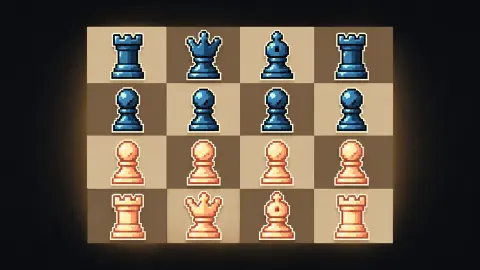
Most chess games for the browser give you the full 64 squares and wish you luck. Mini Chess takes the opposite view. Its first board is four squares by four, each side has a rook, a queen, a king, a rook and four pawns, and the pawns start the game touching each other.
That one detail decides how the board plays. A pawn moves straight ahead and captures diagonally, so a pawn with an enemy pawn right in front of it cannot move at all. When we selected our first pawn, the game showed no square to walk to, only two rings around the black pawns diagonally ahead. On this board the first move is always a capture.
Mini Chess is made by sublevelgames. It was published in August 2026. The menu sums the idea up in four words: "Small boards, sharp games."
We played the first board, 4x4 Silverman, on Normal. Most of our session went on the tutorial, and the real game only got two moves in. This page tells you what we saw and says clearly where we stopped.
Small boards are real chess history
Mini chess was not invented for phones. Chess players and mathematicians have shrunk the board for decades, either to make puzzles or to give a computer something it could actually work through.
The board this game opens with comes from David Silverman, a mathematician who suggested a 4x4 variant in 1981. The board card shows his name and the year, plus a tag that reads "No 2-step": pawns cannot jump two squares, and on a board this short there would be nowhere to jump. Silverman later proposed a 4x5 version that adds a row between the pawns. In Mini Chess it is the second board in the first tab, padlocked until you beat the 4x4.
The larger tabs line up with the best-known variants. Martin Gardner suggested a 5x5 game in 1969, and in 2013 two researchers, Mehdi Mhalla and Frédéric Prost, showed that with perfect play from both sides it ends in a draw. Los Alamos chess, on 6x6 with no bishops, was the first chess-like game played by a computer, the MANIAC I, in 1956. The machine needed about 20 minutes per move.
The game's own listing says Gardner and Los Alamos are among its boards. We did not unlock them, so we cannot tell you which tab each sits in.
Why does it matter when you play? Because the board size is what changes the game, not the pieces. On 8x8 the opening is a slow affair. On 4x4 the two armies start touching, and every legal first move for White is a pawn capture, and the card for Silverman's board says it plainly: White's first-move advantage is so large that a game is a sprint, not a marathon.
The rules that change on a small board
Mini Chess uses normal chess moves with three changes, and you should know them before you start.
No castling. There is no room for it on most of these boards, and the game removes it everywhere.
No en passant. The special pawn capture is gone too.
Capturing the king wins. Normal chess never lets the king be taken; the game ends at checkmate. Here you can also win by simply taking the king. On a board this crowded, a king left in reach of a rook or queen can end the game in one move.
According to the game's instructions, pawns promote when they reach the last row, and each board's Rules card says whether its pawns may step two squares and what counts as a draw. We did not reach a promotion or a draw ourselves.
25 boards, four stars each
The menu has four tabs, named after the board sizes, with a counter under each one that tracks your progress. Add the boards in the four tabs together and you get 25 boards. Every counter started at zero for us.
Each board card carries four grey stars, one per difficulty. Beat the computer on a difficulty and that star is yours, so all four means winning on Easy, Normal, Hard and Master. The first win on a board also opens the next one in its tab, which is why only 4x4 Silverman was available at the start. There is a trophy at the top of the menu, and according to the game's description its leaderboard ranks players by stars.
That structure gives the game more length than a single board suggests. Clearing everything means beating the computer 100 times, four difficulties on each of 25 boards.
What the screen shows during a game
The board sits in the middle with the computer above it, labelled with its level and colour, and you below it. A counter on the right counts the moves of both sides, so after our exchange it read 2 moves. Captured pieces show up as small icons beside the two players.
Below the board are three buttons: New Game, Undo and Theme. The theme button read Walnut for us: brown and cream squares, with pixel-style pieces in cream and dark blue. A Home button goes back to the menu, and there are separate switches for music and sound. The menu also has a Korean language button and a Stats page.
The first time you play, a six-step tutorial walks you through it, from choosing a card to the Undo button. It has a Skip button if you already know chess.
How far we got
Our session lasted about four minutes on 4x4 Silverman, Normal, as White. The tutorial took most of it. In the game itself we played one move: our edge pawn took the black pawn diagonally ahead, and the computer took it back with its queen. Then we selected our queen, saw it had a single square to go to, and the session ended.
So we have not finished a game, won a star, opened a second board, seen a promotion or read a full Rules card. We cannot tell you how strong Master is. What we can say is that the opening is not a warm-up: one exchange in, the black queen was already deep in our half.
More chess from sublevelgames and others
sublevelgames also made Checkmate, a chess game built around hundreds of different boards, and Logic Islands, a logic puzzle in the style of Nurikabe. For a smaller board with luck thrown in, Mini Dice Chess lets a dice roll choose which piece you can move. English Checkers is a different board game with the same one-move-at-a-time thinking. There are more in strategy games.
Screenshots
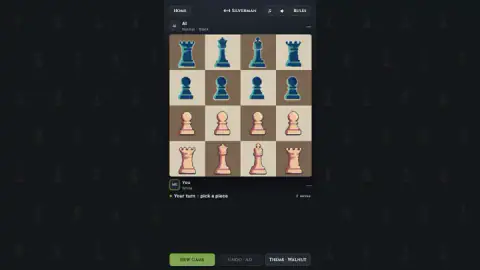
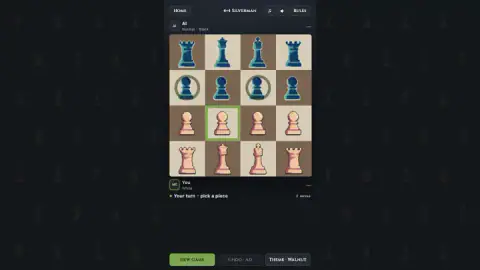
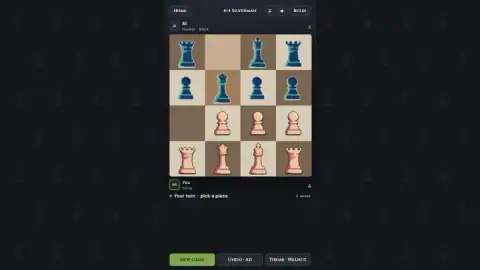
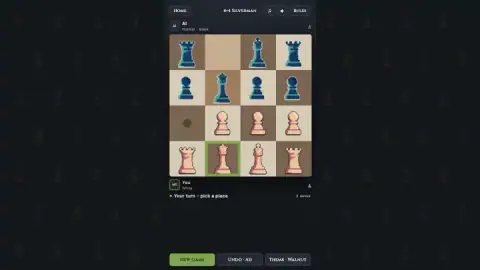
Taken by opening the game ourselves and letting it run — not supplied by the publisher, and not the same picture every other site shows.
How to play Mini Chess
- Open a tab in the menu (4 columns wide, 5x5, 5x6 or 6x6) and tap a board card. Its rules and a short history note appear underneath.
- Choose a difficulty, Easy, Normal, Hard or Master, and press Play.
- You are White, at the bottom, and you move first. Tap one of your pieces: the squares it can reach get a dot, and pieces it can capture get a ring.
- Tap a marked square to move. The computer answers as Black.
- Win by capturing the enemy king or checkmating it. A win earns that difficulty's star and unlocks the next board in the group.
Tips from our run:
- Read the rings before you move. At the start of 4x4 Silverman your pawns have no forward move, so the only marks you will see on a pawn are capture rings.
- Expect the queen to come straight in. We took a black pawn with our edge pawn, and the computer recaptured at once with its queen. After just two moves its queen was standing in the middle of our side of the board.
- Count your safe squares. With the pawn line broken, our queen had exactly one square to go to. On a 4x4 board a piece can be boxed in after one exchange.
- Undo is not unlimited. The button says Undo and Ad. When the free undos are gone, the game asks for an ad.
- Use Rules. Every board has its own rules card, and the boards do not all play the same way.
Controls
| Click or tap one of your pieces | Selects it and marks the squares it can go to |
|---|---|
| Click or tap a marked square | Moves the selected piece there, or captures what stands on it |
| Undo button | Takes your last move back; once the free ones are used, it asks you to watch an ad for another |
| Rules button | Shows the rules of the board you are on |
Features
- 25 boards in four groups, 4 columns wide, 5x5, 5x6 and 6x6, each one a different mini chess variant
- The first board is David Silverman's 4x4 from 1981: rook, queen, king, rook and four pawns a side
- You always play White against the computer, on Easy, Normal, Hard or Master
- Each board has four stars, one per difficulty, and winning once opens the next board in its group
- No castling and no en passant; capturing the enemy king ends the game on the spot
- A move counter, captured pieces beside the players, an Undo button and a Theme button (ours read Walnut)
- Made by sublevelgames, the studio behind Checkmate, Easy Chess and Mini Janggi
Game details
- Developer
- sublevelgames
- Release date
- August 2026
- Last updated
- August 26, 2026
- Added here
- August 2026
- Technology
- HTML5 (2D)
- Platforms
- Browser (desktop, mouse), Browser (mobile & tablet, touch)
- Classification
- Arcade , Cards & Board , Puzzle
- Saved progress
- Saving, when available, is managed by this game. Mava cannot confirm your level.
FAQ
What is mini chess?
Mini chess, or minichess, is any chess variant played on a smaller board with fewer pieces. Well-known ones include Silverman's 4x4 from 1981, Gardner's 5x5 from 1969 and Los Alamos chess on 6x6, the first chess-like game played by a computer, in 1956. Mini Chess on this page collects 25 such boards.
How do you play Mini Chess?
Pick a board from the menu, choose a difficulty and press Play. You are White and move first: tap a piece to see where it can go, then tap one of the marked squares. Win by capturing the enemy king or checkmating it.
How many boards are there in Mini Chess?
There are 25, split into four tabs: 6 boards four columns wide, 5 on 5x5, 7 on 5x6 and 7 on 6x6. Only the first board of the first tab is open at the start. Winning a board once unlocks the next one in its group.
Why can't my pawns move at the start of 4x4 Silverman?
Because the pawns start face to face. On a board four rows tall, each side's pawns stand on the middle rows touching the enemy pawns, so none of them can step forward. A pawn can only capture one square diagonally ahead, which means every game opens with an exchange.
Is there castling or en passant in Mini Chess?
No. The game's rules leave out castling and en passant on every board, and on 4x4 Silverman pawns cannot step two squares either. Capturing the king wins at once, so you do not have to finish with a formal checkmate.
How do you get stars in Mini Chess?
Each board has four stars, one for each difficulty: Easy, Normal, Hard and Master. Beat the computer on a level to earn that star. Stars are also what the game's leaderboard counts.
Does Mini Chess have an undo button?
Yes, under the board. It takes back your last move. The button is labelled Undo with the word Ad beside it: when your free undos run out, the game offers one more in exchange for watching an ad.
Who made Mini Chess?
It is by sublevelgames, whose logo sits at the bottom of the menu. Mini Chess was published in August 2026.