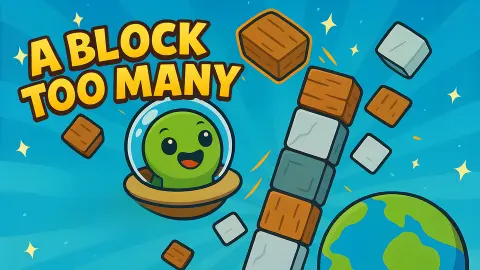



About A Block Too Many
The title is not a joke, it is a statement about the physical world. Every tower that anybody has ever built by hand contains exactly one block that was one too many, and the cruel part is that it is almost never the block you are about to place. It is one from several turns ago, sitting quietly in the middle of the stack, waiting.
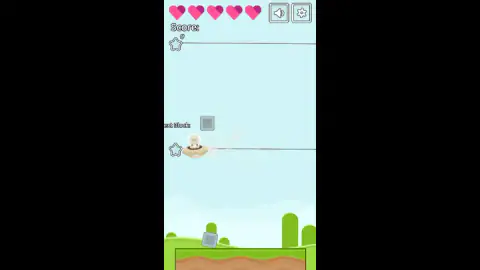
What you do here is simple enough to explain in a sentence. A small alien sits in a tan flying saucer that drifts along a line across a pale blue sky. Under it hangs a grey stone cube. You slide the saucer left or right, you let the cube go, and from that moment it stops being your problem and becomes gravity's. A window beside the saucer labelled Next Block shows the one coming after it. Below, on green turf laid over brown earth, your tower either goes up or it does not.
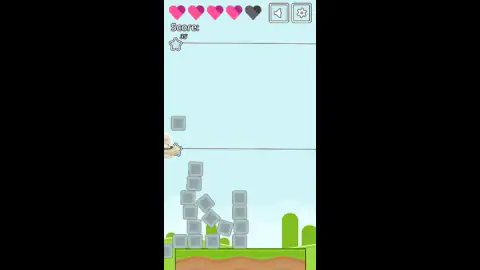
The readouts are three, and they all live along the top. A row of five pink hearts, which go dark from the right as you spend them. A Score, written plainly under the word. And two thin lines ruled horizontally across the sky, each with a hollow star at its left-hand edge — the lower one is the line the saucer itself flies along, and we read both as heights to climb to rather than things to collect. A speaker and a cog sit in the corner next to the hearts, and that is the whole interface.
The game is by PendraGames and was published in September 2025.
Our own run is where the honesty starts. We gave it ten minutes and a dozen or so attempts, got a column standing straight up under the saucer, watched it fold, then watched it happen again with the pieces in a different order. What follows is the shape of that failure, described by the people who walked into it.
Why a tower falls because of a block you placed five turns ago
Every object has a balance point. Slide a finger along under a ruler until it stops tipping, and the spot where it sits level is it. A stack has one too, and so does every part of a stack, all the way down.
Here is the rule that governs the whole game. A stack stands as long as, at every joint, the balance point of everything above that joint is still sitting over the block underneath. Not near it. Over it. The instant that balance point crosses the edge of the block below, everything above that joint turns about the edge like a door on a hinge, and the tower comes apart there.
An off-centre block does not only move itself. It drags the balance point of the whole pile above its joint sideways, and the earlier you place it, the more of the tower sits on that mistake. A block placed badly at the bottom is a debt the tower carries all the way up.
The surprising consequence, and this is a real result rather than a rule of thumb, is how much a stack can lean before it actually falls. With identical blocks, each one only has to balance on the one below it — none of them has to line up with the ground. So you can build an overhang: four blocks are already enough to push the top one's edge clear of the bottom one's, and the stack still stands. Keep going and the overhang keeps growing, just more and more slowly, because each new block buys you less lean than the one before.
So a leaning tower is not a failing tower. It is a tower with no margin left. That is exactly what we watched happen. Early on, a column stands almost straight under the saucer with every heart lit. Later the stack is taller and bent to one side, two cubes caught in mid-air at the angle that means they are not coming back, and a line of earlier cubes lying flat beneath. Nothing dramatic happened in between. We kept adding slightly off-centre blocks to a pile that had already spent its margin.
The dark screen at the end, and what it is counting
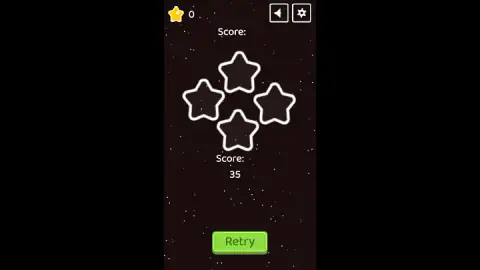
When the last heart goes dark, the field vanishes. In its place comes a card on a starfield: four hollow stars in a cluster, the word Score with your number under it, and a green Retry at the bottom. In the top corner sits a filled yellow star with a count beside it, which is what the attempt actually earned you. Ours read zero, every single time. The game does not dress the moment up either — the words that come up in red when you run out are YOU DIE.
So two different things are being measured, and it takes a few runs to separate them. The hollow stars are a rating for the attempt, and the lines ruled across the sky are the cheapest explanation of how you would fill them in: altitudes to get a stack above. We never reached even the lower line, which is also why that yellow counter never moved.
The number under Score is the other one, and it is the one that actually moves while you play. It climbs in small steps as the tower grows — we watched it pass five, then twelve, then nineteen.
Our ceiling was thirty-five. We hit it run after run and never once got past it, which is a more honest measure of the difficulty than any adjective: the wall is not where the game gets hard, it is where our method ran out.
Retry puts you straight back to the start of a fresh attempt, hearts restored and the score wiped. There is no menu in between and nothing to confirm, which makes the loop fast and the failure cheap.
What we reached, and what we did not
We never escaped the planet, so we will not pretend to describe the ending. We never opened a shop and never saw a skin, so we cannot tell you what stars buy, and we never reached a second level, an endless mode or a sandbox. Every cube we were handed was the same grey stone, so if there are blocks here that behave differently, they come later than we got.
What we can tell you is that the game is honest with you about the one thing that matters. Nothing is hidden. The next block is on screen, the lives are on screen, and the tower is right there in front of you leaning a degree further than it was a minute ago. Losing is never a surprise you could not have seen. It is a surprise you chose not to look at.
More towers, and more ways to lose one
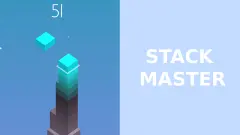
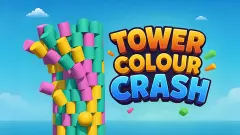
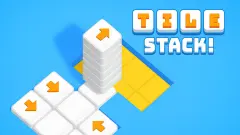
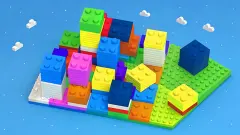
Stack Master is the closest comparison we have: the same business of putting one thing on top of another and finding out how much drift a pile will absorb. Tower Colour Crash keeps the tower and takes the patience away, which makes a very different game out of the same shape. Knife Tower comes at it from the other side, taking a tower apart instead of raising one. And Tile Stack swaps the loose physics for pieces that line up, which is the clearest way to feel what the tumbling here actually costs you. The rest are in strategy games.
Screenshots
How to play A Block Too Many
- Slide the saucer with A and D. The game prints its own legend before you move: Build on the space bar or a mouse click, Move on W, A, S and D. The saucer held the same height all through both our sessions, so left and right is the decision you are actually making.
- Look at the Next Block window before you drop this one. Knowing the next cube is the difference between placing for now and placing for two turns' time.
- Press Space, or click. The cube falls from wherever the saucer was. There is no preview line and no shadow underneath, so the saucer's position is your only aim.
- Watch what the cube does after it lands. It is not a tile that snaps into a grid. It settles, it shifts, and sometimes it keeps going and ends up lying flat on the grass.
- Read the stack, not the top. Five hearts is five mistakes, and a leaning tower has already spent one of them without telling you.
What our sessions taught us:
- Aim for the middle of what is already there, not the middle of the screen. The two are the same only on the first cube.
- A cube that lands a little off does not punish you immediately. It waits. That delay is the whole difficulty of the game.
- Cubes that come off the stack stay on the field. By the back half of a long attempt the grass carries a whole row of them, quietly narrowing the ground you have left.
- The dust trail tells you the saucer is moving. There is nothing in an empty sky to judge motion against, and a pale puff behind it is the only confirmation that a key press registered.
- If a grey Click to keep playing banner drops in under the hearts, the game has paused itself. One click anywhere puts it away and hands the cube back to you.
Controls
| A and D | Slide the saucer left and right along its line. The game's own legend prints the movement keys as W, A, S and D, but the saucer kept the same height throughout both our sessions |
|---|---|
| Space | Build. The game's legend labels this one with a single word, and what it does is let go of the cube the saucer is carrying |
| Mouse click | The same as Space. The opening legend draws a mouse next to the space bar under Build, so either will drop the cube |
| Speaker icon, top right | Sound on and off. It sits next to the cog, in the corner beside the row of hearts |
| Cog icon, top right | Settings |
| Click anywhere | Dismisses the grey Click to keep playing banner, which appears whenever the game has paused itself |
| Retry, on the end card | Restarts from the beginning: the hearts come back to five and the score goes back to nothing |
Features
- Five pink hearts along the top of the screen, spent one at a time and shown as a row that goes dark from the right
- A Next Block window beside the saucer, so the cube after the one you are holding is never a surprise
- Cubes that behave like objects rather than tiles: they tilt, rotate, slide off and come to rest lying on the grass, where they stay for the rest of the run
- A score kept under the word Score that climbs in small steps as the stack rises — we watched it pass 5, then 12, then 19
- Two thin lines ruled across the sky, each with a hollow star at its left edge, marking heights rather than scoring anything on their own
- An end-of-run card on a starfield with four hollow stars, your final score and a green Retry button
- Laid out upright at 720 by 1280, which is the shape of a phone held vertically rather than a desktop window
- Made by PendraGames
Game details
- Developer
- PendraGames
- Release date
- September 2025
- Added here
- July 2025
- Technology
- HTML5 (2D physics)
- Platforms
- Browser (desktop), Browser (mobile & tablet, touch)
- Saved progress
- Saving, when available, is managed by this game. Mava cannot confirm your level.
FAQ
What is A Block Too Many?
It is a browser stacking game in which you play an alien in a small flying saucer, hovering over a green field. The saucer carries a grey stone cube, you slide it left or right, and you let the cube go. Each one lands on the last and the tower grows upward, until the stack leans far enough that it comes apart. You get five lives per run.
How do you control the alien in A Block Too Many?
The game shows its own legend before you start: Build is the space bar or a mouse click, and Move is W, A, S and D. In practice the two keys that matter are A and D, which slide the saucer left and right along a fixed line in the sky. Space drops whatever the saucer is holding.
How many lives do you get?
Five, shown as a row of pink hearts across the top of the screen. They go dark one at a time, from the right, and the row is the only warning the game gives you that a leaning stack has already started costing something. When the last one goes dark the run is over.
What happens when you lose in A Block Too Many?
The field disappears and a card comes up on a dark starfield. It carries four hollow stars, the word Score with your final number under it, and a green Retry button. A filled yellow star in the top corner counts what the run earned you — ours stayed on zero. Retry starts the same run again with five hearts and a clean score.
Why does the tower fall over when the block I just placed looked fine?
Because a stack does not fail at the block you just placed, it fails at the worst joint below it. Every cube you set down slightly off-centre drags the balance point of everything above that joint sideways. The pile keeps standing while that balance point is still over the cube underneath, and the moment one more cube pushes it past the edge, the whole stack rotates about that lower corner. The block that costs you the tower is usually several turns old.
What are the stars in A Block Too Many for?
There are two kinds. The card at the end of a run shows four hollow stars, which read as a rating for the attempt, next to a counter that never moved for us. In play, two thin lines are ruled across the sky with a hollow star at the left end of each, which read as heights to aim for. We never got a stack tall enough to touch the lower one, so we cannot tell you what reaching it gives you.
Is there a shop or are there skins?
The game's description mentions buying things with stars, but we never opened a shop and never saw a skin, so we are not going to describe either. What we can confirm is that the Next Block preview is on screen from the first second of the first run and does not have to be bought.
Can you play A Block Too Many on a phone?
It is built for it. The game is served upright at 720 by 1280, which is the shape of a phone held vertically rather than a desktop window, and it is listed as playing on mobile. Both our sessions were on a desktop with a keyboard, so we cannot tell you how precisely a thumb places a cube compared with tapping A and D.
Who made A Block Too Many and when?
PendraGames, published on 4 September 2025. The game is listed under strategy, which is a fair call: nothing in it rewards fast fingers, only where you decide to let go.