
About BreakBlock
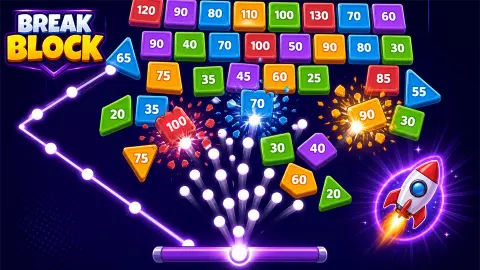
Most brick breakers are about keeping one ball alive. BreakBlock does not care about that. Your balls always come home on their own, nothing bad happens when they land, and the only thing that can beat you is a wall of numbered blocks that takes one step towards you after every shot you fire.
That changes what skill means here. There is no paddle to move and no reflex test. You get one aim per turn, and with it you fire every ball you own in a single stream. The question each turn is where that stream should go: into the block that is closest to the floor, into the yellow dots that give you more balls, or deep behind the front row where the balls can rattle around for a while.
We played BreakBlock on a desktop with a mouse for about four minutes and reached turn 19 with 810 points, the wall still above the floor line. We never lost, so we did not see the game over screen. Every claim below is tied to that single game.
The studio named on its listing is Hong Kong Skyreach Interactive Limited; the game was published in September 2026.
The wall tells you the turn
The rule that matters most in BreakBlock is never written on screen, but you can see it in every shot. Each turn a new row arrives at the top, and its blocks carry the number of that turn. On turn 5 the top block read 5. By our last turn the new row read 19.
That means the game gets harder in a steady, predictable way. The blocks you meet late are not just more numerous, they are tougher, and the ones still hanging around from early turns are the weak ones. In one of our turns the top three rows counted down 14, 13, 12. One turn later all three had moved down a row and a fresh, tougher row sat above them.
The colours follow the numbers, which saves you from reading every block:
| Colour | Hits needed |
|---|---|
| Dark navy | 1 to 4 |
| Mid grey | 5 to 9 |
| Pale grey | 10 to 14 |
| Green | 15 and up |
The first green blocks appeared on turn 15. From then on every new row was green, so if you see green near the bottom of the board, that column has been ignored for too long.
More balls, and where they come from
You start with a single ball, marked x1 under the aiming line. By the last turn we played, the same label read x18. The difference comes from the yellow dots that sit in the empty spaces between blocks. When a ball touches one, it drops to the floor line and joins your pile. In one of our turn 17 shots, three yellow dots lay on the floor next to a returning ball.
You will notice the ball count growing faster than the turn count after a while. That is the race the whole game is built on: the wall gains a little strength each turn, and you gain balls only when you aim for them. Ignore the dots for a few turns and the green rows arrive while you still have a handful of shots.
The score follows the balls. With one or two balls it crept up by about ten a turn, reaching 50 on turn 8. Once we had a long stream in the air it climbed far faster, and it stood at 810 when we stopped.
A small +10 floats up over the blocks you are hitting, and the counter rolls up through the turn rather than jumping at the end.
The two buttons by the floor
Two round buttons sit just above the floor line, one on each side. The right one shows a white rocket. Around it, a thin ring grew from one turn to the next in our early pictures, which looks like a charge meter filling up. The game's own description talks about a charged rocket that helps you last longer. We cannot tell you exactly what it does, because none of our pictures shows it clearly in action.
The left button shows a ball with arrows pointing outwards. It was there in most of our turns and missing in a couple of them, and we did not find out what it does either. Both buttons stay at the same height every turn, so by turn 19, when the left column had come down to their level, the blocks were sliding past them. That is about as close to the floor as you want the wall to get.
Same family as Ballz
If the rules sound familiar, that is because this kind of game has a well-known ancestor on phones. Ballz, published by Ketchapp, put numbered squares at the top of the screen, had you drag to aim and fire a stream of balls, added balls from small circles on the board, and ended the game when a square reached the bottom. According to Wikipedia, it was the number 1 game in Apple's App Store in March 2017.
BreakBlock plays by the same basic rules, with its own look: a purple starfield, the colour bands, and the two buttons by the floor. We know of no link between the two games beyond the genre. What the comparison tells you is what kind of game you are in for: endless, turn by turn, and about planning one good angle rather than reacting fast.
What we did not see
We did not lose, so we have no game over screen to describe. We did not knowingly fire the rocket or find out what the left button does. The listing mentions ball skins; we did not open a shop. We heard no sound effects and saw no adverts during our four minutes. The game is listed for phones as well as PC, in portrait, but we only played with a mouse.
Who it is for
BreakBlock suits anyone who likes a quiet puzzle with a bit of physics in it. Nothing hurried us between shots, there is no enemy and nothing violent on screen, just blocks and balls on a starry background. Younger players can learn it from one shot, and the colours make the board easy to read.
If you want a brick breaker with a paddle and fast reactions, this is not that game. You aim, you wait, and you think about the next angle.
More brick breakers and aiming games
Balls: Ricochet! uses the same falling wall of numbered blocks, with a score that counts the shots you survive rather than the blocks you break. Bricks Buster splits the same idea into numbered levels with three stars to earn. For a single shot timed through a spinning ring, try Color Shot throw the ball. The rest are under arcade games.
Screenshots
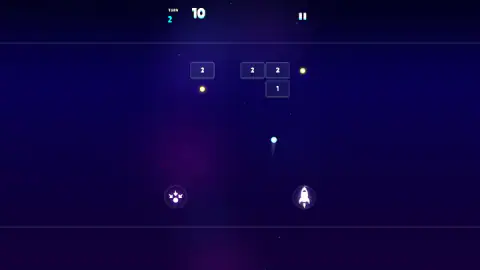
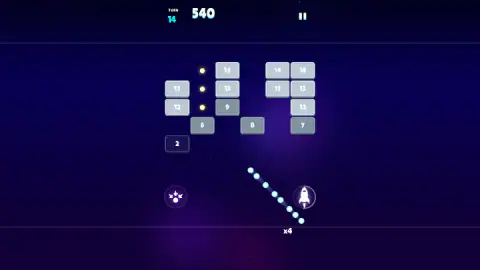
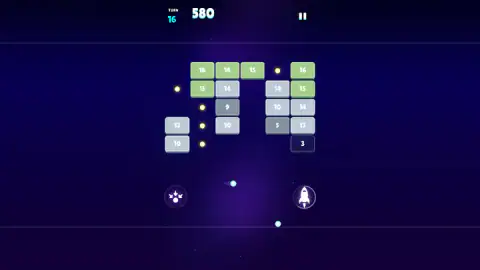
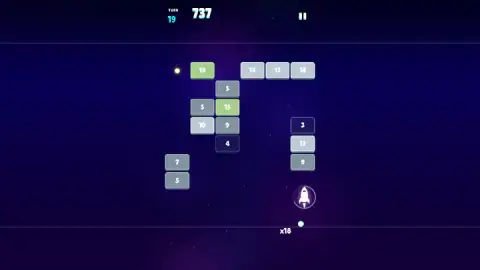
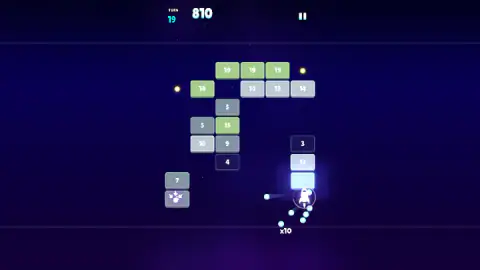
Taken by opening the game ourselves and letting it run — not supplied by the publisher, and not the same picture every other site shows.
How to play BreakBlock
- Press and drag. A white dotted line appears from your ball on the floor line and shows where it will go.
- Release. Every ball you have leaves in a line along that path, one after another.
- Each time a ball touches a block, the number on it drops by one. At zero, the block breaks.
- Hit the small yellow dots between the blocks to add balls for the next turn.
- When all the balls are back, the wall steps down a row and a new row appears at the top. If a block reaches the floor, the game is over.
What our run taught us:
- Read the colours before the numbers. Dark navy blocks are cheap, green ones are expensive. With twelve balls, a dark block goes down in one volley and a green one will not.
- Watch where your balls land. The next shot starts from that spot, not from the middle. On turn 19 ours was far to the right, under the rocket button, which made the left side of the board hard to reach.
- Mind the lowest block in each column. By turn 19 our left column had come down to the level of the buttons by the floor while the right side still had room. One neglected column is enough to end a game.
- Take the dots early. Every extra ball counts on every turn that follows, so a dot in turn 3 is worth much more than one in turn 18.
Controls
| Drag with the mouse or a finger | Aims the shot; a white dotted line shows the path the first ball will take |
|---|---|
| Release | Fires every ball you have, one after another, along that line |
| Pause button (top right) | Pauses the game |
Features
- A wall of numbered blocks on a purple starfield, six columns wide, that steps down one row after every shot
- Each new row arrives at the top carrying the number of the turn, so the blocks get tougher as the game goes on
- Block colour tells you how tough it is, from dark navy for the weakest to green from 15 hits upwards
- Yellow dots between the blocks that fall to the floor when hit; our ball count went from one to 18 by turn 19
- The launch spot moves around the floor line from turn to turn instead of staying in the middle
- A rocket button with a ring around it that grows between shots, and a second round button on the left
- An endless game with a turn counter and a score; we reached turn 19 and 810 points without losing
Game details
- Developer
- HONG KONG SKYREACH INTERACTIVE LIMITED
- Release date
- September 2026
- Last updated
- September 2, 2026
- Added here
- August 2026
- Technology
- HTML5 (2D)
- Platforms
- Browser (desktop)
- Saved progress
- Saving, when available, is managed by this game. Mava cannot confirm your level.
FAQ
How do you play BreakBlock?
Drag to aim and release to shoot. Every ball you own flies out along the dotted line and bounces around the board, and each hit takes one off a block's number until it breaks. After each shot the wall moves down a row, and the game ends if it reaches the floor.
What do the numbers on the blocks mean in BreakBlock?
They are the hits a block still needs before it breaks. A new row appears at the top every turn, and its blocks carry the number of that turn, so on turn 15 the fresh row is worth 15 hits each.
What do the block colours mean in BreakBlock?
They follow the number. In our game, blocks from 1 to 4 were dark navy, 5 to 9 mid grey, 10 to 14 pale grey and 15 or more green. A glance at the colour tells you which blocks your volley can clear this turn.
How do you get more balls in BreakBlock?
Hit the small yellow dots that sit in the gaps between blocks. We started with one ball, had 12 by turn 15 and 18 by turn 19.
What does the rocket do in BreakBlock?
The game's own description calls it a charged rocket that helps you survive longer. In our game a thin ring around the rocket button grew from one turn to the next, which looks like a charge meter, but we never saw clearly what it does when used.
Is BreakBlock endless?
Yes. There are no levels, only a turn counter and a score, and the wall keeps coming. We stopped at turn 19 with 810 points and the wall still above the floor line, so we did not see the game over screen.
Who made BreakBlock?
The game's listing credits Hong Kong Skyreach Interactive Limited. It was published in September 2026.