







About Hatchfire: Dragon Brick Breaker
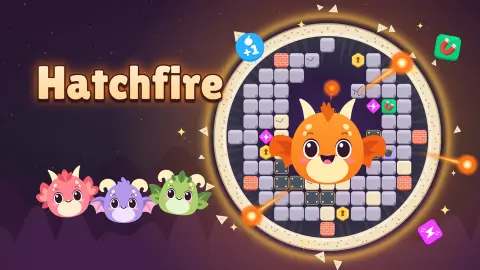
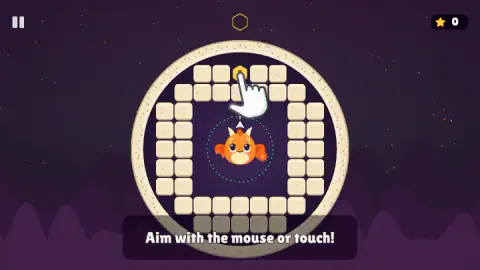
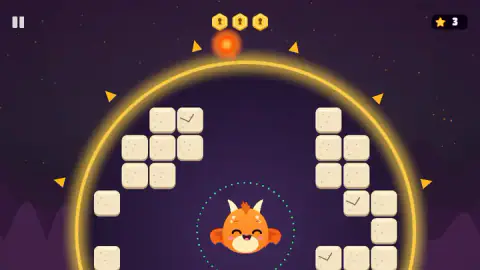
A brick breaker usually hands you two things: a floor to defend and a bat to defend it with. This one has neither. The field is a circle — a pale, speckled stone ring, drawn like an eggshell seen edge on — and you sit at the middle of it, as a small orange dragon with a ring of green dots around you. The bricks are banked up on the outside, facing in. You do not knock a ball upwards and pray. You fire outwards, and there is no bottom of the screen for anything to fall out of.
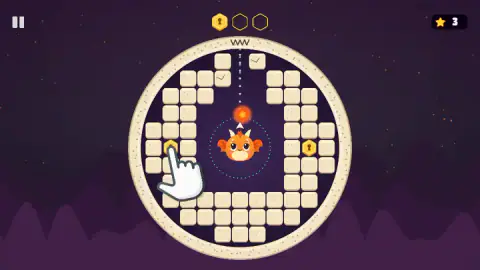
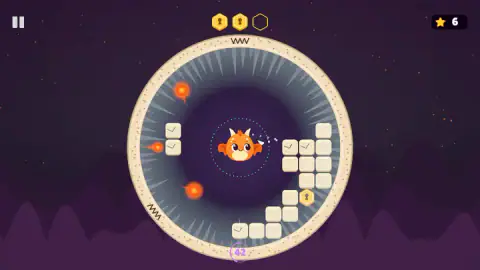
Everything you do is one drag. Pull away from the dragon and a line of white dots shows where the shot is headed; let go and the dragon looses a fireball by itself. The ball then ricochets around the inside of the shell until it runs out of things to hit. Among the plain cream bricks sit gold hexagons with a keyhole stamped on them, and those are the ones that matter: a row of empty hexagon outlines across the top of the screen counts how many are still standing. Take the last one and the shell lights up. Drive a fireball out through the gap and the dragon hatches.
The reward screen is always the same word, "HATCHED!", with the dragon's name under it and three stars below that, of which you are given as many as you earned. Ours read "NEW DRAGON Tangerine" the first time and "HATCHED AGAIN Tangerine" afterwards, so the same dragon keeps coming back through the opening levels.
How far into that we got is worth stating up front. We played one sitting of a little over ten minutes. We hatched the first two levels with all three stars, the third with one, and then the fourth beat us on the clock, four separate times. Everything here about later worlds is the game's claim rather than ours, and it is labelled as such.
The circle takes away the only thing brick breakers are usually about
Strip a classic brick breaker down and what is left is a goalkeeping game. The bricks are a timer; the bat is the skill; the floor is the punishment. Put the bricks in a ring and point the player outwards and all three vanish at once. There is no floor, and nothing to keep. A fireball that goes wrong does not die, it wanders.
So the pressure has to come from somewhere else, and the game moves it to the clock. That is why the frost timer exists, why it gets its own tutorial banner, and why it is drawn as frost closing in off the shell wall rather than as a bar in a corner: it is the only thing here that can end a level against your will. The defeat card is a stopwatch, the words "Out of time", and a count of the runes you left standing — ours read one, two and three on different attempts at the same level. A bad shot costs you time and nothing else, which is why the game feels unhurried for two levels and then abruptly does not.
Why a fireball loose in a circle never visits the middle
Here is a piece of geometry you can check with a compass, and it is the reason the shots behave the way they do.
A ball bouncing off a wall leaves at the same angle it arrived at. A circular wall curves identically at every point, so that angle comes out the same at every single bounce. Which means every straight leg of the ball's journey across the circle — every chord, to use the proper word for a straight line with both ends on a circle — is exactly the same length as the last one. And equal chords in a circle all sit the same distance from its centre. Draw a small circle at that distance and the ball's path will skim it forever without ever crossing inside.
That small circle is a dial you set with your aim, and it is the single most useful thing to know about the game. Aim straight outwards, dead through the centre, and the small circle shrinks to nothing: the ball goes out, meets the wall head on, and comes straight back through the middle at you. Aim almost along the wall and the small circle swells to nearly the size of the shell, and the ball simply laps the rim. Everything useful lives in between.
You can watch it happen. A shallow shot in our runs would hug the brickwork for three or four laps and never go near the inner rows; a steeper one cut across the field and clipped bricks on opposite sides in one pass. If a level keeps its runes tucked deep inside, a rim-hugging shot will never find them, however long it survives.
The one thing that breaks the pattern is a brick. A brick face is flat, and a flat face does not reflect the way a curved one does, so the moment your fireball clips one the tidy ring of equal legs is gone and the shot turns into scatter. That is the honest shape of a level: your first shot is the most predictable one you will take and your sixth is the least. Which is also why the pickups matter — three fireballs at once is not three times the aim, it is three times the chaos, and with no floor to lose, chaos is free.
The frost timer is the opponent, and stone is its weapon
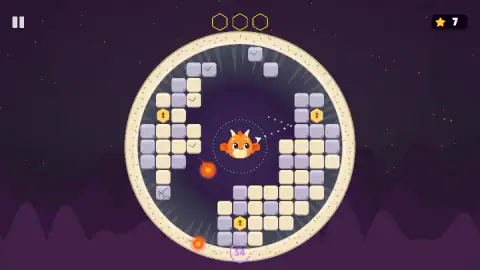
Level four is where this stops being theory. The field arrives half-filled with grey stone, each brick wanting five hits, the runes buried behind it. Ninety seconds sounds generous until you work out what it buys: a fireball that clips a stone brick on a long bounce has taken one fifth off it, and the frost keeps coming.
We lost that level four times and the card said the same thing each time, with only the rune count changing. A level is not harder because the dial starts lower; it is harder because of what the bricks in front of the runes are made of. Worth knowing before you restart out of stubbornness, which we did, repeatedly.
The part we cannot report on is everything past it. The game's own listing promises two hundred levels across five worlds — Fire Mountain, Frost Peaks, Forest Grove, Storm Sky and Golden Dunes — along with bombs that take out whole sections, unbreakable iron, spinning rings, hard eggs, and two more power gems besides the extra fireball: one that widens the dragon's catch zone and one that speeds things up. A Dragon Book button on the level screen is where the four dragons it names are meant to end up. We saw the button and one dragon. For the eggshell, the runes and the clock we can vouch; past that, you will have to go and look.
More circles, bricks and dragons
If what you want is the same aim-and-smash with the geometry the right way round, Bricks Buster puts the bricks above you and the shot below, which makes a useful comparison for exactly how much the circle changes. Idle Gravity Breakout 2 inverts Hatchfire instead: the target sits at the centre and the balls orbit it from outside. MergeMaster: Dragonets keeps the baby dragons and swaps the fireballs for merging them in bubbles, and Unravel Eggs Puzzle keeps the eggs and asks you to untangle them instead of cracking them. The rest are in puzzle games.
Screenshots
How to play Hatchfire: Dragon Brick Breaker
- Drag away from the dragon to aim. A line of white dots marks the line of fire, and the dragon shoots on its own the moment you release.
- Go for the gold hexagons. Those are the runes, and the hexagon outlines along the top of the screen tell you how many are left.
- From the third level on, watch the small purple dial at the foot of the shell. That is the frost timer, and spikes of frost creep in from the wall while it empties.
- Run the ball through any blue disc marked "+1". Each one puts another fireball into play, and they all keep bouncing.
- When the last rune goes, the shell glows. Fire a ball out through it to finish.
What only sitting in front of it teaches:
- The little tick on a brick is a crack, not a tick. It is what a brick wears after a hit that did not kill it. We spent a good part of our session clicking those marks expecting something, and nothing ever happened. The brick needs more fireball, not more clicking.
- Grey means five. The grey-lilac bricks are stone, and the game halts the level the first time one appears to say so, on a card reading "Stone: 5 hits". Cream bricks go on first contact. A level stacked with grey is one you lose on time.
- The first two levels have no clock at all. Look at the foot of the shell on level two and the stone is clean. The dial arrives with the third level, on its own banner reading "Beat the frost timer!", with ninety seconds on it.
- Pausing is free. The two-bar button in the top left opens a panel headed PAUSE with Resume, Restart and Home, plus round switches for Music and Sound. The ball stops where it is and nothing is lost.
Controls
| Drag with the mouse | Aims the shot. A line of white dots marks the line of fire, and the dragon looses the fireball by itself when you let go. The game prints this instruction itself on the first level |
|---|---|
| Touch and drag | The touchscreen version of the same aim, per the game's own listing. We played with a mouse, so this is the listing's claim rather than ours |
| The two-bar pause button, top left | Opens a panel headed PAUSE holding Resume, Restart and Home, with round switches for Music and Sound underneath. Nothing is lost while it is open |
| P or Esc | Listed by the game as the pause key. We pressed Esc once, on a defeat card, and nothing on screen moved |
| R | Listed by the game as the level restart. Pressing it produced nothing we could see or hear in our run, which is not the same as doing nothing |
| Click a card | Clears the tutorial panels and the advert slot that stop the level. The Stone card closes on its own line, Tap to continue |
Features
- The field is a circle with no bottom edge and no paddle: you play from the middle of it, firing outwards, and a loose fireball can never be lost over the bottom of the screen
- Gold hexagons stamped with a keyhole are the runes you have to break, and a row of empty hexagon outlines across the top of the screen counts the ones still standing
- Break the last rune and the shell lights up; you then have to drive a fireball out through the gap before the dragon hatches
- Grey-lilac bricks are stone and take five hits each, which the game stops the level to tell you on a card reading Stone: 5 hits
- A frost timer arrives with the third level: ninety seconds on a small purple dial at the foot of the shell, with frost spikes creeping inward from the wall as it empties
- Blue discs marked +1 put another fireball into play, and we had three bouncing around the shell at once
- Levels are scored out of three stars and the hatch card names the dragon you have freed, which was Tangerine every time for us
Game details
- Developer
- Partner studio
- Release date
- October 2026
- Last updated
- October 25, 2026
- Added here
- October 2026
- Technology
- HTML5 (2D)
- Platforms
- Browser (desktop), Browser (mobile & tablet, touch)
- Saved progress
- Saving, when available, is managed by this game. Mava cannot confirm your level.
FAQ
How do you play Hatchfire: Dragon Brick Breaker?
You are the baby dragon at the centre of a circular eggshell, and the bricks are arranged around you facing inwards. Drag away from the dragon to aim, and it fires a fireball that ricochets around the inside of the shell. Break every gold hexagon rune to crack the shell open, then fire a ball out through the gap to hatch.
What are the runes in Hatchfire: Dragon Brick Breaker?
They are the gold hexagon bricks with a keyhole stamped on them, set among the plain cream bricks, and they are the only ones you have to break to finish a level. A row of hexagon outlines across the top of the screen fills in as you take them. If the clock beats you, the defeat card tells you exactly how many were left, which is how we know the game's own word for them.
How many hits does a stone brick take in Hatchfire?
Five. The game stops the level the first time one appears and shows a card with a picture of the brick and the line Stone: 5 hits. They are the grey-lilac ones, as against the plain cream bricks that break on the first contact, and a level stacked with them is usually how the frost timer beats you.
What is the frost timer in Hatchfire: Dragon Brick Breaker?
It is the countdown that replaces the usual brick breaker danger of dropping the ball. A small purple dial at the foot of the shell counts down in seconds, frost spikes creep inward from the shell wall while it runs, and the level ends when it reaches zero. It does not appear on the first two levels; it arrives with the third, announced on its own banner reading Beat the frost timer.
How many levels does Hatchfire: Dragon Brick Breaker have?
The game's own listing promises two hundred levels spread across five worlds, named Fire Mountain, Frost Peaks, Forest Grove, Storm Sky and Golden Dunes. We can only vouch for the first four levels, which is as far as we got in one sitting. Progress saves by itself, so the numbered level map picks up where you left it.
Which dragons can you collect in Hatchfire?
The game's listing names four baby dragons — Tangerine, Blossom, Lilac and Clover — kept in a Dragon Book, and a button for that book sits on the level screen. The only one we met was Tangerine. The hatch card said NEW DRAGON the first time and HATCHED AGAIN for every hatch after it, so the same dragon comes back across the early levels.
Are there ads in Hatchfire: Dragon Brick Breaker?
Yes, an advert slot sits between levels, and the game pauses there before handing the next level over. Nothing inside a level is gated behind a video, and there is no shop, no currency and no paid continue to be found in the levels we played. The adverts come from the host rather than from the game itself.
Is Hatchfire: Dragon Brick Breaker free, and who made it?
It is free and runs in a browser with nothing to install, on desktop and, per its own listing, on a phone in either orientation. The studio behind it is not recorded anywhere we can check, so this sheet names no author rather than guessing one. It reached our catalogue on 24 October 2026, which makes it days old at the time of writing.