







About Alchemy Store
Most alchemy games hand you four elements and a blank page, and the fun is guessing. Alchemy Store does something the genre rarely does: it puts a customer at the counter who tells you the recipe, shows you the result and names the price. You are not a wizard in a tower. You are a shopkeeper with a cauldron, and the cauldron is on your side.
That changes what the game is about. The puzzle is not "what makes steam", because the old lady with the teacup has already told you water plus fire. The puzzle is the shelf: eight open slots, two pieces used up per mix, and a cauldron that gives you one element per tap. You manage that small space while townsfolk pay you eight coins a time and the shelf grows one padlock at a time.
Alchemy Store comes from a developer called MemorySharp and was published on 5 November 2026. When we played it two days later. We played one ten-minute run with a mouse, from an empty counter to our third customer. What follows is what we saw; where we quote the publisher, we say so.
The shelf is the workbench, and the cauldron refuses to be one
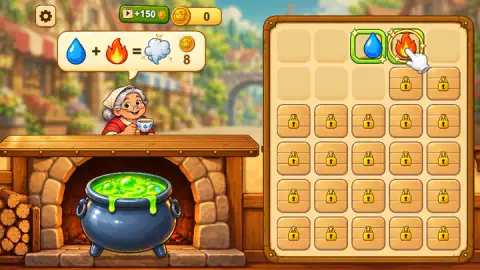
The screen is split in two. On the left, a customer behind a wooden counter and a green, bubbling cauldron below it. On the right, a shelf of five rows and five columns. Only the top row and three slots of the second row are open when you start; the other seventeen wear a gold padlock. That is your entire workspace: every combination happens by dragging one element onto another inside those slots.
We tested the alternative, because the publisher's own text invites it. Dragging a water drop down into the cauldron left the drop where it was, and the cauldron answered with a speech bubble, "Mix on the shelf!", while a hand pointed at the die on its rim. A second try got the same answer. Later we spent five minutes dragging a finished cloud into it, and that time there was not even a message. Whether the cauldron ever takes spare elements, we cannot say; it would not take ours.
Drags within the shelf do work. Pulling the water drop sideways moved it one slot to the left, so you can arrange pieces before combining them. And a combination is a trade, not a copy: when the steam appeared, the water and fire were gone; when the plant appeared, the rock and water were gone; when the cloud appeared, the shelf held nothing but the cloud. In our run each sale left the shelf empty, and the next order started from no ingredients.
The cauldron hands you what you are missing
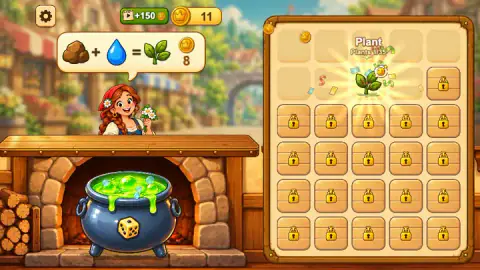
A die is painted on the cauldron, which suggests chance. Our run did not look like chance. Four times we tapped it, and four times the element that appeared was an ingredient of the order on the counter, in the order the recipe listed them. The flower girl wanted rock plus water: the first tap gave a rock, the second a water drop, and both lit up with green frames. The boy wanted water plus steam: a tap gave water, and after our detour through the cauldron's refusals, another tap gave steam.
We cannot promise that holds past the tutorial, and the die may be there for later. But the practical reading is simple: when the bubble asks for a thing you do not have, the fastest route is a tap, not a guess.
Three coins for a discovery, eight for a sale, one slot per order
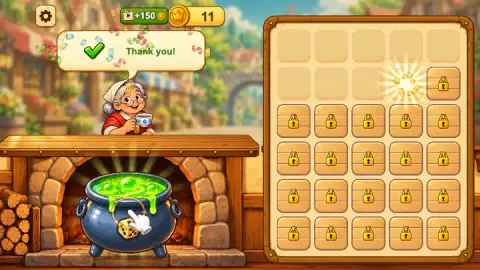
The crown counter at the top of the screen told the whole economy. It started at zero. When water and fire became steam, it read 3. When we handed the steam to the old lady, it read 11.
The plant took it to 14, the sale of the plant to 22, and the cloud to 25, where it stayed because we never sold the cloud.
So every new element is worth 3 the moment its card appears, and every order is worth whatever the bubble says, which was 8 for all three customers we met. An order is worth nearly three discoveries, which is why leaving a finished cloud on the shelf was the most expensive mistake of our run.
The shelf grows the same way. After the first Thank you, a padlock on the second row sparkled and the slot was open in the next frame. After the second, the last padlock on that row went too, leaving ten free slots and fifteen locks on the bottom three rows. We did not see what opens those. Nothing we discovered opened one; only sales did.
Water, Air and Plants: the families behind the padlocks
Each unlock card names the element and its family with a count. Steam arrived as Water 2/6, Cloud as Air 2/11, Plant as Plants 1/35. Read those as a map: water is a short family, air is a medium one, and plants are where most of the discoveries, and most of the discovery coins, are waiting.
The publisher puts the total at 212 elements and 569 recipes; we saw six elements and three recipes, so take the big numbers as the publisher's claim.
The starting pair is the oldest idea in the genre. Greek philosophy, from Empedocles in the fifth century BC, held that everything is made of four roots, earth, water, air and fire, and the alchemists who came after kept the scheme for two thousand years. Games like Little Alchemy and Doodle God inherited it as a blank page and four icons. Alchemy Store keeps the chemistry but adds a counter and a customer, so the first recipes are told to you rather than found. Whether the later ones are told as well, we did not get far enough to know.
What we saw, and what we did not
In ten minutes we met three customers: an old lady with a teacup, a red-haired girl with flowers, and a boy in a red cap with an apple. Each held one recipe at a price of 8, and none of them hurried us. We saw no rush order, no timer and no ad break, and a green +150 button with a play symbol sat at the top of the screen untouched; it looks like a reward for watching something, and we leave it at that.
The publisher promises heroes, a fox, a bear, a raccoon, a cat and a frog, each with its own shelf, plus a collection book, an Alchemy Map and eleven achievements. We saw none of them, and no button that might lead to them beyond the gear in the corner. We played with a mouse only; one click to start and the game was already at the counter, with no title screen we noticed.
Who is it for? Someone who likes the combine-two-things idea but wants to be told what to make and paid for making it. Younger players can follow the green frames without reading a word. Anyone after the open-ended guessing of the classic alchemy games may find the hand-holding thick, at least in the first ten minutes, which is the part we can vouch for.
More crafting and shop games
For the blank-page version of the same idea, four elements and no customers, there is Alchemy Elixir of Life. Potion Kitchen also runs a shop with guests who order, but there the cauldron is where you mix. The Flowers Merge and Sell Bouquets keeps the combine-and-sell loop in a garden, and Mergetopia is merging for the sake of discovery. More in our puzzle games and casual games sections.
Screenshots
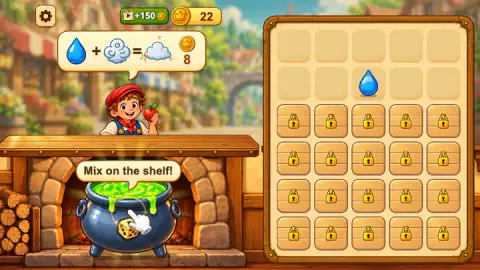
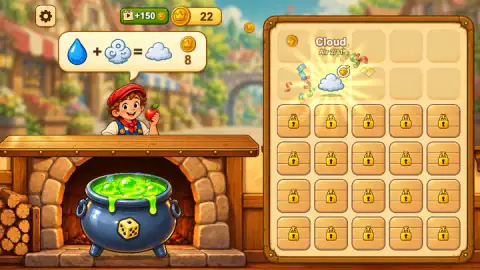
Taken by opening the game ourselves and letting it run — not supplied by the publisher, and not the same picture every other site shows.
How to play Alchemy Store
- Read the bubble. Each customer holds up a recipe: two elements, an equals sign, the result and a coin price. The first is water + fire = steam, and both ingredients are already on the shelf with green frames.
- Drag one element onto the other on the shelf. If the recipe works, both vanish and the result appears with an unlock card, such as Steam · Water 2/6, and a coin flies to your counter.
- When the customer's element gets a green frame and a coin badge, click it. The customer says Thank you, confetti falls, the price lands on your counter, and a padlock on the shelf sparkles open.
- If the recipe asks for something you do not have, tap the cauldron. It puts one element on the shelf with a sparkle. Repeat until both ingredients are in front of you.
Tips from our run
- Do not drop ingredients into the cauldron. The publisher says you can toss extras in, but our water drop stayed on the shelf while the cauldron said "Mix on the shelf!", and the cloud we dragged there eight times never moved.
- Click the framed element the moment you see the frame. Our third customer, a boy with an apple, waited more than five minutes for a cloud that sat finished on the shelf because we kept trying to do something cleverer with it.
- A mix spends both pieces. With eight slots and a two-for-one trade, room was not our problem; ingredients were, so the cauldron was the button we pressed most.
- Everything new pays. The unlock card is worth 3 coins on its own, paid before the customer buys the element.
Controls
| Drag | Drop one element onto another on the shelf to combine them; both pieces are used up and the result takes their place |
|---|---|
| Click or tap the framed element | When the customer's element gets a green frame and a coin badge, a click on it hands it over; the tutorial hand also drifts from the shelf toward the customer |
| Click or tap the cauldron | Puts one new element on the shelf; in our run every tap gave an ingredient the order was missing |
| Drag inside the shelf | Moves an element to an empty slot |
| Touch | The publisher lists Android and iOS and describes tap and drag; we only played with a mouse |
Features
- A 5x5 shelf with 8 slots open at the start and padlocks on the other 17; each order we served opened one more
- Orders that are recipes: the customer's bubble shows the two ingredients, the result and the price, 8 coins every time in our run
- A discovery bonus of 3 coins for every new element, paid before any customer buys it
- A cauldron with a die on it that hands you one element per tap; four taps, four ingredients we needed
- Combining uses up both ingredients, so the shelf empties as fast as it fills
- Element families with counters on each unlock card: Steam is Water 2/6, Cloud is Air 2/11, Plant is Plants 1/35
- Three customers and no ad break in ten minutes, plus a +150 button with a play symbol that we left alone
Game details
- Developer
- MemorySharp
- Release date
- November 2026
- Last updated
- November 6, 2026
- Added here
- November 2026
- Technology
- HTML5 (2D)
- Platforms
- Browser (desktop, mouse), Browser (mobile & tablet, touch)
- Saved progress
- Saving, when available, is managed by this game. Mava cannot confirm your level.
FAQ
How do you play Alchemy Store?
A customer stands at your counter with a bubble that shows a recipe: two elements, the result and a price. You mix on the shelf to the right by dragging one element onto another, and the cauldron under the counter gives you a new element each time you tap it. When the element the customer wants appears, it gets a green frame and a coin badge; click it and the customer pays. We saw no clock, and our third customer waited five minutes without leaving.
How do you combine elements in Alchemy Store?
Drag one element onto another on the shelf. If they make something, both disappear and the new element takes their place with an unlock card, such as Steam or Cloud. Dropping an element into the cauldron does not combine anything: when we tried it with a water drop, the drop stayed on the shelf and the cauldron said Mix on the shelf.
What does the cauldron do in Alchemy Store?
It gives you elements. Tap it and one appears on the shelf with a sparkle. It has a die painted on it, but in our run all four taps produced exactly the ingredient the current order was missing, in the order the recipe listed them. The publisher says you can also toss spare elements into it; we could not get it to accept any.
How do you give a customer their order in Alchemy Store?
Make the element in the bubble. It then gets a green frame and a small coin badge on the shelf, and clicking it handed it over for us, with a Thank you and the coins. The tutorial hand also drifts from the shelf to the customer, so dragging it there is probably the intended gesture. If you do neither, nothing happens: our third customer waited five minutes with his cloud sitting on the shelf.
How do you earn coins in Alchemy Store?
Two ways, and we saw both on the counter. Discovering a new element pays 3 coins the moment its unlock card appears, before the customer has bought it. Serving an order pays the price in the bubble, which was 8 for all three customers we met. Our ten minutes ended at 25 coins: three discoveries and two sales.
How do you unlock more shelf slots in Alchemy Store?
By serving orders. The shelf is five by five, and only 8 slots are open when you start. After our first Thank you a padlock on the second row sparkled open, and after the second another one did, which left the whole second row free. We did not see what opens the three bottom rows.
What are the recipes in Alchemy Store?
The three we were asked for are water plus fire makes steam, rock plus water makes plant, and water plus steam makes cloud. Each unlock card also names the element's family and its size: water has six members, air eleven and plants thirty-five. The publisher says there are 212 elements and 569 recipes in all; we saw six and three.
Who made Alchemy Store, and is it new?
The game is credited to a developer called MemorySharp. The game was added on 5 November 2026, which is too few to mean much. We found no other article or guide about it.