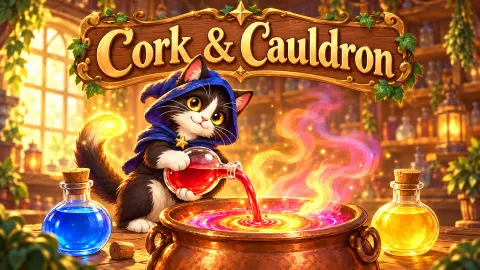

About Cork & Cauldron
In a colour-sorting puzzle, the moment every flask holds a single colour is the moment the level ends. Cork & Cauldron treats that moment as halfway.
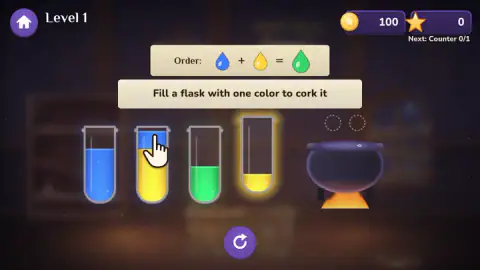
Fill a flask with one colour here and it seals itself with a cork. The game says so in its own words the first time it happens — "Fill a flask with one color to cork it" — and from then on that flask has changed job. It is no longer somewhere to pour. It is an ingredient, and a cauldron sits at the end of the shelf waiting for it, two empty circles above the pot showing how many it wants.
What it wants is written on a card above the board. Level one's card is a sentence in symbols: a blue drop, a plus sign, a yellow drop, an equals sign, a green drop. Sort the blue into its own flask, the yellow into its own, cork both, tap each to send it to the pot, and the pot hands back green. Then you pour that green down onto the shelf yourself, and only then is the order filled.
So the sorting is the labour and the brewing is the point, and the two halves pull against each other. The shelf pays you for keeping colours apart. The cauldron only pays you for putting them together.
One thing before the rest. We filled the first order, moved to level two, and stopped there: level two is where the pointing hand lets go, and we never got it out.
Your stars are a shopping list, not a score
The two counters in the top corner look like the same idea twice. They are not. Coins are money, and we began level one with a hundred of them and never spent one. Stars are something stranger: under the star, in small orange type, the game keeps a running note of what the next one is already spoken for. On the first board it read "Next: Counter 0/1" — a fixture, and its price.
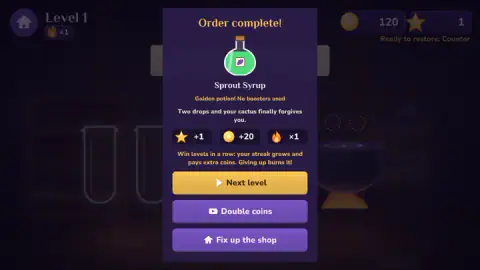
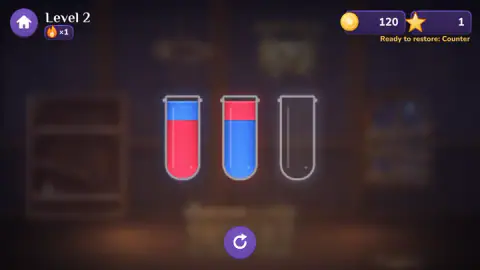
Finish the order and the note changes its grammar. The reward card paid one star, and the orange line stopped naming a price and started naming a permission: "Ready to restore: Counter".
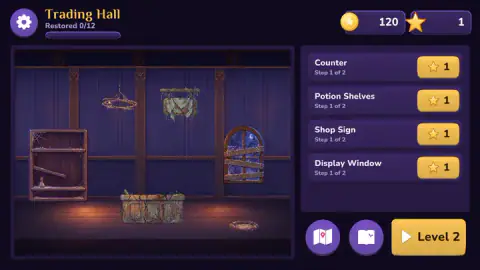
Press the third button on that card, the one marked Fix up the shop, and you see what it has been pointing at. A room called the Trading Hall, and it is a wreck — an arched window boarded over with planks, a shelf frame with nothing on it, crates on the floor, cobwebbed fittings swinging from the beams. A panel on the right lists what can be put right: Counter, Potion Shelves, Shop Sign, Display Window. Each is split into two steps, each step priced at one star. A bar across the top reads "Restored 0/12", which is more jobs than the four it shows at once.
That is the engine: every puzzle you solve buys one plank of one fixture, and the game shows you the ruin early so you know what the planks are for.
Why a real potion shop kept coloured glass in the window
Two fixtures on that list are named Shop Sign and Display Window, and the pairing is two centuries older than this game.
Through the nineteenth century, a chemist's window in Britain or America held a row of enormous glass vessels filled with brilliantly coloured liquid — crimson, emerald, blue, amber. In Britain they were called carboys; in America, show globes. What was inside them was dyed water. It was not medicine and it was never for sale: the globes were the shop's sign, the way a striped pole was the barber's and three hanging balls were the pawnbroker's. On a street where many of the people walking past could not read a painted name, a window full of coloured glass said apothecary from thirty paces away.
Which is why the puzzle and the shop here are the same object looked at twice. The thing you spend each level arranging — coloured liquid, separated by colour, standing in glass in a row — is exactly what a real potion shop put in its window to be looked at. You earn stars sorting colours into glass, and you spend them rebuilding the window that colours in glass were invented to fill.
Level two takes the hand away
The first board is guided from the opening second. A pointing hand hovers over the flask you are meant to touch, and a banner above the shelf rewrites itself at every step: "Now tap where to pour. Same color or an empty flask!", then "Corked recipe ingredients go into the cauldron. Tap the flask!", then "The potion is ready! Tap the cauldron, then a flask".
Level two prints none of it, and removes the order card and the cauldron as well. What is left is three flasks — one nearly full of red under a thin blue cap, one nearly full of blue under a thin red cap, and one standing empty. Two colours, three containers, no pot to send anything to and no card telling you what the finished thing should look like.
We did not crack it. We poured, restarted, poured again, and the session ended with the board as it began. That is the honest shape of the difficulty curve: the first level cannot be failed, and the second is a real puzzle the moment the tutorial stops talking. If you like being taught by getting stuck, that handover is the selling point. If you wanted a gentle hour, it is a wall at minute three.
What we never reached
The game promises a great deal more than we saw. Its listing describes two hundred levels, eight rooms and a book that records every potion with a name and a joke. The one we earned was called Sprout Syrup, graded a golden potion because we had used no helpers, and its story line read: "Two drops and your cactus finally forgives you." That much is real. The rest of the book, the other rooms, the murky layers and frozen flasks it advertises, and every level past the second, are the publisher's claim and not our report. We restored no fixture either, so we cannot say what the Trading Hall looks like with its counter back.
One claim in that list deserves more than a shrug: the colour-symbols mode for colour-blind players. Here colour is not decoration — it is the entire message, the only thing a flask tells you about itself. Level one resolves to green and level two sets red against blue, and red against green is exactly the distinction the common form of colour blindness makes hard, in roughly one man in twelve of northern European descent. A mode that stamps a shape on each liquid is no courtesy here. It is the difference between a puzzle and an unreadable screen. We did not switch it on, so we cannot say how well it is done — only that it is the setting worth finding first.
More flasks to pour
If it is the pouring you came for and not the shop, Vials: ASMR Sand Sort Puzzle runs the same glass-and-colour logic with sand and no clock at all, and Ball Sort Puzzle is the plainest version of the idea there is. Nuts Puzzle: Sort By Color swaps liquid for bolts on a screw, which changes the geometry of what you may move, and Color Sort Puzzle Milk Tea Sorting keeps the drinks and drops the alchemy. The rest are under puzzle games.
Screenshots
How to play Cork & Cauldron
- Tap a flask to pick it up, then tap where to pour. The rule is the one the game prints on the board: the same colour, or an empty flask.
- Keep pouring until one flask holds a single colour all the way up. It corks itself, and that is your first ingredient.
- Tap a corked flask to send it to the cauldron. Two dotted circles sit above the pot, so it is holding out for a pair.
- When the brew is ready the game says so and asks for a destination. Tap the cauldron, then tap the flask you want it poured into.
- The order card clears and a reward card comes up. Its yellow button is the next level; the other two go elsewhere.
What only sitting in front of it teaches:
- Read the card before you touch anything. Level one asks for blue and yellow, which makes the half-full green flask on the shelf a decoy — green is the output, and shuffling it about is work nobody pays for.
- The cork is a one-way door. A sealed flask cannot take a pour any more, so the empty flask you are leaving yourself is a resource. Decide which one it is before you fill the last of the others.
- Restarting costs nothing but the flame. The purple arrow under the board resets the level. We found no life counter and no failure screen; the only thing a restart burns is the streak, as the reward card admits.
- The helpers the game advertises are not on every board. Its instructions name an undo, a hint from the shop's owl and a spare flask. Neither of our boards drew any of the three.
- Watch the cauldron when it fires. A ×2 flashed over the pot as our green came out. We did not play long enough to learn what it doubles, and would rather say so than guess.
Controls
| Click or tap a flask | Picks it up. The glass lifts and tilts, and the board waits for you to say where it is going |
|---|---|
| Click or tap a second flask | Pours. The game states its own rule on screen the first time — the same colour, or an empty flask |
| Click a corked flask | Sends it to the cauldron as an ingredient. Two dotted circles above the pot show how many it is holding out for |
| Click the cauldron, then a flask | Pours the finished potion back down onto the shelf, which is what actually fills the order |
| The purple arrow at the foot of the board | Starts the level again. It is the only button under the tubes on either board we played |
| The house button, top left | Leaves the board for the shop screen |
Features
- Filling a flask with a single colour is not the goal but the halfway point: the flask corks itself and turns into an ingredient you have to carry somewhere else
- The order card above the board is a recipe in symbols — level one asks for a blue drop and a yellow drop and promises a green one back
- The cauldron holds out for two corked ingredients at a time, drawn as two empty circles above the pot, and the brew has to be poured back onto the shelf by hand
- Finishing an order without a helper earns the golden edition of that potion, with a name and a one-line joke attached — ours was Sprout Syrup
- Stars are currency rather than score, and the line under the star counter always names the next fixture they will buy
- The first room of the shop, the Trading Hall, counts twelve restorations and charges one star for each step
- A flame counter tracks a winning streak, and the game warns in its own words that giving up burns it
Game details
- Developer
- Partner studio
- Release date
- October 2026
- Last updated
- October 25, 2026
- Added here
- October 2026
- Technology
- HTML5 (2D)
- Platforms
- Browser (desktop), Browser (mobile & tablet, touch)
- Saved progress
- Saving, when available, is managed by this game. Mava cannot confirm your level.
FAQ
How do you play Cork & Cauldron?
You pour coloured liquid between flasks until one flask holds a single colour, which corks it and turns it into an ingredient. A card above the board shows the recipe the customer ordered. Tap each corked ingredient to send it to the cauldron, and when the brew is ready tap the cauldron and then a flask to pour it back out. That last pour is what fills the order.
What does corking a flask do in Cork & Cauldron?
It changes what the flask is for. Up to that point a flask is a container you pour into; once it is full of one colour the game seals it with a cork and it becomes an ingredient, which is something you send to the cauldron rather than something you keep rearranging. That is also the game's own first lesson, printed on the board as "Fill a flask with one color to cork it".
What are the stars for in Cork & Cauldron?
They rebuild a ruined potion shop. Each finished order pays one star, and a line in the corner of the board names what the next star will buy — ours read "Next: Counter 0/1" before we had one and "Ready to restore: Counter" the moment we did. In the shop screen, every fixture is split into steps and every step costs a star.
How many levels does Cork & Cauldron have?
The game's own listing promises two hundred levels, eight rooms to restore and a hundred and twenty potions for the book. We filled one order and got stuck on the second board, so those three figures are the publisher's claim rather than anything we can confirm. What we can confirm is that the first room alone counts twelve restorations.
Is Cork & Cauldron free, and does it have ads?
It is free and runs in a browser with nothing to install. The only advert we met was one we could decline — the reward card after a finished level offers a Double coins button carrying a video symbol, which is the usual sign of an advert you choose to watch. We took the plain Next level button instead and the game carried on without one.
Why is level two harder than level one in Cork & Cauldron?
Because level one is a guided tour and level two is the game. The first board puts a pointing hand on the flask you should touch and changes its banner at every step. The second prints no instructions, takes away both the recipe card and the cauldron, and leaves three flasks — two of them capped with each other's colour — and nothing else. We did not solve it.
Is there a colour-blind mode in Cork & Cauldron?
The game's own listing says yes, describing a colour-symbols mode that marks each liquid with a shape as well as a hue. We never switched it on, so we cannot describe what the symbols look like. It matters more here than in most puzzles, because colour is the only thing the board tells you and the red-and-blue pairing of level two is in the range that red-green colour blindness confuses.
Does Cork & Cauldron work on a phone, and who made it?
Every control is a tap, so there is nothing a touchscreen cannot do — although we played with a mouse, so the phone version is the listing's claim rather than our experience. As for the author, no studio is recorded anywhere we can check, so this sheet names none rather than guessing. It reached our catalogue on 24 October 2026.