

About Block Puzzle: Jewel Block
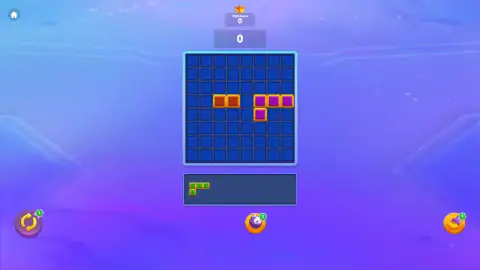
Ten minutes with Block Puzzle: Jewel Block left us with exactly the score we had when we started: zero. Pieces went down, they stayed where we dropped them, and the counter above the board never twitched. That is not a fault in the game. It is the rule the whole thing is built on. A piece sitting on the board is worth nothing at all until a full row or a full column is covered, and until that moment every piece you place is only making the board smaller.
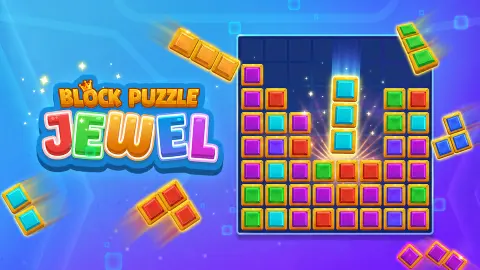
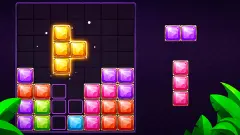
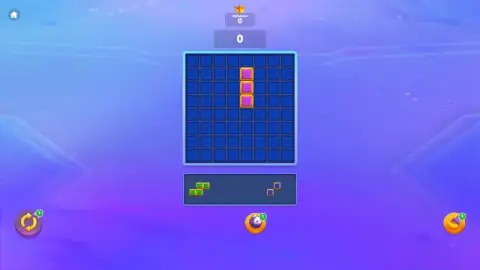
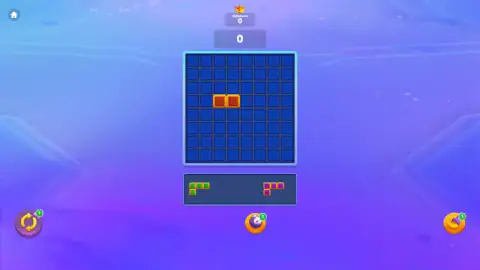
The setup takes seconds to read. The grid is eight cells across and eight down, dark blue squares on a purple sky. Under it sits a tray with three slots, each holding a little cluster of glossy squares in a gold frame. You hold the mouse button on one, carry it over the grid and let go. Nothing falls, nothing is timed, nothing hurries you.
The game's own title screen is as plain as the board: the logo with a crown on it, a settings gear in the corner, and one orange button that reads ENDLESS. No level select, no chapter map, no second mode hiding behind it. One board, one score, and a Highscore box with its own little crown that you are meant to beat.
The game is credited to Hong Kong Skyreach Interactive Limited and has been available from August 2026. Before any of it loads you meet the portal's cover page with a play button, and then a black screen with an advert on it.
Now the honest part, because the rest of this page rests on it. Over those ten minutes we made 53 attempts at the board and only four of them changed anything on screen. We never filled a line, never scored a point and never saw a run end. So the clearing rule, the combos and the way a game finishes are given here the way the game's instructions give them. Everything else is what we watched happen.
A tray of three, and nothing comes until it is empty
The refill rule is the one piece of timing this game has, and it is worth understanding before you start. Watch one of our trays empty out: it held two pieces, then one, and only after that last one went down did three new ones appear together.
That changes how you should read a tray. These are not three offers from which you pick the best. They are three obligations, and the order is yours to choose. The sensible move is to look at the awkward one first and decide where it can live, because it is not going anywhere.
The pieces themselves range further than you would expect from the screenshots. In this run we were handed a single square on its own, a flat pair, bars of three, and several four-square shapes: boot-shaped ones and S-shapes. An earlier visit dealt us a nine-square block twice in a row, which on a board of 64 cells is a serious commitment. So some turns barely touch the board and others redraw it.
Three round buttons sit along the bottom of the screen, each wearing a small green 1. The left one, two yellow arrows chasing each other, swaps whatever is left in the tray for a new set. The centre one is a bomb and the right one a broom, and the game describes both as help for a crowded board. We finished this run with all three badges still showing their 1, so we cannot tell you what the bomb and the broom actually take off the board. What we can tell you is that one use of each is not a safety net. Keep them for a board that is nearly closed.
The shapes are older than video games, and one of them is not a shape at all
Nearly every piece in the tray is a polyomino: a figure built of equal squares joined edge to edge. The word was coined in 1953 by the American mathematician Solomon W. Golomb, and it reached a wide audience a few years later through Martin Gardner's column in Scientific American. Mathematicians count them by size. There are two ways to join three squares, five ways to join four, twelve ways to join five.
Those four-square shapes are the ones most players know from Tetris. Alexey Pajitnov built that game in the mid-1980s after buying a pentomino puzzle set, and cut the twelve five-square shapes down to seven four-square ones because twelve felt needlessly complicated. Tetris then added gravity and a clock: the piece falls, and you place it in a hurry.
Games like this one keep the shapes and throw away the falling. The piece is in your hand and you have all the time you want, so the pressure comes from the board rather than from the clock. That is exactly why the eight-cell side matters.
And then there is the piece that does not belong to the family at all. One tray handed us two blue squares that touched only at their corners, with empty tray between them — we enlarged the screenshot to be certain. A polyomino has to be joined edge to edge, so that one is not a polyomino by any definition. It is a piece that lands in two different rows and two different columns at once and fills neither, which on a board this tight is a small problem with a gold frame around it.
Who it is for
It suits a player who wants a quiet puzzle with nothing to read and no timer, and who is happy chasing one number. You can stop after any piece and lose nothing but the board.
It is not a match-three game, whatever the jewels suggest. It has no levels, no story and no second mode: the title screen says Endless and means it. If you want a goal beyond your own record, this will feel thin.
More games to try next
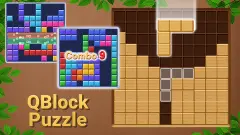
Block Crush is the closest relative we have: the same 8×8 board, pieces that never rotate, and a streak that multiplies the points. Block Master Gem Puzzle runs the same size of board but adds the modes this one does not have. Block Combo Blast goes the other way again, with numbered levels instead of a single endless run. QBlock Puzzle gives you a roomier 10×10 wooden board, and Wood Block Journey uses a 9×9 sudoku grid where the 3×3 boxes clear as well. The rest are under puzzle games.
Screenshots
Taken by opening the game ourselves and letting it run — not supplied by the publisher, and not the same picture every other site shows.
How to play Block Puzzle: Jewel Block
- Read all three pieces before you move any of them. You will have to place every one.
- Hold the mouse button on a piece and drag it over the board.
- Release over empty cells. The piece lands in the exact shape the tray drew it and stays there.
- Empty the tray. A new set of three only arrives once the old three are all down.
- Fill a whole row or a whole column. The instructions say that is what clears cells and earns points.
What our session taught us:
- Covering cells earns nothing. Our fullest board held three pieces over ten cells and the score still read 0. A piece that does not help finish a line is pure cost.
- A drop that does not fit costs nothing either. Most of our attempts did precisely nothing: the piece returned to the tray and the board stayed as it was. You cannot lose a piece by misjudging a gap, only time.
- You cannot turn a piece. What the tray shows you is what the board gets, so half the work is finding the hole that already matches.
- You cannot wait out an awkward piece. The tray does not hand you a replacement after each placement, so the third piece has to go somewhere whether you like it or not.
- Work along one row. Eight cells is a short row. In our best board we had five of the eight in a single row covered and were still two pieces away from a clear, which tells you how much of the board one careless piece swallows.
Controls
| Hold the left mouse button on a tray piece and drag | Picks the piece up and carries it over the board |
|---|---|
| Release over empty cells | Drops it there, in the exact shape and direction the tray drew it |
| Release anywhere it does not fit | Nothing happens; the piece goes back to the tray and the board is unchanged |
| Round button with two arrows (bottom left) | Swaps whatever is left in the tray for a new set of three; its badge offers one use |
| Bomb and broom buttons (bottom centre and right) | Two more helpers, each with a 1 on its badge; we did not spend either of them |
| House button (top left) and gear button (title screen) | Home and settings per the game's instructions. We pressed neither |
Features
- An 8×8 board: 64 cells, smaller than the 9×9 and 10×10 boards common in this genre
- One mode, named Endless on the title screen: no levels, no chapters, nothing to unlock
- A tray of three pieces that refills only once all three have been placed
- Pieces from a single square up to nine, including one made of two squares that touch at a corner
- Pieces land in the direction the tray shows them; we found no way to turn one
- A score box and a separate Highscore box under a crown, neither of which moves until a line is full
- Three helper buttons, each starting with a 1 on its badge: a pair of arrows, a bomb and a broom
Game details
- Developer
- HONG KONG SKYREACH INTERACTIVE LIMITED
- Release date
- August 2026
- Last updated
- August 17, 2026
- Added here
- July 2026
- Technology
- HTML5
- Platforms
- Browser (desktop, mouse), Browser (mobile & tablet, touch)
- Classification
- Puzzle
- Saved progress
- Saving, when available, is managed by this game. Mava cannot confirm your level.
FAQ
How do you play Block Puzzle: Jewel Block?
You drag pieces out of a tray under the board and drop them on empty cells of an 8×8 grid. The tray holds three at a time and only refills when all three are gone. The game's instructions say a full row or column clears and scores points, and that a run ends when none of the pieces in the tray fits. In ten minutes of play we never got as far as a clear.
How big is the board in Block Puzzle: Jewel Block?
It is eight cells wide and eight tall, 64 in all, which we counted on an enlarged screenshot. That is one or two cells tighter than the 9×9 and 10×10 boards most block puzzles use, so a row needs only eight squares to clear and a careless piece blocks a row much sooner.
Do you get points for placing a piece in Block Puzzle: Jewel Block?
No. We covered ten cells in our longest board and the score still read 0, exactly as it had at the start. Points come from clearing complete rows and columns, according to the game's instructions, and the scoreboard we watched agrees with that.
Can you rotate the pieces in Block Puzzle: Jewel Block?
We found no way to. One of our pieces was drawn in the tray as three squares in a row with a fourth under the left end, and it landed on the board in exactly that shape and direction. There is no rotate button on screen and the instructions describe only dragging and dropping, so a piece that points the wrong way is simply the wrong piece.
How many modes does Block Puzzle: Jewel Block have?
One. The title screen carries the game's logo and a single orange button reading Endless, with a settings gear in the corner and nothing else. There is no level select, no campaign and no second board, so the only thing that changes between runs is your record.
What do the three round buttons at the bottom do?
They are helpers, and each one starts with a small green 1 on it: a pair of circular arrows on the left, a bomb in the centre and a broom on the right. The arrows swap the tray for a fresh set of three pieces. The bomb and the broom are described as boosters for a crowded board, but we never spent either, so we cannot tell you how much each one removes.
Is Block Puzzle: Jewel Block the same as Tetris?
No. It borrows the same family of shapes, squares joined into small clusters, but nothing falls and nothing is timed. You choose where each piece goes and take as long as you like. It has no connection with Tetris or with any of the mobile apps that carry similar names.
Who made Block Puzzle: Jewel Block?
It is credited to Hong Kong Skyreach Interactive Limited. It was published on 16 August 2026. It is listed for PC, Android and iOS; we played it on a desktop computer with the mouse.